EH Bildu runs for the European Parliament elections in coalition with Esquerra Republicana (ERC), the Galician Nationalist Bloc (BNG) and Ara Més, a coalition of Balearic forces with an independence orientation. Polls currently predict 2-3 seats for the Ahora Repúblicas candidacy, which is what they have named the electoral alliance. If a voter registered in the Basque Country wishes to support the coalition, on the ballot, printed under the name EH BILDU-ORAIN ERREPUBLIKAK, they will find the following names in the starting positions:
- Pernando Barrena Arza
- Oihana Etxebarrieta Legrand
- Oskar Matute García de Jalon
Does that mean that, if the forecasts are met, Oskar Matute will leave the Congress of Deputies to start a political stage in the Eurochamber? No, not even close. For Matute to be elected, Ahora Repúblicas would need at least 8 seats. How is this explained?
Customizable ballots for each territory
The law permits, when presenting candidacies to the Central Electoral Board, that parties, coalitions, or reader groups may reflect on the ballots for each autonomous community "only the names of the candidates (…) with a scope of action statutorily limited to said territory", in the same way that they may appear in each region with "their own denomination, acronym, and symbol". This is stated in Article 222 of the Organic Law on the General Electoral Regime (LOREG), which governs the electoral system for European Parliament elections.
That is to say, that the ballot can be "simplified" in an autonomous community by leaving only the names of the candidates organically linked to that area.
This is what they have done, apply article 222 of the LOREG, the parties that make up Ahora Repúblicas, which have decided to participate with "à la carte" lists in Catalonia and the Valencian Community (under the ERC brand), Basque Country and Navarre (acronym and symbol of EH Bildu), Galicia (BNG) and Ara Més (Balearic Islands). In this way, even if an elector from Galicia sees the current MEP of the BNG Ana Miranda Paz heading the slate, she will not achieve representation if the coalition does not manage at least three representatives this Sunday.
A power with the initial rejection of the nationalists
Now Repúblicas is not the only candidacy that has opted to personalize its lists in certain communities, a generalized practice extended over time, especially by regional parties, in order to concentrate votes and gain strength in the distribution of seats in elections that are of a single constituency: the 61 deputies corresponding to Spain are distributed based on the votes obtained by each candidacy throughout the country.
Although the nationalist and pro-independence forces are the ones that most resort to modified ballots, the truth is that in their origin they were not the ones that welcomed the idea with the most enthusiasm. For different reasons, both the Basque Parliamentary Group (PNV) in Congress, and that of Convergéncia i Unión (CiU) in the Senate, proposed to eliminate from the bill by which the LOREG was modified for the regulation of European Parliament elections, in 1987, and by which the aforementioned article 222 was approved.
In the Lower House, the Basque nationalists rejected the proposal that the European elections be held in a single district, that is, with a single national constituency. From the PNV they defended the autonomous community as an electoral division, a demand that was also defended by the deputy of Eusko Alkartasuna (EA), Joseba Azkarraga Rodero, from the Mixed Group. Consequently, both parties registered separate amendments for deletion. In the eyes of the Basque nationalists, the possibility of ad-hoc lists only made sense in a system with several constituencies. None of them prospered.
A "mockery" and a "fraud"
On the part of CiU, to the demand for a multi-member constituency system and, consequently, its opposition to article 222 when the original proposal for a single national system was imposed, was added a demand for greater clarity when elaborating those adapted lists by autonomous communities. Already in the Senate, from the group of Catalan nationalists, an alternative amendment was proposed by which it was requested that, in the case of modification of the ballots with respect to the national list, along with the names of the candidates, "the numerical order in which they appear on the candidacy of which they form part" should be indicated.
They intended thus to "avoid false electoral appearances", "false expectations", as defended in the plenary debate by the senator for Girona of Unió Narcís Oliveras i Terradas, who saw in the wording of that future article 222 of the LOREG "a mockery of the voter". The amendment was not accepted.
In the same vein as the Catalan nationalists, they manifested from the ranks of Alianza Popular, from where it was defended in both chambers, the suppression of 222 through two amendments registered by the Popular Coalition group. The reason? They saw in it an anomaly that could «give rise to great misunderstandings in the electorate». This mechanism was referred to, during the debate of the opinion on the bill in the Constitutional Commission of the Congress, in terms of «trickery», «fraud» and a «element of confusion» by the deputy for Lugo of Alianza Popular Antonio Carro Martínez. His amendments also did not go through.
A proposal defended by the PSOE
Despite the opposition of a good part of the parliamentary spectrum, the PSOE made a strong defense of "such reviled" system, the one that allows altering the order of candidates on ballots. The deputy for Barcelona Joan Marcet i Morera alluded to the defense of parties with "their own legal entity", such as the PSC, the Socialist Party of Euskadi, or other federations of the PSOE, although Marcet insisted that it was not an article "solely for the benefit of our group or party," but for others that "have this same need to see their possibility of representation reflected in a diverse way".
In the final vote in the Plenary, the article passed with the support of socialists, six deputies from Coalición Popular (among them Celia Villalobos or Alfonso Osorio) and the Partido Liberal; the rejection of CiU and PNV and the abstention of the bulk of Coalición Popular, the CDS, the Partido Demócrata Popular and IU among others.
Three coalitions with modified candidates
Beyond Ahora Repúblicas, two other coalitions are running in this week's European elections in Spain, which have also decided to present modified ballots in some constituencies to only show some of their candidates. These are the Coalición por una Europa Solidaria (CEUS) and Sumar. Under the coalition of Yolanda Díaz's platform, Movimiento Sumar, Izquierda Unida, the Comuns, Más Madrid, Compromís, Verdes Equo, the Chunta Aragonesista, and Nueva Canarias are running.
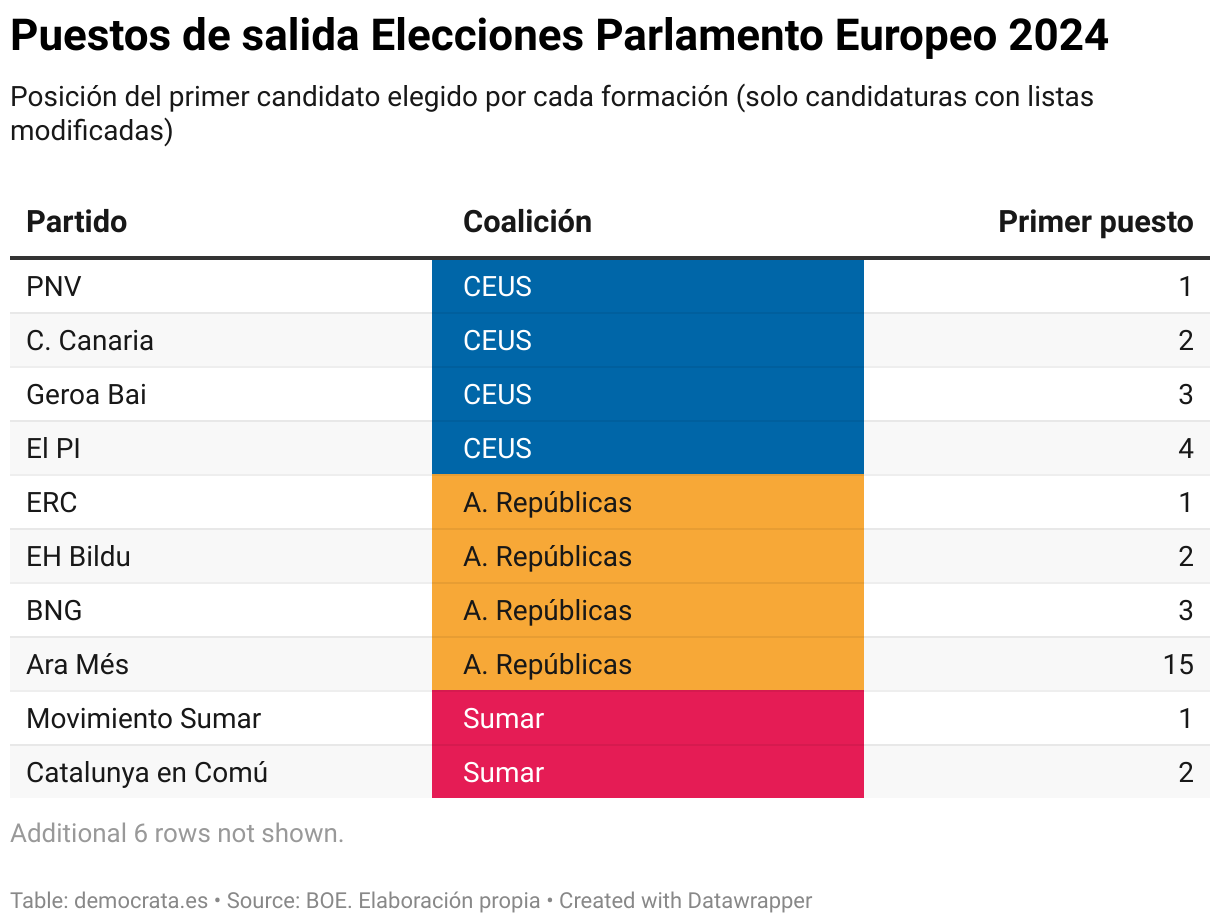
In the case of CEUS, under these acronyms come the PNV, Coalición Canaria, Geroa Socialverdes and Agrupación Atarrabia (which together with the PNV form the coalition Geroa Bai) and El PI (Proposta per les Illes Balears), a Balearic regionalist party. In the case of Sumar, although the coalition presents a multitude of nomenclatures in different communities (always with the Sumar brand present), only in Catalonia have they opted to leave a ballot in which the only candidates are those running on behalf of Catalunya en Comú (Comuns).
Other candidacies in which several parties are integrated, such as that of España Olvidada Existe – Mundo Justo (EXISTE), have decided to vary their denomination in certain territories, but always with all the names of the candidacy included. In the case of EXISTE, headed by the former deputy in Congress for ¡Teruel Existe!, Tomás Guitarte, they include the acronyms to which the first candidate of each platform or group belongs.