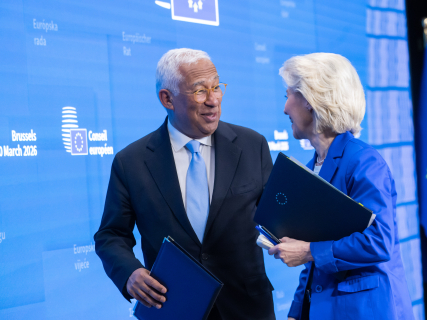

For years there was an expression that in Brussels was pronounced with care, almost with the discomfort of someone who fears saying something inappropriate: strategic autonomy. It was not forbidden, but it was not welcome either. It sounded too ambitious, too Gaullist, perhaps even too European.
The dominant logic was different. The United States guaranteed the security of the continent and Europe contributed what it best knows how to produce: markets, regulation, institutional stability. A comfortable division of roles. While Washington dealt with hard power, Brussels could dedicate itself to managing norms, consensuses, and procedures. That balance worked for decades.
But there are moments when even the most stable relationships start to creak. And the recent war between the United States and Iran -with Israel as the immediate military protagonist- has been one of those moments.
Featured story
Europe parks its competitiveness while it convinces itself of the de-escalation in Iran
4 minutes
Not because the conflict is being fought on European territory. But because the decisions that triggered it were taken completely ignoring Europe, despite the fact that its economic, energy, and strategic consequences directly affect the continent. That disregard -open, almost careless- has filled the cup of what is acceptable for many European leaders. Even for those who for years felt comfortable in the traditional division of roles within the Atlantic alliance.
That is why it is especially significant to hear Ursula von der Leyen speak now before European diplomats of a “new geopolitical era” and of the need for Europe to assume more strategic responsibility in an increasingly unstable world.
Featured story
The EU clings to the international order while shying away from the war in the Middle East
4 minutes
It is worth saying without irony: the diagnosis is correct. And it also deserves recognition, even if it arrived late and has been criticized for its ambiguity in the declaration, sometimes interpreted - self-servingly? - as a renunciation of the foundational values of the Union, based on respect and the defense of norms.
For a long time, von der Leyen herself embodied a rather orthodox version of Atlantic Europeanism: firm in the alliance with the United States, cautious about any discourse that could be interpreted as an aspiration for strategic autonomy. That today it is she who speaks openly of European strategic responsibility indicates to what extent the international context is changing.
The problem is that geopolitics usually advances faster than the institutions that must manage it.
The war that Europe has not decided
The war between the United States and Iran illustrates that gap quite clearly. It is not fought on European territory, but it reveals with remarkable harshness the place the Union occupies today on the international stage. A secondary place and if it occupies any place at all.
Strategic decisions are made in Washington, Tel Aviv or Tehran. Europe reacts afterwards. Sometimes with concern. Sometimes with prudence. Almost always with carefully balanced statements.
The statement coordinated by High Representative Kaja Kallas after the first attacks is an almost perfect example of contemporary European diplomacy: concern about escalation, calls for restraint, condemnation of violence. Everything carefully calibrated to preserve unity among twenty-seven governments that rarely see the world in exactly the same way. What the text avoids with notable discipline is calling things by their name: a preemptive attack against a sovereign State without an international mandate constitutes a violation of international law. It is not a lapse. It is a political decision.
Europe continues to present itself as the great defender of the international order based on rules. But when that order is violated by strategic allies, legal clarity suddenly transforms into diplomatic prudence.
When strategic contempt changes the tone
What is truly significant about this crisis is not just the conflict itself. It is the change of tone that is beginning to be perceived in Europe.
For years, even when disagreements arose with Washington, the European reaction moved within a framework of diplomatic discretion. It was criticized in private and accompanied in public. This time the discomfort is more visible. Not so much because all member states share the same reading of the conflict -they don't-, but because many perceive that Europe has been treated as an irrelevant actor in a crisis whose consequences directly affect it. From energy prices to the stability of the Mediterranean and the Gulf.
When decisions are made without consulting whoever will have to manage part of their effects, strategic irritation begins to appear even among the most disciplined allies. That discomfort partly explains the change of discourse in Brussels.
Three Europes and no strategy
The European reaction to the Iranian crisis, even the discomfort, has once again exhibited the same known pattern. A fragmented Union, incapable of articulating a common position when it is most needed.
On the one hand, there are the uncomfortable ones -Spain, external Norway or Finland- who have recalled something so elemental that today it begins to sound almost subversive: bombing a sovereign State without an international mandate violates international law, and the selective assassination of foreign leaders can hardly be presented as justice. Neither moral nor legal.
The enthusiasm for “externalized tyrannicide” is intellectually comfortable, but politically irresponsible: accepting that powerful states can eliminate foreign leaders because they consider them criminals opens a precedent that Europe will hardly be able to close. Above all, because it does not have the moral power to use it, but it does have much to lose when others do. They are, in reality, simple truisms. Truisms also shared by a good part of the European citizenry, although today, in certain political circles, uttering them begins to sound almost provocative.
Then there is the Europe of the critical throat-clearing. France and the always contrived United Kingdom have tried a slight distance from the American script; Paris has even dropped some reference to the non-compliance with international law, with the tone of someone who apologizes for being annoying. The United Kingdom tries its usual post-Brexit ambiguity -critical abstention to fall, in the end, into active action-. Germany, on the other hand, has opted for alignment without questions, with the diligent application of the student who does not raise legal doubts that might inconvenience the teacher. Italy accompanies disciplined. Much “regional stability”, much condemnation “of one of the parties” and unequivocal political and operational support for Washington. Aesthetic criticism above, real support below.
And finally, the silent Europe. States that say nothing, not because they don't have an opinion, but because they have decided that silence is safer than coherence. In the midst of the war in Ukraine, inconveniencing the United States is perceived as an existential recklessness. So it keeps silent. And by keeping silent, it legitimizes itself.
The problem is not the discrepancy. The problem is that nobody seems willing to pay the price of converting the norms into a position of shared power.
The turn of von der Leyen
In this context, Ursula von der Leyen's change of tone is not an anecdote. For years her European leadership was associated with a deeply Atlantic vision of the continent's role. The response to the Russian invasion of Ukraine reinforced that image: close coordination with Washington, firm defense of the transatlantic link, and absolute priority to Western cohesion. None of that disappears now. But the emphasis is starting to shift.
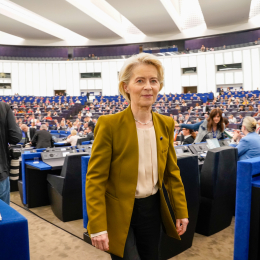
When von der Leyen speaks of strengthening European defense, reducing strategic dependencies, and acting with greater autonomy when European interests are at stake, she is recognizing something that for a long time was avoided admitting in Brussels: Europe cannot limit itself to being the normative guardian of an international order that others sustain with hard power. It needs, without renouncing them, something more than norms. It needs capability.
Between consciousness and power
The problem is that between that diagnosis and political reality there still exists a considerable distance. Europe can talk more and more about geopolitics, but it continues to function with structures designed for another time. Foreign policy depends on member states with distinct distant interests. Strategic decisions require unanimity. Military capabilities remain fragmented.
The result is known: when an international crisis erupts, Europe is slow to react, speaks with multiple voices and ends up influencing little in the outcome. It is not a question of political intelligence, it is a question of power.
Sovereignty or irrelevance
For decades Europe could afford that ambiguity. The international order was relatively stable and American protection seemed unquestionable. That balance is running out. Great powers compete openly. Rules are weakening. Regional crises once again have global strategic consequences.
In that context, the debate on European sovereignty ceases to be an academic discussion, it becomes a matter of political survival. That is why the change in discourse in Brussels deserves attention. It indicates that something is starting to move in the European strategic consciousness: talking about sovereignty is no longer an eccentricity, it is starting to be a necessity.
But recognizing the problem is only the first step. The real challenge is to transform that strategic awareness into real capability. Because in the international order that is taking shape there is a fairly simple rule: actors who do not exercise power end up living under the power of others. And Europe has been trusting for too long that this rule would not apply to it as well.
If it wants to avoid it, it will have to start with decisions that until recently seemed unthinkable: defining its own strategic interests -even if they do not always coincide with Washington's-, acquiring real defense and deterrence capabilities, and acting with a recognizable political voice when its security is at stake. None of that will be easy in a Union crossed by very different strategic sensibilities, as the already evident “three Europes” show.
But the alternative is even less comfortable: to keep talking about sovereignty while others exercise power. And in the world that is emerging, rhetorical sovereignty is often simply another form of dependence.