
In a context marked by logistical tensions, inflation, energy crises and geopolitical conflicts, ensuring access to safe, affordable and sustainable food has become one of the great challenges for Europe. Recent reports on competitiveness and strategic autonomy underline the need to strengthen the entire food value chain, from production to distribution.
In this scenario, packaging ceases to be a secondary element to become a key technology within the food system. Beyond its function as a container for beverages and food, it contributes to protecting them, ensuring food safety, improving logistical efficiency, and facilitating their access worldwide.
Following the vision of its founder, Ruben Rausing —who advocated that “a package must save more than it costs”—, Tetra Pak continues to develop solutions that seek to balance food safety, industrial efficiency, and environmental sustainability.
Protect food to guarantee its availability
Perishable foods such as milk, juices or plant-based drinks require packaging solutions that ensure their preservation during transport and storage without compromising their quality.
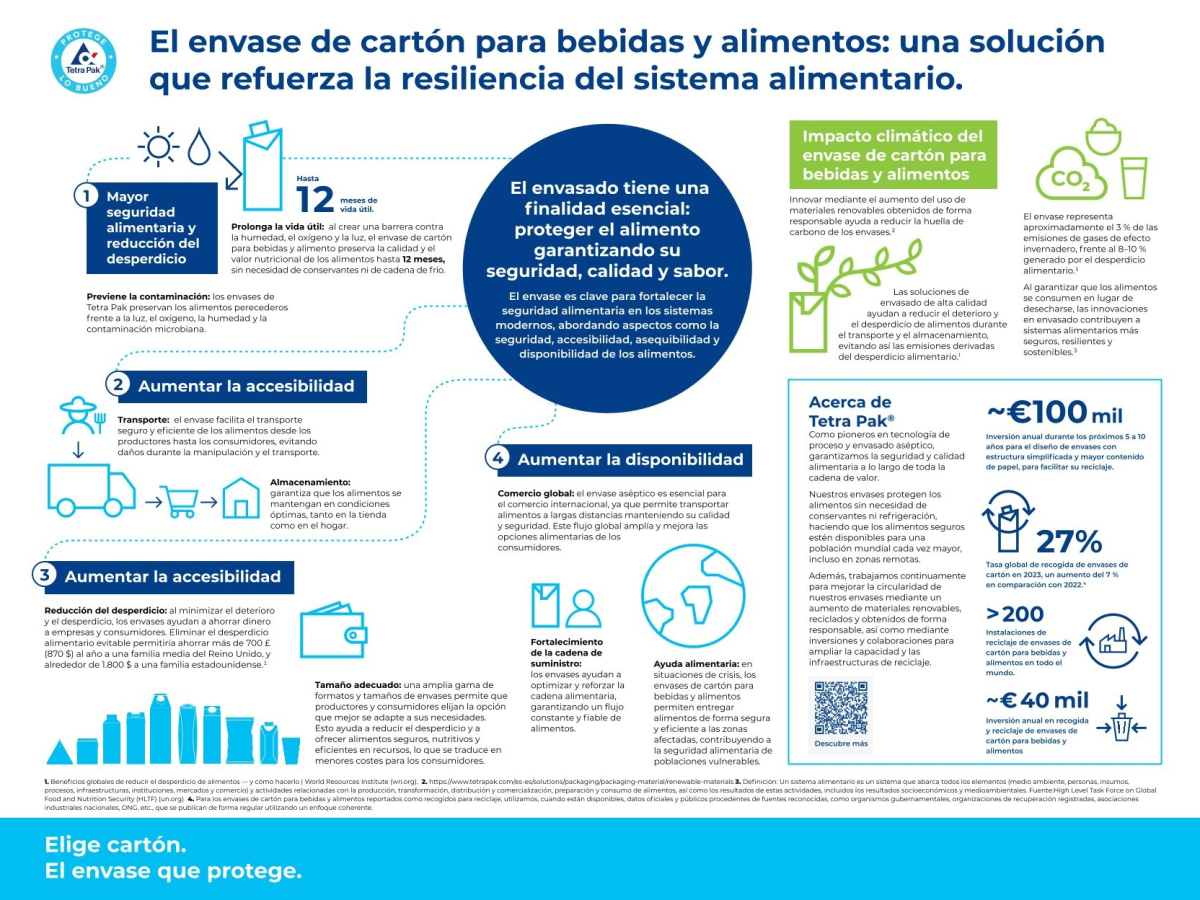
Cardboard packaging for beverages and food allows to extend the shelf life of these products up to 12 months without the need for refrigeration or adding preservatives, thanks to an aseptic technology that protects the content against light, oxygen, humidity, and microorganisms.
This protection is achieved through a structure in which each material fulfills a specific function: cardboard provides rigidity and stability; the polymer layers act as a barrier against moisture; and a thin layer of aluminum protects against light and oxygen, preserving the flavor, texture, and nutritional properties of the food.
Thanks to this technology, foods produced in one region can be safely distributed over long distances, even in areas with limited refrigeration infrastructure.
More efficiency in transport and storage
The impact of packaging also extends to supply chain efficiency. Cardboard packaging is designed to optimize storage and transport, which allows for the reduction of logistical costs and associated emissions.
Its compact and stackable format facilitates a more efficient use of space in the logistics chain. This means that it is possible to transport more product in fewer trucks, reducing fuel consumption and associated emissions.
Furthermore, by not requiring a cold chain during their distribution, these packages contribute to reducing energy consumption derived from storage and refrigerated transport.
“Today packaging not only protects the product: it is also an efficiency tool for the entire food chain”, explains José Luis Velilla, Marketing Director of Tetra Pak Iberia. “It allows optimizing transport, storage, and distribution, which helps food producers reduce operational costs, improve logistical efficiency, and safely bring their products to more consumers”.
Less waste and greater access to food
The extension of the shelf life of food is one of the factors that contribute to reducing food waste, a global challenge with environmental, economic, and social impact.
When food is preserved for longer in optimal conditions, losses are reduced throughout the supply chain —from production to the final consumer—.
Furthermore, this preservation capacity facilitates that basic products can reach regions far from production centers or with more limited logistical infrastructures.
Innovation towards increasingly sustainable packaging
Sustainability is today one of the main drivers of innovation in the packaging industry. In the case of Tetra Pak packaging, its structure is mainly based on paper fiber from renewable sources, such as responsibly managed and FSC™ certified forests.
Tetra Pak also works to progressively increase the renewable content of packaging through solutions such as plant-based polymers derived from sugarcane with Bonsucro certification, recycled polymers certified through ISCC Plus mass balance or paper-based protective barriers.
At the same time, Tetra Pak collaborates with recycling companies, material converters, and public administrations to strengthen collection, sorting, and recycling infrastructures. The objective is to recover the materials from the packages once used and keep them in circulation for as long as possible, thus contributing to the progress towards an increasingly circular economy.