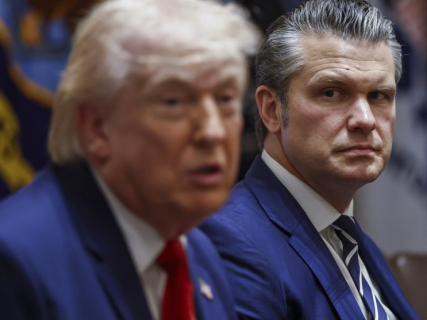
The United States Secretary of Defense, Peter Hegseth, has warned Iran this Thursday that Washington is prepared to resume combat “immediately” if Tehran rejects a potential ceasefire agreement. “Our forces are ready,” he assured in a press conference.
Hegseth has stressed that the United States maintains total vigilance over Iranian movements, including attempts to recover previously destroyed launchers, and has stated that the country is not only resupplying, but “recharging with more power than before”. In that context, he has insisted that a presidential order would be enough to activate high-precision attacks against key Iranian infrastructures: “We just have to press a button”.
Hegseth also has delegitimized any Iranian aspiration to control the Strait of Hormuz, calling their actions “piracy and terrorism,” and has highlighted American naval superiority, assuring that the current deployment represents barely 10% of its total capacity.
Criticisms to the allies and personal attack on the Iranian leadership
In parallel, Hegseth has repeatedly launched the reproaches that the US has been launching for weeks at its international allies, especially in Europe and Asia, for their absence at a critical moment despite their energy dependence on the Gulf. “The world cannot expect the United States to always do all the work”, he warned, urging greater global involvement after.
Likewise, the secretary has affirmed that the Iranian leadership suffers extreme wear and tear and has stated about the supreme leader. “We believe that he is disfigured”, he has said.
Nuclear stagnation, but with margin for dialogue
Meanwhile, the negotiations on the Iranian nuclear program remain blocked. According to Iranian sources cited by Reuters agency, fundamental disagreements persist with the United States, especially on the fate of highly enriched uranium and the duration of nuclear restrictions.
Despite this, after recent diplomatic contacts, the possibility opens to prolong the ceasefire and advance towards a second round of conversations, although for now without a confirmed date. Pakistan, mediator in part of the process, has indicated that nuclear issues continue to be the central axis of the disagreement.
Escalation in Lebanon and pressure from Trump to open dialogue
In parallel to the tension with Iran, the conflict in southern Lebanon intensifies. The Israeli Army has redoubled its attacks this Thursday on Bint Jbeil, a key stronghold of Hezbollah, with operations that include the destruction of dozens of infrastructures in a matter of minutes.
According to Lebanese sources to international agencies, the bombings have also affected civilian areas, including the Borj El Chmali refugee camp and the city of Tebnine, where a hospital has suffered serious damage. Furthermore, an attack would have destroyed the last bridge connecting the south of the country with the rest of the territory, aggravating the isolation of the area.
For its part, Hezbollah has responded with new attacks against Israeli military positions in the north of the country, in a dynamic of sustained escalation.
In this context, the American president, Donald Trump, has asked to “give some breathing room” to both parties and has advanced a possible first direct dialogue between Israel and Lebanon in decades. Until now, the only confirmed contacts have been between the Lebanese president, Joseph Aoun, and the Secretary of State, Marco Rubio.