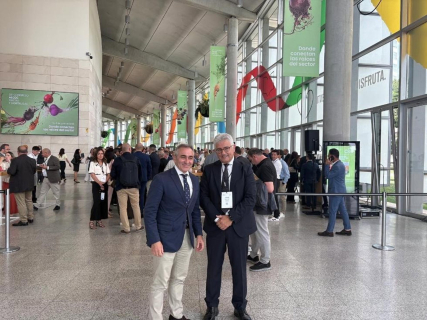

The Minister of Agriculture, Water, Livestock and Fishing, Miguel Barrachina, has pointed to generational change and the modernization of agricultural holdings as two "essential" factors to strengthen the export capacity of the Valencian agri-food sector and ensure that fruits and vegetables from the Valencian Community maintain their presence in the most demanding international markets.
Barrachina spoke at the 28th AECOC Fruit and Vegetable Congress, which is taking place at the Valencia Conference Centre and brings together nearly 700 professionals from major companies in the fruit and vegetable industry and trade, according to a statement from the regional administration.
During his speech, he emphasized that this forum "very well represents the strength of an agri-food chain that only works when all its links move in the same direction: producers, cooperatives, industry, logistics, distribution, and administration." In his opinion, the Valencian Community "has built a successful agri-food model over decades" based on the quality of its producers, the capacity of its industry, and the power of distribution to bring Valencian products to millions of consumers.
Along the same lines, he highlighted that in the first quarter of 2026, agri-food exports from the Community stood at around 2.9 billion euros, with a trade surplus of over 1.2 billion. "These figures are not a coincidence. They are the result of the effort of thousands of farmers and ranchers, the commitment of our cooperatives, the adaptability of our industry, and the professionalism of distribution and marketing companies, which have managed to open markets and generate trust among consumers worldwide," he stated.
The minister argued that exporting means "generating employment, attracting investment, retaining population in the territory, and projecting the image of quality of the Valencian Community in the world." Therefore, he stressed that "defending the competitiveness of the fruit and vegetable sector is defending an essential part of our economy, our landscape, and our ability to produce food."
Generational Change in Valencian Agriculture
Barrachina has emphasized that the export capacity of the Valencian agri-food sector "can only be maintained if we guarantee the continuity of agricultural activity and if we make the countryside a profitable and attractive professional option for new generations".
At this point, he recalled that the Generalitat has granted aid totaling 27.4 million euros, which have facilitated the incorporation of 548 young people and new farmers and ranchers into the Valencian countryside, of whom 439 are young farmers and 109 new farmers. Likewise, 203 applications correspond to women. "Generational change is no longer an exclusively agricultural issue. It is an economic, social, and territorial issue. It affects the continuity of thousands of family farms, the conservation of our agricultural landscape, the life of many rural municipalities, and the capacity to produce food in our own territory," he stressed.
Boost to farm modernization
The regional official pointed out that the incorporation of young people into the sector "is fundamental," but warned that "we must also ensure that they find modern, competitive farms prepared to face the challenges of the future."
For this reason, he recalled that the Generalitat is promoting a new call for aid for the modernization of agricultural farms, endowed with 50 million euros and aimed at improving competitiveness, promoting digitalization, boosting sustainability, and reinforcing the sector's resilience.
"We want farms that are more efficient in water use, more technologically advanced, more sustainable, and better prepared for extreme climate phenomena. Because only with a modern and profitable countryside can we continue to meet the demands of consumers and markets," he concluded.