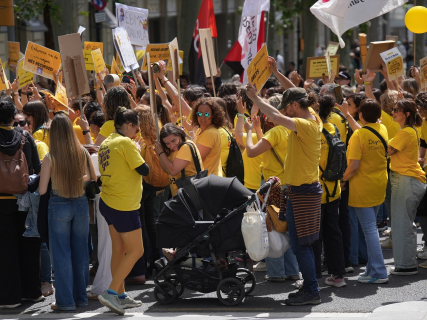

Education and the majority unions have reached a preliminary agreement to try to defuse the teachers' strike in Catalonia after weeks of tension, mobilizations, and negotiations at the limit. Saturday's picture, however, is not yet that of a resolved conflict: the agreement is pending the consultation of the teaching staff, who will be the ones to decide whether or not to endorse the proposal reached with the Department.
The agreement was reached on Friday night after another day of talks between the Department of Education and the teaching unions. USTEC and Professors de Secundària have agreed to take the proposal to the collective, while CGT, Intersindical, and COS rejected the approach and walked away from the negotiation, considering that it did not include their minimum demands.
The key to Saturday lies precisely there: the conflict enters a decisive phase. It is no longer just a negotiation between unions and the Government, but an internal vote among teachers that will determine whether the school year faces a de-escalation of the conflict or if the strike and union pressure continue to be open.
The agreement is not definitive: the consultation with teachers begins
The preliminary agreement reached between Education and the majority unions must be ratified by the teaching staff. As USTEC explained after the meeting, the consultation will begin this Saturday and the results will be collected between Monday afternoon and Tuesday morning.
This means that, over the next few hours, the strike is in a kind of political and union pause: there is a proposal on the table, there are unions willing to defend it to the teaching staff, but there is still no definitive closure.
The result of this consultation will be decisive. If the teaching staff validates the preliminary agreement, the Government will be able to present the pact as the turning point to close one of the most significant educational crises in recent months in Catalonia. If they reject it, Education will once again be under pressure and the unions will have arguments to maintain the mobilization.
What the preliminary agreement between Education and the unions includes
The central point of the agreement is the progressive salary improvement for teachers until 2029. The agreed proposal includes a cumulative increase of 384.77 euros per month in Primary and 389.50 euros in Secondary in the regional part of the salary.
If the planned state increases are added, the total raise would reach 599.50 euros per month in Primary and 633.58 euros in Secondary by 2029.
In addition to the salary component, the preliminary agreement incorporates other relevant measures for the Catalan education system. Among them, the call for 5,000 professorship positions for Secondary school teachers, spread between 2027 and 2028, with 2,500 positions each year.
New provisions for inclusive education, compensation for stages, and a progressive reduction of ratios to reach 20 students per class in Primary and 25 in Secondary are also included.
The Government argues that teachers will be among the best paid
From the Department of Education, the interpretation of the agreement is clear: the Government considers that it has put extraordinary resources on the table to respond to the discontent in the education system.
The Secretary for Educational Improvement, Ignasi Giménez, argued that the agreement represents an “exercise of responsibility” and should serve to lay the groundwork for the system’s transformation. He also maintained that, with the implementation of the planned improvements, Catalan teachers would become among the best paid in the State.
This is one of the messages the Government will try to convey in the coming hours: that the pact is not just a salary increase, but a structural response to a conflict that had been accumulating wear and tear due to working conditions, the system's burden, and the loss of purchasing power.
The majority unions are putting it to a vote, but not all endorse it
Union unity, however, is not complete. USTEC and Professors de Secundària have agreed to submit the preliminary agreement to a vote, but other unions have rejected the proposal.
CGT, Intersindical, and COS walked away from the table, considering that the final text did not incorporate issues they deem essential. Among the demands that were left out or considered insufficient are opposition to the closure of public lines, the internalization of certain support profiles, and a faster reduction of ratios.
CGT, which does have representation in the Sectoral Table, was particularly critical of the Department's latest proposal. The union considers that the improvements are not sufficient and maintains a position of rejection of the agreement.
This division will be important in the consultation. Although the majority unions endorse taking the agreement to the teaching staff, the result will depend on the real climate in the schools and the degree of acceptance of a proposal that comes after days of strikes and weariness.
What is happening today, Saturday, with the teachers' strike in Catalonia
This Saturday is the first key day after the pre-agreement. A new formal negotiation is not expected, but rather the start of the consultation process for the teaching staff.
Teachers will have to assess whether the Departament's proposal is sufficient to end the conflict or if they believe pressure should be maintained. In practical terms, the focus will be on assemblies, internal union channels, and the level of participation achieved in the consultation.
The planned calendar indicates that the results will begin to become clear between Monday afternoon and Tuesday morning. Until then, the agreement remains in suspense.
The figures of the agreement: almost 600 euros in Primary and more than 630 in Secondary
The most visible element of the pre-agreement is the salary increase. The agreed regional component stands at around 385 euros per month in Primary and close to 390 euros in Secondary.
With the sum of the state increases, the improvement would reach approximately 600 euros per month for Primary school teachers and more than 630 euros for Secondary school teachers in 2029.
The agreement also includes a new teaching supplement, with an improvement compared to the previous offer. This issue had been one of the main points of friction during the negotiations, as unions demanded that the increase have broad scope and not be limited only to certain positions or functions.
5,000 professorship positions and more resources for inclusion
Another of the highlighted points of the pre-agreement is the call for 5,000 professorship positions for Secondary education. The measure would be spread over two years: 2,500 positions in 2027 and another 2,500 in 2028. The text also contemplates new resources for inclusive education, one of the recurring demands of the education sector. The lack of resources to cater to diversity in classrooms has been one of the underlying issues of teacher discontent.
Added to this is the commitment to advance in the reduction of ratios. The goal set is to progressively reach 20 students per classroom in Primary and 25 in Secondary, a measure that unions consider key to improving working conditions and student attention.
The educational conflict enters its decisive phase
The agreement comes after a period of strong union pressure. Mobilizations, strike days, and successive meetings had placed the Government in front of a conflict that was difficult to sustain politically.
The fact that the agreement is reached with the majority unions allows the Department to gain breathing room, but does not completely eliminate tension. The final word will now rest with the teaching staff.
If the consultation goes ahead, the Government will be able to close the educational front with a picture of social pact and progressive improvement. If the result is negative or very divided, the conflict may reopen with more force, because the rejection will no longer come only from minority unions, but from a significant part of the teaching collective.
When will it be known if the strike ends
The immediate calendar is clear. This Saturday the consultation begins. On Monday afternoon and Tuesday morning, the data will be collected. From there, the unions will have to communicate whether the teaching staff ratifies the pre-agreement.
Until then, the teachers' strike in Catalonia cannot be considered over. What there is is a principle of agreement capable of de-escalating the conflict, but pending validation.
Today's day will therefore be less visible on the streets than in the schools and internal structures of the unions. It will be decided there whether the Education proposal is enough to end months of discontent or if the Catalan educational system faces a new phase of mobilization.
The political key: Illa and Education try to close a sensitive front
The agreement also has an evident political reading. Education had become one of the most sensitive social fronts for the Government. A prolonged teaching conflict directly erodes the image of management, affects thousands of families, and places the Administration under constant pressure.
Therefore, the preliminary agreement has value beyond the figures. For the Government, it represents the possibility of regaining initiative and presenting a negotiated solution. For the unions, it offers a concrete improvement after weeks of mobilization. For teachers, it opens up a complex decision: accept a progressive increase and staffing commitments or maintain pressure to try to extract more measures.