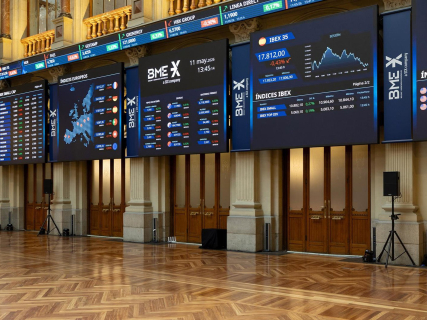


The Ibex 35 has concluded this Tuesday's session with a decrease of 0.34%, finally settling at 19,476.5 points, in a day conditioned by strong corrections in Wall Street technology stocks and tensions in the Middle East.
The Nasdaq, a US index specializing in technology stocks, closed Monday's stock market session with a drop of 1.32%, with SpaceX losing 16.43% just one week after its IPO. At the close of the European session this Tuesday, the Nasdaq was down another 1.7% and Elon Musk's company was up 2.3%.
On the other hand, Iran's president, Masoud Pezeshkian, reiterated this Tuesday that the success of talks with the United States "depends on full commitment to agreed obligations" and their "correct implementation," following technical discussions held in recent days in Switzerland.
The geopolitical front is marked by the 60-day license granted for Iran to export oil, although Renta 4 analysts warn that the Strait of Hormuz—through which one-fifth of the world's crude oil passes—"remains institutionally unaddressed."
"As long as the conflict in Lebanon is not resolved, the risk of negotiations breaking down remains latent. The market is reading this as a scenario of half-hearted risk reduction: enough to push crude oil down, insufficient to assume that supply is guaranteed in the long term," they point out.
Within Europe, the Prime Minister of the United Kingdom, Keir Starmer, announced his resignation on Monday after stating he had heard internal questioning of his leadership of the Labour Party and two years after winning the general election in July 2024.
In Spain, on the corporate front, the board of directors of Duro Felguera has decided to execute a capital reduction due to losses and, subsequently, an increase in share capital of more than ten million euros, in line with the joint restructuring plan signed in October 2025.
In addition, the European Investment Bank (EIB) has signed an agreement with Banco Sabadell to channel 1 billion euros in investments aimed at SMEs and mid-caps for defense and security projects.
Following in the business sphere, Telefónica, through its subsidiary Telefónica Emisiones, has gone to the Australian markets with a bond placement for a total amount of 700 million Australian dollars (426.5 million euros).
On the macroeconomic level, it has been published that the price of free housing increased by 13.1% in 2025 and reached 2,230 euros per square meter, which represents the fifth consecutive year of increases and places the value 7% above the maximum recorded during the real estate 'boom' of 2007, according to the Ministry of Housing.
In this scenario, among the most bullish stocks in the selective index, Telefónica (+2.59%), Amadeus (+1.91%), Endesa (+0.91%), Repsol (+0.83%), Rovi (+0.68%), and IAG (+0.56%) stood out. On the downside were ACS (-3.05%), Acciona (-2.04%), Acciona Energía (-1.91%), Naturgy (-1.89%), Bankinter (-1.45%), and Cellnex (-1.25%).
The trend in the main European stock markets was also negative, with London falling 0.09%; Paris, 0.71%; Frankfurt, 0.98%; and Milan, 1.46%.
The Brent crude barrel stood at 76.95 dollars at the close of the European session, down 1.21%, while West Texas Intermediate (WTI) fell 1.10%, to 73.06 dollars.
In the debt market, the yield on the Spanish 10-year bond stood at 3.392%, compared to 3.417% at Monday's close, so the risk premium compared to the German bond rose to 47.3 basis points.
In the foreign exchange market, the euro depreciated by 0.43% against the greenback, to an exchange rate of 1.1380 dollars per euro.