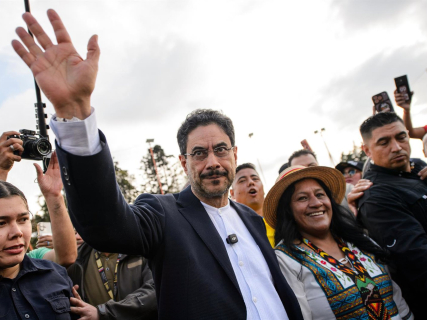


Colombia decides this Sunday who its next president will be. The second round of the presidential elections pits two candidates with opposing political projects against each other: Abelardo de la Espriella, a lawyer and candidate of the hard right, and Iván Cepeda, a left-wing senator and figure linked to the defense of the peace process.
The electoral day will be held this Sunday, June 21, on Colombian territory. The polls will be open from 8:00 AM to 4:00 PM local time. In Spain, this is equivalent to a window from 3:00 PM to 11:00 PM peninsular time. Preliminary results will begin to be known after the polls close, from 11:00 PM in Spain.
Abroad, voting began on June 15 and also culminates this Sunday. The National Registry has enabled more than 1.4 million Colombians residing outside the country.
Who are the candidates
The second round pits Abelardo de la Espriella against Iván Cepeda.
De la Espriella comes as the winner of the first round. His campaign has been built on a discourse of security, a firm hand against crime, reduction of the state, and a political shift from the government of Gustavo Petro. His figure has concentrated the vote of a large part of the right and sectors demanding a drastic change after four years of progressive government.
Cepeda represents the continuity of the left-wing bloc, albeit with his own profile marked by his trajectory in human rights, victims, and defense of the peace agreement. His candidacy seeks to maintain the progressive cycle opened by Petro and prevent a shift towards the harder right.
Voting hours in Colombia and Spain
- In Colombia, voting will take place this Sunday from 8:00 AM to 4:00 PM.
- In peninsular Spain, Colombian polls will open at 3:00 PM and close at 11:00 PM.
Colombians must vote at the same polling station assigned for the first round. The Registry reminds that to vote, it is necessary to present the physical or digital citizenship card. A passport or proof of application will not be accepted.
When will the results be known
Preliminary results will be published after the polls close in Colombia, starting at 4:00 PM local time. This means that in Spain, they will begin to be known from 11:00 PM.
As is customary in Colombia, the pre-count is for informational purposes and does not have definitive legal value. The official result is consolidated later through the scrutiny.
Even so, if the difference is wide, the trend may become clear during the Spanish night. If the result is narrow, attention will shift to the progress of the count and the reaction of the campaigns.
What the polls say
The last publishable polls showed a lead for Abelardo de la Espriella.
AtlasIntel placed the right-wing candidate ahead of Iván Cepeda by a margin of nearly eight points. Other poll analyses also gave him a lead, albeit with varying margins.
Colombian law prohibits the publication of polls during the last week before the vote, so the demographic picture is frozen from days before June 21.
The important fact is this: De la Espriella starts as the favorite in the polls, but not as a sure winner. The difference in the first round was narrow, and the behavior of the center vote, abstentions, and undecided voters can sway the election.
First round result
- In the first round, Abelardo de la Espriella was the most voted candidate with 43.7% and more than 10.3 million votes.
- Iván Cepeda came in second with 40.9% and nearly 9.7 million votes.
The difference was just 2.8 points. It is a relevant distance, but not decisive in a second round.
The remaining candidacies, the blank vote, null votes, and unmarked votes totaled around 3.9 million votes. That electoral pool is one of the keys to the day.
The votes that can decide Colombia
The election is being contested by three groups. The first is the center vote, especially from those who supported alternative candidacies in the first round. Some of these voters may lean towards De la Espriella as a reaction to petrismo; another part may support Cepeda out of rejection of a hard-right turn.
The second group is the abstentionists. If participation increases, as often happens in some second rounds, it could alter the balance of the first round.
The third group is the last-minute undecided voters. The polarization of the campaign can mobilize emotional votes, fear votes, or useful votes in the two blocs.
Participation, the figure to watch
Colombia reaches this second round with more than 41 million people eligible to vote inside and outside the country.
Participation will be one of the main indicators of the night. High turnout can change the scale of the result, especially if voters who did not attend the first round participate.
In 2022, the second round increased turnout compared to the first. If something similar happens this Sunday, more than a million additional votes could come into play.
The question is who that mobilization benefits: De la Espriella, who has turned the election into a plebiscite against Petro, or Cepeda, who needs to broaden the progressive base and attract centrist voters.
Peace, security, and violence: the great underlying axis
Beyond the economy and polarization, the election has a central axis: what to do about violence and armed groups.
Cepeda defends a line of continuity with the search for agreements and negotiation, albeit with adjustments after the problems of the Petro Government's "total peace" project.
De la Espriella proposes a hard-line approach, with more military and police pressure against criminal and armed organizations.
The result could profoundly change Colombia's security policy. A Cepeda victory would keep the negotiating path open; a De la Espriella win would mean a clear hardening of the State's approach.
The Petro factor
Although Gustavo Petro is not a candidate, his government is at the center of the vote. For De la Espriella, the second round is a judgment on "Petrismo." His campaign has sought to present the election as an opportunity to close the progressive cycle and recover an agenda of order, market, and authority.
For Cepeda, the challenge is more complex. He must defend part of Petro's legacy without getting trapped by the political costs of the outgoing government. His campaign needs to retain the progressive vote and, at the same time, convince moderate sectors that he can govern with stability.
Trump, Latin America, and international impact
The Colombian second round is also viewed from outside the country. A victory for De la Espriella would reinforce the regional advance of hard-right leadership and bring Colombia closer to an agenda more aligned with Donald Trump, Javier Milei, Nayib Bukele, and other conservative governments in the Americas.
A Cepeda triumph, on the other hand, would keep Colombia in the Latin American progressive bloc alongside governments like Mexico's.
That is why the election is not just Colombian. It also marks the political balance of Latin America at a time of strong regional polarization.
Congress, another limit for the next president
Whoever wins, the next president will not have an easy path. The Colombian Congress is fragmented and will force the new Government to negotiate. This may limit the speed of Cepeda's reforms or De la Espriella's shock changes.
The presidential result will give political power, but not automatic control of the system. Governability will be one of the big questions of the day after.