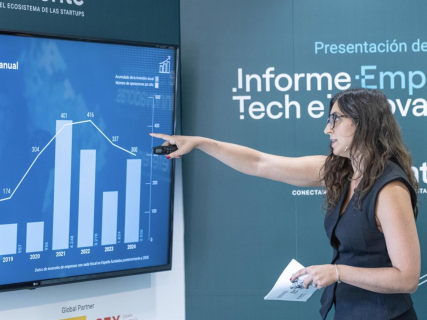

The Spanish technological ecosystem accelerates its expansion again and enters a more advanced phase of consolidation and maturity. At the close of 2025, 10,294 active technology companies are counted, compared to 8,580 in the previous year, which implies an increase of 20% and reinforces the trend of sustained growth of the country's innovative fabric.
Spanish technology companies already generate 137,042 jobs and an economic impact of 19,442 million euros, with increases of 26.9% and 31.2%, respectively, even above the pace of new company creation, according to the "National Report on Tech and Innovative Companies 2026", prepared by Scoutyn based on data verified with the Mercantile Registry.
The study also shows an internal transformation of the ecosystem: although the number of "startups" falls slightly —from 5,010 to 4,856—, the rebound in "scaleups", which reach 672 firms, and technology SMEs, which rise to 4,605, confirms greater business maturity and positions them as the central economic engine of the Spanish ecosystem.
Madrid closes the gap with Catalonia
Catalonia retains leadership in terms of the volume of technology companies, with 2,632 companies, but Madrid already has 2,607 and reduces the gap to just 25 companies.
Both regions continue to concentrate a very relevant part of the national technological network and the capital invested in it.
Furthermore, the city of Madrid is consolidating itself as the country's main technological hub, with 1,801 "tech" companies, 833 "startups", and 140 "scaleups", leading the three major categories ahead of Barcelona.
Andalusia is the protagonist of one of the biggest leaps of the year and consolidates itself as the region in the national 'top 5' with the highest percentage growth. The community goes from 714 to 885 technology companies and is, moreover, the only one among the main autonomous communities that increases the number of "startups".
AI drives the great leap of the technological ecosystem
The report identifies the strong irruption of artificial intelligence (AI) within the Spanish technological ecosystem as one of the year's major milestones. AI is now the third vertical with the most "tech" companies in Spain and the fastest-growing segment during 2025.
In total, the country has 959 companies specialized in AI, compared to 309 the previous year, which represents an increase of over 210% in just twelve months.
This figure confirms the rapid adoption of AI-based solutions and the growing strategic importance of this area within the national innovative fabric.
The rise of AI is accelerating the transformation of numerous technological verticals and economic branches, from health, fintech, or advanced industry to energy, mobility, education, or business process automation.
The report highlights that a significant portion of new technological entrepreneurship in Spain is already born directly linked to AI-based models, consolidating a stage of greater specialization and sophistication of the ecosystem.
In parallel, SaaS is consolidated as the main technological vertical in terms of number of companies, with 1,387 companies, followed by eHealth, with 1,000, and AI, with 959.
Among the sectors with the largest presence are also "Foodtech" (568), Energy (526), "Biotech" (523), "Edtech" (515), and "Fintech" (479). The study also includes the continued growth of areas such as "big data", sustainability, mobility, cybersecurity, or automation, reflecting an increasingly marked technological specialization.
More than 3.210 million invested in Spanish startups
Investment in "startups" and innovative companies exceeded 3.210 million euros, distributed in 327 operations during the last analyzed year.
Catalonia and Madrid remain the major poles of attraction for capital and, between them, they concentrate about 77% of all national investment.
The report recalls that Spain has already accumulated more than 15.500 million euros invested in "startups" in the last five years and remains one of the few European ecosystems capable of sustaining high investment volumes in an international context marked by uncertainty.
The Spanish ecosystem also shows greater business and financial consolidation, supported by the increase in "scaleups", the growth of medium and large funding rounds, and the emergence of companies capable of competing internationally and attracting global capital.
The gender gap remains unclosed
Despite the general dynamism of the ecosystem, the gender gap continues to be one of the major pending challenges.
Women represent only 17% of the founders of technology companies in Spain, a percentage practically stagnant compared to the previous year.
In solo-driven "startups", female presence is 18%, which highlights the persistence of structural barriers in technological entrepreneurship.
The report concludes that Spain is entering a new stage of technological consolidation, in which the challenge is no longer solely to create "startups", but to scale companies capable of competing internationally, attracting large investment rounds, and generating sustained economic impact.