Consult here the complete agreement of PP and Vox in Andalusia

DEMOCRAT has had access to the full document of the agreement that unblocks the investiture of Juanma Moreno as president of the Junta de Andalucía

1 minute

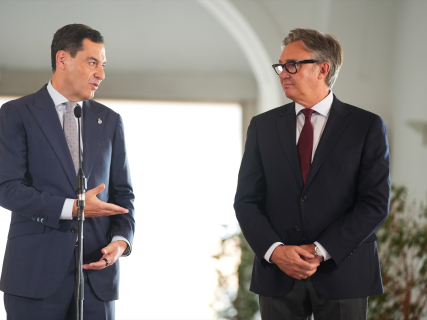
EuropaPress 7638772 presidente funciones junta candidato pp a reeleccion juanma moreno junto

EuropaPress 7638772 presidente funciones junta candidato pp a reeleccion juanma moreno junto

Add DEMÓCRATA to Google

Ask FREN

Published

Last updated

1 minute

Most read

The People's Party and Vox have reached a government agreement in Andalusia to invest Juanma Moreno as president of the Junta and to incorporate Santiago Abascal's party into the regional Executive with a ministry with the rank of vice-presidency.

The pact, composed of 60 pages and 150 measures, sets the lines of action for the coalition for the legislature and establishes the distribution of responsibilities between the two parties.

Below, DEMÓCRATA reproduces in full the document signed by PP and Vox, which includes the political, programmatic, and institutional commitments agreed upon by both parties.


📄 Read the full PP and Vox agreement in Castilla y León here
Preview in the news (if your browser allows it)
 

More key points, information and questions with FREN

AI-GENERATED CONTENT

What is the current status of the parliamentary processing of the agreement between PP and Vox in Andalusia?

The agreement between PP and Vox in Andalusia has already completed its key phase in the parliamentary venue: it served to invest Juan Manuel Moreno as president of the Junta in the second vote and to establish the basic institutional power distribution between both parties. The so-called “Government and Stability Agreement for Andalusia” is signed and has resulted in explicit support from the 15 Vox deputies for the PP candidacy, which has gathered 68 votes. From a strictly parliamentary point of view, the processing related to this pact can be considered closed: the investiture is approved and the rest of the effects will be channeled through Executive decisions and specific agreements of the Chamber. What continues from now on is the complete configuration of the Government and the practical materialization of the agreement during the legislature.

What has already been approved in the Andalusian Parliament

Debate and investiture of Juan Manuel Moreno

The only formal procedure in the Andalusian Parliament linked to the PP–Vox pact is the investiture process of Juan Manuel Moreno. This debate has been held in several plenary sessions (June 29, 30 and July 2, 2026), recorded in the official weekly agenda of the Andalusian Chamber, where the object is the investiture of the PP candidate, not the approval of the pact itself (Andalusian Parliament agenda).

In the investiture speech, Moreno expressly acknowledged that he needed external support and mentioned that he maintained “a dialogue process with Vox,” highlighting that it was the only force willing to negotiate with the Andalusian PP to avoid institutional blockage (Juanma Moreno’s investiture speech). This political framework ultimately leads to the formal agreement.

Second vote and investiture result

After a failed first vote, in which Moreno did not achieve the necessary majority due to the lack of agreement with Vox, negotiations accelerated. According to political reports, the national leadership of the PP considered it a fact that “sooner rather than later” a pact with Vox would be reached to unblock the situation (statements by Ester Muñoz at Nueva Economía Fórum).

That pact materializes just before the second investiture vote. According to available political information, PP and Vox sign the “Government and Stability Agreement for Andalusia” on July 2, 2026, and in the final vote Moreno obtains 68 votes (53 from PP and 15 from Vox), enough to be invested president of the Junta. From that moment, the Chamber has fulfilled the essential procedure linked to the agreement: granting or denying confidence to the candidate.

Political content of the agreement and institutional effects

Power distribution between PP and Vox

Although the full text of the pact is political in nature and not legislative, available information points out that it is a coalition and stability agreement, similar to the model applied in other autonomous communities. According to this same information, the agreement grants Vox:

– A vice presidency in the new Andalusian Executive.
– A broad-scope ministry, grouping areas such as Tourism, Deregulation, Justice, and Local Administration.
– An autonomically appointed senator, who must be formally elected by the Parliament in a subsequent vote.
– The vice presidency of the Board of the Andalusian Parliament, reflecting its weight in the governance of the Chamber.

It is important to emphasize that this distribution does not constitute a “law” nor a “parliamentary agreement” processed as such: they are political commitments materialized through appointments by the president of the Junta and, where applicable, internal elections of the Parliament (for example, the autonomous senator).

Parliamentary scope versus governmental scope

From the point of view of parliamentary processing, the PP–Vox pact does not generate its own legislative file. There is no bill, decree law, or registered resolution whose object is to “approve the PP–Vox agreement”; the Chamber does not vote on the text of the pact, but reflects the agreement through:

– The favorable vote of Vox in Moreno’s investiture.
– The constitution of the Parliament Board and its distribution of positions.
– Future key votes (budgets, Junta laws, etc.), where Vox will be a reference partner.

Current status of the processing

As of today, July 2, 2026, the parliamentary phase linked to the agreement can be summarized as follows:

Investiture debate held and concluded.
Second vote passed with 68 votes thanks to Vox’s support, guaranteeing Moreno’s continuity as president.
PP–Vox agreement signed and already operational in terms of power distribution.

Steps remain that will involve the Parliament, but no longer as “processing of the agreement,” but as ordinary procedures: the election of Vox’s autonomous senator, the approval of the community’s next budgets, or possible laws agreed upon by both groups. In summary, the pact has fulfilled its central function in the parliamentary venue — the investiture and institutional integration of Vox — and now unfolds mainly in the field of government action and daily legislative negotiation.

What are the powers and functions of the president of the Junta of Andalusia according to the Statute of Autonomy?

The Statute of Autonomy for Andalusia, reformed by Organic Law 2/2007, configures the President of the Junta as the highest political authority of the Community and the central piece of the relationship with the State. The Statute attributes to him the direction of the Council of Government, the coordination of the entire autonomous Administration, the power to appoint and dismiss councilors, and the supreme representation of Andalusia and ordinary representation of the State in the territory. Additionally, he is responsible for promulgating Andalusian laws in the name of the King, ordering their publication, proposing popular consultations, and, in certain cases, dissolving the Parliament. It also establishes his method of election, his political responsibility before the Parliament, and his criminal responsibility before the Supreme Court.

Institutional position of the President of the Junta

The Statute establishes that the President of the Junta “holds the supreme representation of the Autonomous Community and the ordinary representation of the State in Andalusia.” This means he is the highest political representative of Andalusia before other institutions, public and private, and, at the same time, the main authority of the State in the autonomous territory, which is especially relevant in relations with the central Government and other communities.

The President directs and coordinates the activity of the Council of Government, a collegiate body that exercises the political direction of the Autonomous Community and the executive and administrative functions of the Junta of Andalusia. In turn, he coordinates the autonomous Administration as a whole, ensuring the coherence of government action and public policies developed by the different ministries.

Executive and government functions

Among the most relevant executive powers, the Statute indicates that the President “appoints and dismisses the Councilors,” that is, he freely appoints and dismisses the members of his autonomous government and distributes the corresponding executive functions among them. He may also temporarily delegate his own executive functions to one of the vice presidents or councilors, which allows ensuring the continuity of government action in situations of absence or temporary impediment.

Likewise, the President may propose the holding of popular consultations within the scope of the Autonomous Community “on his own initiative or at the request of citizens,” on matters of general interest in autonomous or local matters, in accordance with article 78 of the Statute itself and state legislation. This faculty places him as a key actor in the articulation of participatory democracy instruments in Andalusia.

Promulgation of laws and normative functions

The Statute establishes that Andalusian laws are promulgated, in the name of the King, by the President of the Junta, who “will order their publication in the Official Bulletin of the Junta of Andalusia within fifteen days from their approval, as well as in the Official State Bulletin.” The relevant date for the validity of the laws will be that of their publication in the Official Bulletin of the Junta of Andalusia. This is an essential function that connects the legislative activity of the Parliament with the effective entry into force of the autonomous regulations.

Additionally, in the field of judicial organization and the Public Prosecutor's Office, the Statute provides that the President orders the publication in the Official Bulletin of the Junta of Andalusia of certain appointments (such as the Presidency of the Superior Court of Justice of Andalusia or the Superior Prosecutor of Andalusia), reinforcing his institutional role in the official projection of these acts.

Relationship with the Parliament and political responsibility

The President of the Junta is elected by the Parliament of Andalusia from among its members, after the proposal of the President of the Parliament, who must previously consult the spokespersons of the political groups. The candidate presents his program before the Chamber and needs an absolute majority in the first vote or a simple majority in a second or successive votes. Once elected, the King formally appoints him President of the Junta, in accordance with the Statute.

The President is politically responsible before the Parliament. The Statute itself provides that he may raise a vote of confidence on his program or on a general policy statement; if the Chamber denies him confidence, he must resign and a new investiture process is opened. At the same time, the Parliament may demand the political responsibility of the Council of Government, including the President, through a motion of censure, which must include an alternative candidate for the Presidency and be approved by an absolute majority.

Power to dissolve the Parliament and criminal responsibility

The Statute recognizes the President of the Junta the power to decree the dissolution of the Parliament “after deliberation of the Council of Government and under his exclusive responsibility,” setting the election date in the decree. There are limits: he cannot dissolve the Chamber when a motion of censure is in process and cannot agree on a new dissolution before one year has passed since the previous one, except in the specific case linked to the lack of investiture within two months from the first vote.

Regarding his criminal responsibility, the Statute provides that it will be enforceable before the Criminal Chamber of the Supreme Court, and before that same body civil liability will be demanded for any acts the President may have incurred in the exercise of his office. This special jurisdiction reinforces the institutional condition of the President and aligns with the treatment provided for other high State authorities.

Reference regulations

All these powers and functions are regulated in Organic Law 2/2007, reforming the Statute of Autonomy for Andalusia, published in the Official State Bulletin. There are also related regulations concerning former presidents and the Andalusian institutional framework, such as Law 2/2005, on the statute of former presidents of the Junta of Andalusia (BOE), amended by Law 9/2011 (BOE and BOJA), as well as other autonomous and state provisions connected with the Statute: Law 8/2006, on the Statute of Andalusians in the world (BOE, BOJA), Decree 236/2011 on the International University of Andalusia (BOE), Order of January 23, 2015 on the “Andalucía, Quality Craftsmanship” distinction (BOJA) or Decree 602/2019 on honorary distinctions (BOJA).

Various state regulations are also historically linked to the Andalusian statutory process such as Royal Decree 1835/1981, on the referendum of the Statute project (BOE), Order of September 3, 1981 on postal shipments of referendum propaganda (BOE), Order PRE/3908/2006 on the call for the statutory reform referendum (BOE) and resolutions of the Central Electoral Board related to that referendum (BOE, BOE). Other regulations cited in the sources, although not directly related to the Andalusian Statute, complete the general context: Royal Decree 1275/2011 on the Spanish Agency of Medicines (BOE), Royal Decree 375/2001 on the Carlos III Health Institute (BOE), Order of January 19, 2005 of the Municipal Museum of Luque (BOJA) and Constitutional Court resolutions on Andalusian local autonomy (STC 19/2022, unconstitutionality issue 3523-2021).

Which political party does Juanma Moreno belong to and what is his political career?

Juan Manuel Moreno Bonilla, known as Juanma Moreno, belongs to the People's Party (PP), of which he is one of its main territorial references. Since March 2014 he has been president of the PP of Andalusia and, since January 2019, president of the Junta of Andalusia, a position he renewed with an absolute majority in 2022. His career combines a long stage in the Congress of Deputies, responsibilities in the central Government as Secretary of State, and later an autonomous cycle where he has led the alternative to Andalusian socialism. Below is a summary of his main political trajectory at local, national, autonomous, and internal PP levels.

Political party and internal leadership

Moreno Bonilla is a member of the People's Party, a formation in which he has been consolidating since a very young age. In the organic field, he first stood out in the youth organization: he was president of New Generations of the PP in Málaga (1993), in Andalusia (1995), and later national president of New Generations between 1997 and 2001, according to party and Junta of Andalusia biographies (PP Navarra, PP Andalusia, Junta of Andalusia).

In March 2014 he was elected president of the People's Party of Andalusia, a position he has held since then (National PP). He has subsequently been re-elected with overwhelming internal support, as reported by the press and particularly the newspaper El Demócrata, which highlights his role as undisputed leader of PP-A and his goal of consolidating broad majorities in the community.

Beginnings and local career

His first institutional positions are linked to Málaga. In the mid-nineties he was councilor for Youth and Sports in the Málaga City Council, also managing municipal districts and the presidency of a District Board, according to PP biographical files (PP Navarra, PP Andalusia). At the same time, he was consolidating his profile as a youth leader and organic party cadre.

National career: Congress and Government of Spain

At the state level, Juanma Moreno was a deputy in the Congress from 2000 to 2011, serving several terms for the PP. In 2011 he resigned his seat to assume responsibilities in the central Government as Secretary of State for Social Services and Equality in the Government of Spain (Nueva Economía Fórum – profile, National PP).

As Secretary of State (2011–2014) he promoted initiatives in key social areas: the National Strategy for the Eradication of Violence against Women, the General Law on the Rights of Persons with Disabilities, the National Plan for Childhood and Adolescence, and the National Plan for Social Inclusion, among other programs, according to his official biographies (PP Andalusia, Junta of Andalusia).

After this stage in the Executive, the Parliament of Andalusia appointed him autonomous senator (2014–2017). In the Senate he was a member of the Permanent Deputation and chaired the Incompatibilities Commission, as reflected in his parliamentary file (Senate of Spain).

Autonomous leadership in Andalusia

Since 2015 he has been a deputy in the Parliament of Andalusia and president of the Popular Group. After the 2018 autonomous elections (invested in January 2019), he became the first president of the Andalusian Government from the PP, ending 36 years of socialist governments. This political change and his subsequent absolute majority in the 2022 elections are highlighted by various political reports and by the PP itself (PP Andalusia, PP – Political Report).

During his terms, he has placed healthcare and economic stability as the axes of his project. Interviews such as the one published in Redacción Médica record his commitment to “legally protect” the Andalusian health budget so that it grows every year. At the same time, recent information shows that his leadership faces scenarios without absolute majorities and complex negotiations for governance after the May 2026 elections (Redacción Médica – management without majorities, post-electoral situation, first failed investiture).

His figure is also the subject of attention in the national political debate: PP leaders such as Alberto Núñez Feijóo have claimed his management as an example of “good Andalusian government” (PP article), while Vox reproaches him for an alleged “continuity” with previous policies (Vox statement, Nueva Economía Fórum, criticisms by Manuel Gavira).

Other aspects and external projection

Besides his institutional activity, the Junta’s biography records that since December 2021 he holds a vice-presidency position in the European Committee of the Regions, reinforcing his European profile (official biography, Wikipedia entry). He also maintains an active public presence on social networks, as shown by his profiles on Instagram and Facebook.

For more information about his career and recent activity, you can consult, among others, the profiles and news from Nueva Economía Fórum, campaign news and institutional agenda in media such as Nueva Economía Fórum, Redacción Médica or Redacción Médica – health program, as well as the official agenda published on agend.as 06/10/2026, 06/17/2026, 06/20/2026, 06/24/2026, 06/25/2026 and 07/01/2026.

Play

Test your knowledge with FREN!

How much do you know about this topic? Answer the following 3 questions.

Who will be sworn in as president of the Junta of Andalusia after the agreement between PP and Vox?

Question 1 of 3

How many measures does the government agreement signed between PP and Vox in Andalusia contain?

Question 2 of 3

What rank will the ministry that Vox will hold in the Andalusian Government have?

Question 3 of 3

Hola, soy Fren. ¿Cómo te ayudo?