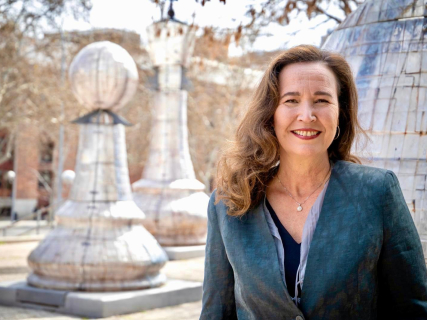

In tennis, after moving agilely, stopping, measuring and executing the impact, one must return “to the center”. It is the most efficient position to defend the next play and deploy strategy. A continuous plan that develops by managing each point. If we change the court for the Schuman roundabout, the European Union plays nowadays in a similar situation. Susana del Río, a high-competition tennis player during her student years, explains with this example how consensus is sought and found, so important both at a political and business level. The European Union must find its “center” to redefine its global geopolitical strategy.
From Brussels to Madrid, on the other end of the phone emerges one of the most reputable voices in the analysis of Spanish and EU community policies. She holds a doctorate cum laude in Political Science, and an extraordinary doctorate award in Social and Legal Sciences. She is a member of the European Commission's Committee of Independent Experts for various initiatives and director of different cycles on the analysis of European policy and its impact on the business, legal, and financial sectors. Del Río has dedicated her career to analyzing with maximum precision each of the European institutions' serves.
After touring some of the most relevant forums on foreign policy with the presentation of her book Twelve European Women. Building the European Union—where she narrates the process of European integration and its current axes, analyzing the common European project through twelve references linked to the values of Europe—she attends Demócrata at a moment of profound relevance for Europeans. Between meeting and meeting, she manages to make a pause in her agenda to deeply analyze the transformative process that intertwines the destiny of the Twenty-Seven.
Question: Where is the European Union right now?
Answer: In a decisive time. Europe is defining its strategic power because it must not allow others to define it. And here I speak of Europe, our continental power. In the structuring of the geopolitics of the current global map, it is fundamental that we pay close attention to the continental power of the European Union. Europe has enormous geostrategic impact capacity.
Question: In her book Twelve European Women, the word that accompanies President Von der Leyen is “management”. Her second term is being characterized by a commitment to the simplification of regulations that marked the previous legislature.
Answer: In the first legislature in which she was President of the European Commission, it is true that, after the COVID-19 tsunami, the Union had to provide very rapid responses, and it did, tangible responses. What is more tangible than saving lives with a coordinated European vaccination campaign, even though the European Union does not have competence in health?
And then the deployment of a joint, common, European debt, which are the Next Generation EU recovery funds and their two vectors, the European Green Deal and digitalization.
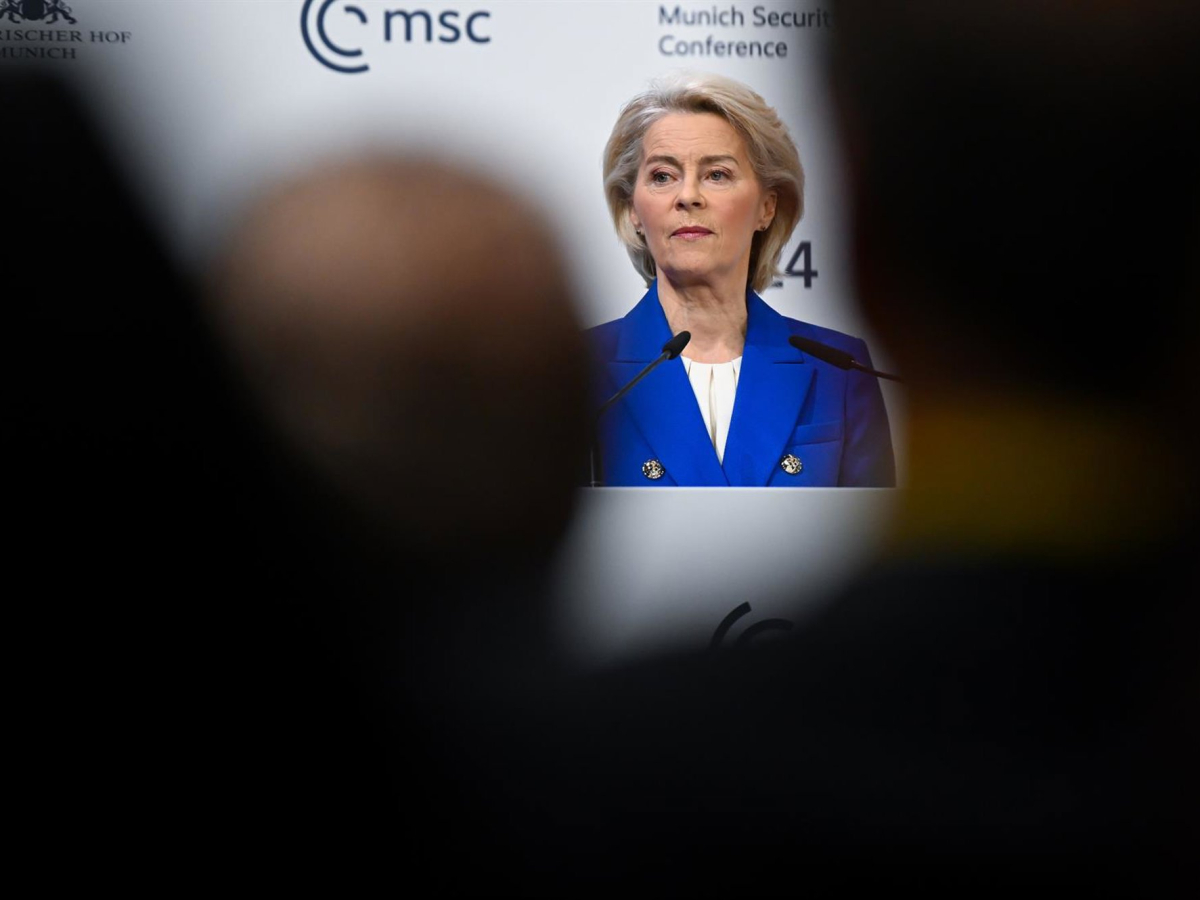
In this second term, in which she continues to be president of our European executive—I like to emphasize "European government"—the responses are being rapid. The European Union, which always has a reactive capacity to crises, is beginning a proactive journey.
A proactive European Union in which the Commission is proposing, driving, deploying different programs, instruments, and tools.
Q: Is Brussels being ambitious in this regulatory simplification agenda?
A: Here, as in almost everything, we observe one of the hallmarks of the EU, which is to seek balance within the decision-making process and, therefore, in its responses.
It is true that streamlining procedures so that companies can advance and consolidate the objective of European strategic Autonomy with realism is necessary. It is key that companies are not straitjacketed so that the European business fabric gains competitiveness. This is the competitiveness on which Mario Draghi focuses his report, very well broken down, in relation to a competitive Europe.
Featured story
How the European competitiveness calendar stands after EUCO: key proposals, dates and deadlines
6 minutes
But at the same time, it is very important that the European Union continues to be strong and an example in regulatory model. In a world where the global chessboard is being reorganized, with emerging models such as the United States, China or India, where some leaders like Trump occasionally decouple, for example with their tariffs and decisions, the global balance, it is very important that the EU continues to be an example in regulation, in order.
Regulation as order, regulation as a normative model. For example, the artificial intelligence law, the first in the world, which is European. Some of its parameters are being debated, but the most important thing is that the EU has contributed an artificial intelligence law to the world.
This regulatory simplification is necessary on the European agenda for companies, capital markets, trade, and financial entities, but always maintaining a balance and a regulatory model. Here also lies the integrating power of the EU and its contribution to a convulsed world currently navigating uncertainty.
Question: Other initiatives are being presented such as Regime 28, the revision of the ETS or those aimed at banking union, to cite some examples. Will they serve for Europe to regain competitiveness against the United States and China?
Answer: Yes, they will serve. Of course they will serve. From the first moment I read Enrico Letta's report, "Much more than a market: speed, security, solidarity," the first thing that caught my attention was the European Regime 28, a virtual country, a common corporate country in which companies can carry out transactions, also the creation of new companies, financial and commercial activity in an agile way with common regulation. The cornerstone of what I also call "register 28" is the instrument for European companies EU Inc.
In addition to Regime 28, the European Union is demonstrating that it is proactive with instruments such as the military Schengen, the SAFE program, the Industrial Acceleration Law, or Made in Europe. I want to highlight the AGILE instrument recently presented by the Commissioner for Defence and Space Andrius Kubilius. The program is endowed with 115 million euros for the acceleration of technological projects by implementing agile innovation in the Defence industry. I also want to highlight the “AI Continent” tool, focused on artificial intelligence and the dual ecological and digital transition.
And all this must be linked to the Multiannual Financial Framework 2028-2034. The business community must pay close attention to the design of the new European budget.
I consider that all these initiatives are going in the right direction because they are catalysts for business growth and competitiveness. We can say that the Gordian knot is the conjugation between European values —democracy, rule of law, fundamental rights— and the implementation, development, and execution of tangible responses that make Europe competitive on the current geopolitical stage.
Question: Given that events point to a disappearance of the United States security umbrella, how do you imagine that European arm of NATO that is so talked about?
Response: I hope that European arm of NATO strengthens but that it also continues to be complemented by the United States arm, with our great transatlantic agreement for defense.
I believe it is very important that the allies continue to complement each other, because we need it.
It is true that events, for example, in the Strait of Hormuz and the war in Ukraine, which has just turned four years old, cause it to become misaligned at times. The French word “decalage” seems appropriate to me and conveys the message well. That new coupling between how the international order was configured and how it is now being reconfigured and evolving.
Regarding NATO, Europe also has to count on its own defense, with a defense with which it can look to the allies, specifically to the United States and leaders like Trump, reaffirming its own military capability.
The strengthening of European defense is the key to our common security. Without security there is no stability and, therefore, no growth. This sequence, and action, is key for a true real geopolitical awakening of the European Union to develop, which is already happening. Europe is awake. This must always be done with a very attentive listening to the business fabric, specifically to industry. We are in a stage of European reindustrialization.
Question: How would a European army materialize?
Response: I remember a speech by Angela Merkel — whom in the book I equate with the word “work” — in the European Parliament, in which she already advocated for the need for a European army. And I thought: now Trump is going to react by saying “what for, if NATO already exists?”. But Angela Merkel was very clear: she presented it as something complementary to NATO.
This is important: complementary. It would be a common European army based on EU missions coordinated with integrated commands.
It would respond proactively and in an orderly manner to events, for example in the face of an invasion or a threat to the territorial integrity of a Member State.
I am thinking about Greenland and that idea of Trump to "invade or buy Greenland" bypassing Denmark's sovereignty. It would also have a solid diplomatic base as a starting point; it would be an army that would respond to a realistic and consolidated European foreign policy, because Europe is defining its strategic power and for that it needs military capabilities.
Susana del Río: "In Defense, they have to be national and European champions"
An army with synchronized capabilities among member states, with coordinated integrated commands, would have to be backed by a strong European defense industry, capable of supplying it. There is the complete chain: European defense industry, the military Schengen, European foreign policy and common security.
Question: There is a debate within the Commission on the mergers model, which affects the defense industry. Some talk about national champions, others about European champions.
Response: They have to be national and European champions.
In our case, Spanish and European champions. Because if we want to grow and have our place in global geostrategy, we have to always think about Spain and Europe.
Here I also link to the main idea of Enrico Letta's report, "Much more than a market, growth, solidarity and speed". European Regime 28, EU INC… all of this points to the same thing.
We have to unite levels: the national and the European to identify competitive advantages, anticipate risks, manage them, agree on responses, and develop business initiatives with projection. A Spanish and European strategic plan that manages to create a trend. It is very important to create a trend. If we want a real strengthening of European defense that contributes to common security, we need scale. And that scale is built from the national towards the European. Europe is our most relevant strategic mission.
Question: Your book also features Margaret Thatcher, linked to the idea of national sovereignty. Saving the distances, one of the most recent Eurosceptic leaders has been Orbán. After sixteen years and historic elections, he has lost power. What does his fall mean for Europe?
Answer: Orbán's fall has very important significance for his projection in Europe. Hungary is now moving towards a pro-European opening, towards a member state aligned with the European project.
That is Europe: seeking the maximum or minimum common denominator among Member States, with their differences, within our institutions.
The result has direct effects on the decision-making capacity of the European Union, because it reduces blockages. On important geostrategic issues, it also dislocates certain blocking dynamics that have existed in the European Council.
And it facilitates moving towards decisions taken by qualified majority instead of by unanimity, which implies greater agility in the European reaction and response.
Susana del Río:“Europe is our most important strategic mission”
It means more Europe, more decision-making capacity and more institutional fluidity. And also greater coherence in common foreign and security policy.
Question: Simone Veil and the European Parliament appear in the book. How do you assess the relationship between the Commission and Parliament in this legislature, especially with recent tensions; the successive motions of censure or appeals to the ECJ?
Response: I value that the European Parliament conducts an “audit” of the European Government.
That is to say, our supranational Parliament audits the European executive, the Commission. It is important to emphasize supranational, because it is not a national parliament, it is the European Parliament. That control function over the executive is essential.
Evidently there is debate with dialectical tension. There are debates in the "State of the Union Debate", SOTEU, in the negotiations of the Multiannual Financial Framework 2028–2034, for example in sectors such as agriculture, where there is a lot of sensitivity regarding the protection of European products. For this reason, protection clauses are being established for European agricultural and livestock products.
Also in agreements like Mercosur, where political and legal debate is generated.
But my assessment is that both institutions —Commission and Parliament— want the same thing: they want Mercosur, they want to advance in trade agreements, they want to strengthen Europe's position. EU-Mercosur is the largest Free Trade agreement in the World. We must be very aware in Spain that we share a common language: Spanish. This fact is a great commercial catalyst. The EU is also activating agreements with Canada, India, Ghana, Australia.
The European Union is an example of multilevel governance. The Parliament is the European representative democracy, it examines and audits the Commission, which
proposes, drives, and executes. It is a living exercise of multilevel governance that forms part of the foundations of the EU. That relationship, with its tensions, is precisely what makes the European system work. European multilevel governance is part of its own model. In this time when it is key to align political and business decisions to gain competitiveness and grow, I consider it important to relate European multilevel governance to business governance, especially in multinationals. Analyzing this link is very necessary, also useful, in the structuring of European projects.
Susana del Río:“The European Union is an example of multilevel governance”
The match's serve arrives. The conversation could be prolonged as great matches do, with long exchanges and decisions that are decided by political millimeters. Susana del Río's diagnosis allows us to understand a European Union at a moment of profound redefinition, where strategic autonomy is no longer an option, but a necessity. She states: “We need political courage, consensus, business drive, and joint work,” in addition to shared responsibility.
Before the farewell, an underlying idea remains floating: that the real game of the European Union is not played in a single serve or in a single legislature, but in a continuous succession of decisions that will define whether this common project is capable of transforming into a more autonomous actor or if it will continue to depend on the rhythm set by others. Del Río explains that "European strategic autonomy" must be understood, in an interconnected and interdependent world, as a Europe with less dependence and, therefore, greater geostrategic power.
The call ends with an implicit, almost sporting promise: to meet again when the European scoreboard has changed, when new political "Grand Slams" have tested the resilience of the community project and when it can be assessed whether this push towards a more strategic Europe has finally translated into decisive points. Susana del Río knows that for Europe to win the decisive points, it has had to train many hours and consolidate its baseline game beforehand.