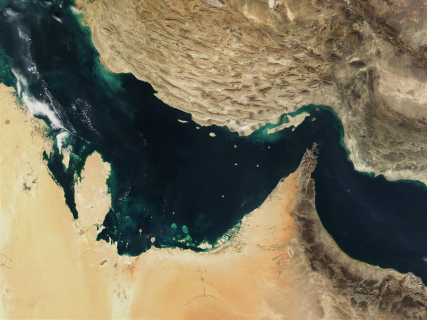
Iran has announced this Friday the full opening of the Strait of Hormuz to international commercial traffic, in a move directly linked to the two-week temporary ceasefire reached with the United States and its allies. The decision means, on paper, the reactivation of one of the world's most strategic maritime passages, through which nearly a third of global oil transported by sea circulates.
The Iranian Foreign Minister, Abbas Araghchi, has confirmed that during this period "totally free" passage for all commercial vessels is guaranteed.
The announcement from Tehran seeks to send a signal of de-escalation at the very start of diplomatic negotiations to consolidate the truce. However, sources from the maritime sector and international organizations warn that normality is far from having been re-established in practice.
A conditional opening to the truce
The reopening of the strait does not respond to a structural change, but to a tactical measure linked to the current negotiation scenario. During the last weeks, Hormuz has been the object of partial closures, selective restrictions, and crossed military warnings in the context of the escalation between Iran, the United States, and Israel.
In this regard, the Iranian decision is interpreted as a gesture to facilitate dialogue, but also as a tool of pressure: Tehran maintains intact its capacity to re-block the passage in case of a ceasefire breakdown.
Limited Traffic and Maximum Caution
Despite the official announcement, maritime traffic continues to operate under conditions of high uncertainty and military control. Several international shipping companies have opted to maintain alternative routes or reduce their activity in the area due to the risk of incidents.
Recent reports indicate that the flow of ships continues to be reduced and selective, with inspections, diversions, and significant naval presence from both Iranian forces and the United States and its allies.
Furthermore, concerns persist about possible threats such as sea mines, attacks on ships, or sudden changes in passage rules, which hinder an immediate return to logistical normality.
Global Impact: Oil and Trade
The Strait of Hormuz is a critical point for global energy supply, so any alteration in its operation has a direct impact on markets. The announcement of opening has contributed to temporarily easing the tension on crude oil prices, although volatility remains high.
In the medium term, the evolution of the situation in Hormuz will be decisive for the stability of global trade and to avoid a new inflationary rebound linked to energy.
Key in negotiations
The opening of the strait has become one of the central elements of the ongoing conversations to transform the truce into a more lasting agreement. The United States and its partners insist on guaranteeing freedom of navigation, while Iran seeks that any solution include its conditions on the regional chessboard, especially in relation to Lebanon and the balance of power in the Middle East.
In this context, Hormuz is not just a maritime passage, but a geopolitical instrument of the first order whose situation will continue to mark the course of negotiations in the coming days.