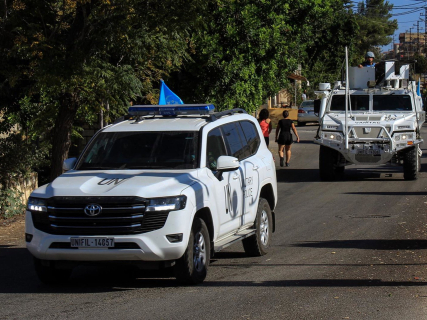

A Serbian peacekeeper from the United Nations Interim Force in Lebanon (UNIFIL) has died and two other Spanish soldiers have suffered minor injuries after an attack with mortar shells against a peacekeeping position located near the Lebanese town of Marjayoun, in the south of the country, an incident that also left two other injured.
UNIFIL detailed in a statement that the peacekeeper died early in the day in a Beirut hospital as a result of the "critical injuries" caused by the attack, and specified that the injured are being treated in the mission's medical facilities.
Sources from the Spanish Ministry of Defense have confirmed to Europa Press that the two injured peacekeepers are of Spanish nationality and have stressed that their condition is minor and their lives are not in danger.
In its note, UNIFIL expressed its "deep condolences" to the families and loved ones of the deceased and wished a "speedy recovery" to the injured, while announcing the opening of an investigation "to determine the exact circumstances that led to this tragic incident."
"UNIFIL has detected an increasing number of trajectories and impacts in southern Lebanon. The violence must cease," warned the mission, which reiterated its call to all parties to "comply with their obligations under International Law and ensure the safety of UN personnel and property at all times, including refraining from actions that could endanger peacekeepers."
"Likewise, we urge the competent authorities to investigate the incident, bring those responsible to justice, and ensure accountability," it added, before recalling that "deliberate attacks against peacekeepers constitute serious violations of International Humanitarian Law and Security Council Resolution 1701, and may constitute war crimes."
The Serbian Ministry of Defense has identified the deceased soldier as Sergeant Milovan Jovanovic, deployed in Lebanon as part of UNIFIL, and has stated that he "died this morning due to injuries caused by the impact of a projectile on a UN base where peacekeeping troops are stationed, including part of the Serbian contingent."
In its statement, the Serbian department has stressed that "Sergeant Jovanic received emergency medical attention within the base after being wounded, after which he was transferred by helicopter to the University Medical Center of Beirut, where he passed away at 4:00 AM (local time)".
The Spanish Ministry of Defense, for its part, has conveyed "all support" to the Spanish personnel integrated into UNIFIL following the attack. "All our encouragement and solidarity to the Serbian contingent," it indicated in a brief message disseminated on social networks.
The attack, on which neither Israel nor the Shiite party-militia Hezbollah have commented for now, occurred a few hours before the delegations of Lebanon and Israel agreed to the implementation of a ceasefire conditioned on the complete cessation of offensives by the Lebanese group and the withdrawal of all its combatants from the area south of the Litani River, after concluding this Wednesday in Washington a new round of talks sponsored by the United States and initiated the previous day.
The latest large-scale hostilities began on March 2, when Hezbollah launched projectiles against Israeli territory in response to the assassination of the then supreme leader of Iran, Ayatollah Ali Khamenei, in the offensive carried out on February 28 by Israel and the United States against the Islamic Republic.
Since then, the operations of the Israeli Army in Lebanon have caused more than 3,500 deaths and 10,600 injuries, despite the ceasefire agreed by both countries in mid-April —later extended for 45 more days—, which failed to stop the bombings or the Israeli ground incursion, accompanied by threats to extend the air campaign to the capital, Beirut.
Previously, the parties had already reached a ceasefire in November 2024 after thirteen months of fighting triggered by the attacks of October 7, 2023. However, Israel has since maintained an intense campaign of attacks on Lebanese territory and the presence of troops in several enclaves, alleging operations against Hezbollah, while Beirut and the Shiite group denounced these actions.