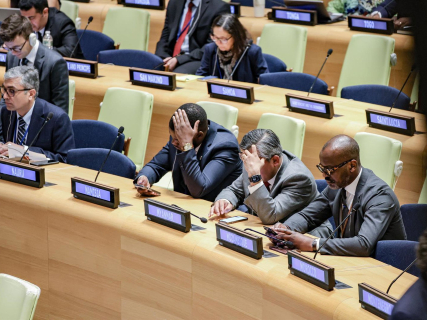

The Russian Executive has attributed the fiasco of the recent Nuclear Non-Proliferation Treaty (NPT) review conference to the attack by the United States and Israel against Iran and to the "destructive agenda" of the European Union, which it holds responsible for having blown up the possibilities of agreement.
In a statement, the Russian Ministry of Foreign Affairs has pointed out that "the most serious obstacle to achieving the objectives of the conference was the aggression of Israel and the United States against Iran under the invented pretext of 'protecting' the nuclear non-proliferation regime," alluding to an "unprovoked, unjustified, and illegal" offensive against Iranian territory.
According to Moscow, the delegations of the "collective West" that participated in the sessions held in New York "had their own political objectives unrelated to the NPT," which would have generated an "unfavorable atmosphere" during the negotiations. "They did everything possible to hinder a productive dialogue, with a destructive agenda focused on criticizing Russia, China, Iran, and North Korea," the Ministry has stressed.
As an example of this attitude, Russia maintains that several European and NATO countries defended their nuclear tests, arguing that they served to "reinforce the non-proliferation regime."
The conference concluded last Friday, after four weeks of meetings at UN headquarters in New York, and the next NPT review round is scheduled for 2031.
United Nations Secretary-General António Guterres expressed his "disappointment at the inability" of the conference "to reach a consensus on a substantive outcome and seize this crucial opportunity to make our world a safer place."
Guterres stressed that "a world free of nuclear weapons remains the United Nations' highest disarmament priority, and a goal to which the Secretary-General remains firmly committed. The Treaty is the cornerstone of the global nuclear disarmament and non-proliferation regime, and an essential element for promoting the peaceful uses of nuclear energy."
In parallel, the United States has for years maintained its demand for permanent guarantees that Iran will not develop an atomic weapon, while Tehran has reiterated on numerous occasions that its nuclear program is exclusively civilian and peaceful, and that it complies with the limits established by the NPT.