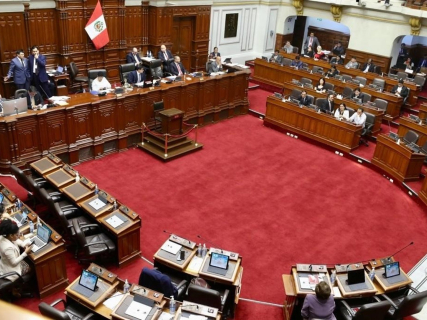


The Congress of Peru has given the green light to a norm that reinforces the legal protection of the actions of military and Police agents, establishing that the crimes of murder, torture, forced disappearance, or sexual assault can only be classified as crimes against humanity when it is proven that they were perpetrated within a "widespread" or "systematic" attack against the civilian population.
The initiative has been approved in a second vote, with 52 votes in favor and 43 against, in addition to five abstentions, according to a statement released by Parliament itself. The modification, which alters the Military Police Penal Code, will also have effects on the New Criminal Procedure Code and will remove members of the Peruvian forces who commit crimes in the performance of their duties from ordinary jurisdiction.
The approval of this legislation coincides with the counting of the second round of presidential elections, in which, for now, the far-right candidate Keiko Fujimori is ahead of Roberto Sánchez, of Juntos por el Perú, with a lead of just about 40,000 votes. The parliamentarians have ignored the warnings of the UN High Commissioner for Human Rights, Volker Turk, who has alerted of possible violations.
The reform has also been promoted by Fujimori's party, Fuerza Popular, on behalf of hundreds of military personnel prosecuted for the commission of serious crimes during the dictatorship of Alberto Fujimori.
The resolution blocks the issuance of final judgments in ordinary justice and consolidates a penal assimilation mechanism that the National Coordinator of Human Rights (CNDDHH) has described as worrying, recalling that in the 80s and 90s military justice served to protect these military personnel and close cases of torture and extrajudicial executions.