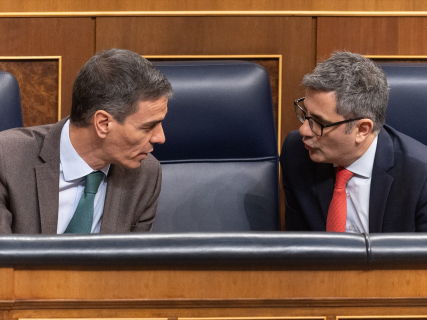

This Tuesday, one of the priorities of the Government will get underway: the Bill for the Protection of Minors in Digital Environments. After the celebration of the Justice Commission at 11:30 a.m., the committee that will prepare the report will be constituted. The initiative includes the prohibition of social media use for minors under 16 announced by Pedro Sánchez, as well as several aspects that keep the sector agitated. What is expected from the norm, what are the hot points, how will it shake up the sector, and what real possibilities does it have?
What the law proposes
The bill states that minors have the right to be effectively protected in digital environments, for which, a package of measures will be implemented, notably, parental control, which is also one of the hottest points.
The political consensus is that there should be a kind of parental control on devices so that minors cannot access certain content. The key question is on whom the responsibility falls and how to technically implement it. The dispute is between manufacturers and operators; and between those who opt for products to have it activated by default and those who choose to apply it during initial setup.
On the other hand, the new standard establishes the obligation for manufacturers of smartphones, tablets, computers, digital televisions and other devices to inform on their labels about the risks derived from access to content harmful to the health and physical, mental and moral development of minors. It should be visible on the packaging and in the instruction manual.
The PSOE intends -via amendments- to toughen the Penal Code on two fronts: the dissemination of intimate images without consent and identity theft online. It also aims to shield the data protection of children and adolescents and reinforce that of people with disabilities. Specifically, they propose a prison sentence of three months to one year or a fine of six to twelve months for anyone who "without authorization from the affected person or persons, reveals or transfers to third parties intimate material that they have at their disposal with the consent of said persons, whether in durable or limited support or in live broadcasts, when the disclosure seriously undermines privacy."
The nuance with respect to the current regulations is the reference to "intimate material that they have at their disposal". Currently, the Penal Code speaks of materials that "they would have obtained with their consent". The purpose, as justified by the PSOE, is to avoid interpretative problems with the word "obtain". The victim can voluntarily send the images and the recipient "obtains" them, just as if they are recorded. The obtaining always stems from the victim's consent, but what is truly relevant is the typical conduct of the crime, which is the non-consensual dissemination of those images, not their "obtaining". With this amendment, the possible loophole is remedied.
Another of the facets that the report will have to discuss will be the regulation of the use of technology in educational settings. The text that came out of the Council of Ministers aims to combine digital competencies with the obligation for educational centers to expressly regulate the use of mobile devices and similar (tablets, computers, smartwatches, etc.), both in classrooms and in extracurricular activities, in accordance with the regional regulations that already exist or that will have to be approved. The parliamentary groups agree on the core issue, which is the need for regulation, but propose significant changes such as time limits for use or, even, the absolute prohibition.
The debate on social media
The President of the Government announced that a transactional amendment would be promoted so that the text explicitly included the prohibition; a measure that from Sumar accept with nuances.
In the opinion of the magentas, the wording already contemplated it in a sufficiently guaranteeing way. Furthermore, they consider that the debate should not pivot around prohibition, but should focus on making the network a safe environment for minors to browse without risk. In fact, they raise the possibility of promoting a public social network, not controlled by "technological warlords" with "algorithms harmful to our children".
Tagging, a pulse of container and content
The manufacturers of technological devices are reluctant to the current wording regarding the obligations of labeling for two reasons. In the first place, because they consider that it generates legal uncertainty, since each manufacturer would indicate different information, among other things, because elements such as recommendation times are outside their control and there is no scientific consensus, as they depend on individual factors. On the other hand, they argue that it would increase the use of paper (manuals and labels) and ink.
As an alternative, the sector proposes to the parliamentary groups that the information can be integrated on the website or in an easily accessible digital format, in addition to public authorities and bodies being the ones to design a label with standardized information so that it is uniform, regardless of the manufacturer.
In an interview with Demócrata, the Minister of Youth and Childhood, Sira Rego, explains that the Government is digesting all the amendments and that the decision could be executed through a subsequent regulatory development.
The minority partner of the Executive, Sumar, through its parliamentary group, proposes as an alternative that manufacturers can provide an easily accessible digital format, such as on the website, but maintaining the information on the packaging and in the instruction books, manuals or user guides. And in line with the sector, they consider that it should be the public authorities and bodies that legally determine the standardized set of information.
Other groups, such as PNV, ERC or Junts, through their respective amendments, advocate for relaxing the requirement and that the information can be made available on any medium to prevent an excess of it from confusing consumers who, at times, do not pay due attention to the packaging of a new product.
Real possibilities?
The million-dollar question is whether, all the aforementioned, will finally find a place in the BOE or will be cut short at some point of the parliamentary processing.
The breakup announced by Carles Puigdemont specifically affects this proposal, as it does not integrate the list of five that they guaranteed they would facilitate their processing. To make matters worse, it is an Organic Law, so it will require an absolute majority for its approval and, with Junts' withdrawal from the investiture bloc, the numbers don't add up. The sum of PSOE (121), Sumar (26), ERC (7), EH Bildu (6), PNV (5) and those assigned to the Mixed Group, Águeda Micó (Compromís), BNG, Coalición Canaria and the four from Podemos, results in a total of 172.