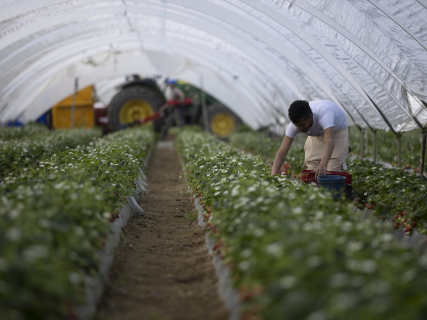

Moroccan women harvesting strawberries and red fruits in Huelva; Latin American men in Murcian greenhouses and Moroccan men in Almerian ones; Sub-Saharans who travel through Spain starting with the apricot and cherry harvest and continuing with the peach, nectarine, flat peach, pear, and apple campaigns, these last ones already overlapping with the grape harvest.
What hands work and harvest the fresh produce that is consumed at home?
According to the president of ASAJA Cataluña and head of Agricultural Campaigns in the same national organization, Pere Roque, “the most important labor hiring campaign in España is that of Huelva with strawberries and red fruits”, where 80,000 people are needed during between the months of November to May. Subsequently, for the harvesting of the summer fruit of the Valle del Ebro (Aragón y Cataluña) they concentrate the hiring of around 40,000 seasonal workers.
In this regard, Roque understands that “facing the fruit harvest, starting in June, it will indeed be possible to hire immigrants who have already applied for regularization” and therefore emphasizes that agricultural entrepreneurs will be able to breathe easier regarding finding available and legal labor.
From the agrarian organization COAG, the head of Labor Relations, Andrés Góngora, considers that the process of regularizing immigrants “is an opportunity to solve the labor problems that this sector sometimes has and that has even led to leaving campaigns unharvested. That is why we ask the Administration to speed up this process as much as possible, which will regularize thousands of people”.
Must-haves for the field
Góngora explains that in recent decades, immigrant flows in the countryside have been various and diverse. More than 25 years ago arrived Moroccans and Algerians; when Europe opened to Eastern countries, came Romanians, Poles, and Bulgarians; labor also arrived from other Latin American countries, with Argentinians, Peruvians, and Ecuadorians; and in the last decade the most common origin of immigrants is from sub-Saharan countries, such as Mali, Senegal or Mauritania, etc.
According to data from the Special Agrarian System of Social Security, more than 35% of registered wage earners are foreigners, which means that the powerful Spanish agricultural sector (the fourth largest in the European Union), could not be maintained without immigrant labor.
The document "Diagnosis of agricultural labor with a gender perspective" carried out by the Ministerio de Agricultura, Pesca y Alimentación last year, states that the agricultural sector is the productive area that employs a larger proportion of foreign people in Spain.
In said report it is stated that (without counting the fishing subsector) lthe population employed in the countryside that has dual nationality or foreign nationality accounts for 27.5% of the total, with 96% being salaried employees.
And what happens with the remaining 4%?
Immigrants who are farmers
Some of the immigrants who years ago began to work as wage earners on agricultural farms, are those who take charge of the farm when the owner retires and does not find generational replacement to substitute him.
This is how Andrés Góngora tells it, who knows examples, especially, in fruit and vegetable farms, where up to three types of incorporations can be found. On the one hand, that the immigrant worker decides to lease the agricultural farm from the retiring owner to continue working; on the other, the immigrant stops being an employee and becomes part of a partnership with the owner of the farm, so that one provides the land and inputs and the other the labor on the agricultural farm, “this is known as sharecropping”, Góngora adds. And in third place, there are children of immigrants (who, having been born in Spain, are Spanish), whose parents have worked as employees in the countryside, who know the sector and join by renting farms to work them.
The generational relay is a challenge that the countryside, both Spanish and European, has not managed to solve in recent decades. A challenge that in recent years has become even more complicated, since to the lack of labor in the countryside, we must now add the scarcity of workers for other sectors that may be more attractive, such as transport, hospitality or even healthcare and elder care. And it is in many of these labor areas where immigrant workers will be able to find a job.