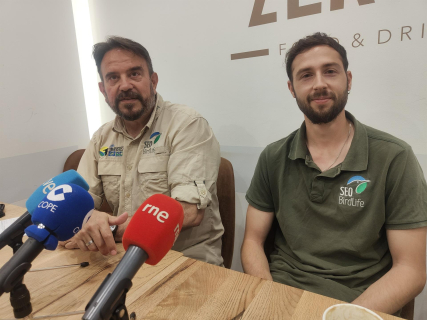

The delegate of SEO/BirdLife in Extremadura, Marcelino Cardalliaguet, has demanded that the Junta de Extremadura implement a global strategy, agreed upon with all involved agents, to anticipate large forest fires and prevent "a small fire from becoming a monster," something that, he pointed out, is being seen more frequently due to the effects of climate change, which generates much more aggressive and difficult-to-control fires.
In this regard, he criticized the existence of "political leaders in this autonomous community who are not willing to admit that there is climate change and that this has an essential importance in how problems like fires must be faced." At the same time, he insisted that the phenomenon of fires "is very complex" and, therefore, requires addressing it from multiple areas and with a comprehensive vision.
During a press conference held this Thursday in Cáceres, the representative of the conservationist organization in the region urged the regional Executive not to act on a whim or limit itself to launching "big messages after putting out a large fire, which after a year one would have to see what they have amounted to."
"It is necessary to articulate an Extremaduran strategy for the prevention of large fires in which all involved society participates, in which all parties are heard, especially science, and in which decisions are made that are supported by what is happening," he stressed, emphasizing that such planning must be stable and evidence-based.
Looking ahead to summer, Cardalliaguet expressed his concern because, in his opinion, the "promises" to reinforce fire-fighting devices in Extremadura have not been fully materialized. He warned that "when everything fails and a fire starts, the only thing that saves us from a fire remaining a small incident or becoming a monster is the immediate response. And for that, we also have to be prepared. We have to have good resources, they have to be very professional, they have to be well treated."
Regarding the theories linking the worsening of fires to the supposed prohibition of livestock farming in certain areas, which would allow vegetation to get out of control, the SEO/BirdLife delegate has pointed out that "that makes no sense". He recalled that "in other words, it is not prohibited to have livestock in practically anywhere in Extremadura and vegetation grows even with livestock because many burned areas were livestock areas, where livestock could not eat all the vegetation that grows".
Defense of Natura 2000 Network and European funds
In relation to the Natura 2000 Network, Cardalliaguet has urged the regional Executive to "stop cutting" the protected areas of the community, which currently cover 30.9% of the regional territory, and instead of reducing their surface area, to "make proposals for strategic projects to manage Natura 2000 and take advantage of the available European funds" destined for these enclaves.
Likewise, he has denied that the regulations of the Natura 2000 Network prevent construction in these areas, recalling that it is possible to build "any building that is considered of public interest". In this regard, he has criticized that "this is not what the Junta is saying, which says the opposite, that protected space must be removed to be able to do anything. And that is not a correct approach".
"We ask the Junta to admit that it has the capacity to give the green light to this type of construction in many municipalities, including housing," he stressed, emphasizing that "all municipalities that are entirely within Natura 2000 have the right to have urban development in accordance with it," something that, he maintained, is compatible with current regulations.
He also recalled that SEO/BirdLife has appealed the regional decree that cut 36 Special Protection Areas for Birds (SPABs) in rural and urban environments, insisting that this decree is "not necessary," since "all these towns and cities have the capacity to urbanize based on public interest" without needing to reduce protection.
Currently, Extremadura maintains 30.9% of its surface area integrated into the Natura 2000 Network, a percentage similar to that of Catalonia and lower than that of the Community of Madrid, which reaches 40% of protected territory. For this reason, Cardalliaguet has argued that the "problem" of the region's industrial development does not lie in the extent of the areas covered by this protection figure.
"If they tell us that the problem is Red Natura, they are deceiving us and Extremadura is not for anyone to deceive it, much less for us to deceive ourselves. The problems are elsewhere and this campaign against the protected areas of Extremadura makes no sense," emphasized the head of SEO/BirdLife in Extremadura.
Along these lines, he remarked that Natura 2000 Network also represents a way to access community funding. He pointed out that at the moment there are 166 million euros from the LIFE program that will be distributed in September and that prioritize projects linked to network spaces. "If Extremadura is a powerhouse in Red Natura, we are going to get a good few million of those," he urged.
Agricultural model and limits to the industrialization of the countryside
Accompanied by the technician in species and spaces of SEO, Diego Navarro, Cardalliaguet also addressed the agricultural model promoted in the community. He questioned the trend towards over-industrialization of the countryside and advocated for a production system compatible with nature conservation, which many Extremaduran farmers already apply and which, as he denounced, do not have sufficient support from the administration.
"We work so that the services provided by farmers and ranchers to agricultural ecosystems are valued, because agriculture and livestock farming create favorable conditions for many species," he explained, highlighting the effort of those who opt for more respectful practices and the use of healthy products.
He also warned that "industrializing the countryside must also have a limit. There are limits set by climate change. There is not enough water to irrigate all of Extremadura. Many people should already know this and a moment will come when the heritage will be endangered and the profitability and continuity of many agricultural areas will be endangered by insisting on basing them on an increasingly scarce resource, which will be water."
Cardalliaguet has lamented that, with certain agricultural transformations, traditional systems that generate high-quality food, such as transhumance, linked to the production of first-class wool and meat, are being abandoned and barely have institutional support. "We ask the Government that supporting nature and protected areas is also supporting the people who live in them and the agriculture that maintains them and the services that these farmers and ranchers provide," he pointed out.
He concluded by emphasizing that "it is time to take advantage of the opportunities that these natural resources we have give us and to take advantage of European funds destined to conserve these natural resources and leave this clear message: nature is not ideology, it is a resource and a heritage of Extremadura and we must take advantage of it and not let it dilute and get lost."