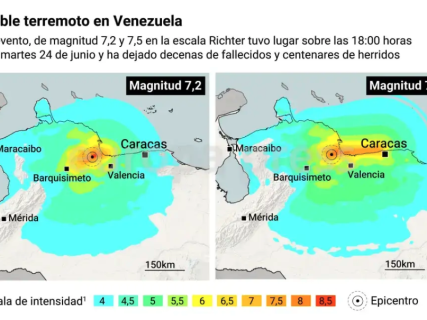

The infographic of the double earthquake in Venezuela allows a clear visualization of the dimension of the seismic emergency that hit the north of the country. Two high-magnitude earthquakes, one of 7.2 and another of 7.5, shook Venezuela with only seconds of difference and extended their effects towards Caracas and several regions of the center and north of the country.
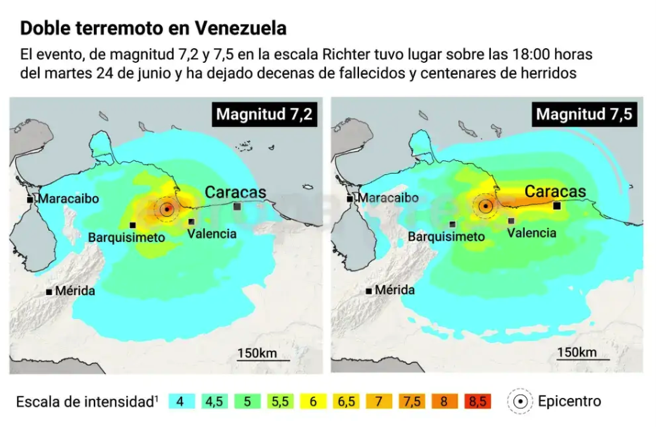
The maps show the epicenters of both tremors and the estimated intensity in different areas. The color scale allows observing how the second earthquake, of magnitude 7.5, projected a strip of greater intensity towards the Caracas area, which explains the damages recorded in the capital and in the nearby coast.
Where the epicenters were
The two maps place the epicenters in northern Venezuela, in the central axis of the country, between areas close to Carabobo, Yaracuy, and the coast near Caracas.
The first earthquake, of magnitude 7.2, appears concentrated around the epicenter zone, with a high intensity in the nearby area and a moderate expansion towards Caracas, Valencia, Barquisimeto, and other cities.
The second, of magnitude 7.5, shows a wider and more intense footprint towards the east, with a yellow and orange strip reaching the vicinity of Caracas. This visual difference helps to understand why the impact was especially severe in the capital and in La Guaira.
What the infographic teaches
The infographic compares the two earthquakes in two parallel maps.
In the first, corresponding to the 7.2 magnitude earthquake, the zone of maximum intensity is more concentrated around the epicenter. In the second, corresponding to the 7.5 magnitude earthquake, the area of high intensity extends more markedly towards Caracas.
The intensity scale ranges from values close to 4 to 8.5. Colder colors indicate lower perceived intensity, while yellow, orange, and reddish tones indicate areas where the movement was much stronger.
Caracas appears within the impact zone of the second earthquake, which aligns with the structural damages, evacuations, and collapses recorded in the capital.
Magnitude does not explain everything, but it does give an idea of the energy released.
A 7.5 earthquake is a very powerful event. Furthermore, when two earthquakes of more than 7 degrees occur with very little time difference, structures damaged by the first can become even more vulnerable to the second.
This makes the episode a particularly dangerous emergency. The first movement can open cracks, weaken buildings, or cause landslides; the second can further compromise already damaged structures.
That is why the authorities have asked not to return to buildings with visible damage and to remain alert to possible aftershocks.
Caracas and La Guaira, critical points
Caracas is one of the areas where the earthquake had the greatest urban impact. Images released by international agencies show collapsed buildings, damage to facades, and rescue teams working among the rubble.
La Guaira appears as one of the most worrying points. Delcy Rodríguez has described the situation as a "disaster zone" and has warned that the provisional casualty toll does not yet fully include that region.
This detail is key: the number of dead and injured may change as rescue efforts progress and information from the most damaged areas is consolidated.
Which areas appear on the map
The image shows several geographical references that help to understand the extent of the earthquake: Maracaibo, Barquisimeto, Valencia, Caracas, and Mérida.
The greatest impact is concentrated in the north and center of the country. The intensity band extends from the vicinity of the epicenter towards the Venezuelan capital and the coast.
In the second map, the one with a magnitude of 7.5, the estimated intensity appears more extended towards Caracas, reinforcing the idea that the second tremor was the most decisive for the damage in the capital.