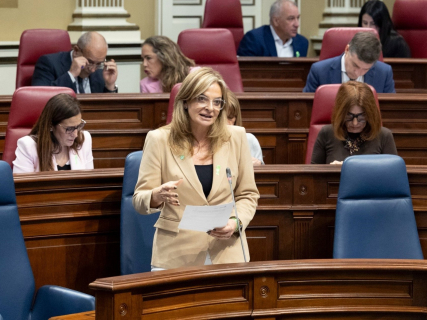


The Minister of Health of the Government of the Canary Islands, Esther Monzón, detailed this Tuesday in the Plenary Session of the regional Parliament that her department has launched the work to define the Canary Islands Oncology Strategy for the period 2026-2032. This plan aims to establish a roadmap that guarantees comprehensive care for cancer patients, covering prevention, diagnosis, treatment, follow-up, palliative care, and the improvement of the quality of life of people with cancer.
To achieve this, the Canary Islands Health Service (SCS) has initiated the design and implementation process of this strategy, which will be adapted to the demographic, epidemiological, social, and organizational characteristics of the archipelago.
"It is a project that seeks continuous improvement in care, and acts as a roadmap in all stages whose purpose is to improve the quality and life expectancy," she explained.
Among the goals of the Canary Islands Oncology Strategy are to move towards a multidisciplinary, coordinated, and integrated model of cancer care; to ensure people with cancer receive quality healthcare, based on care processes that guarantee continuity of care and promote outpatient treatment; to incorporate socioeconomic, gender, or island-related determinants into studies; to optimize preventive, diagnostic, therapeutic, and palliative processes; to reduce the disease burden associated with tumors, improving healthy life expectancy in terms of incidence, morbidity, mortality, and economic impact; to reinforce the active participation of professionals and patients in the entire process, and to promote cooperative and translational research in cancer.
According to her, to achieve these objectives, it is essential to have the involvement of SCS professionals in defining a model of integrated care for cancer patients, which allows for the coordination of the competencies of different profiles, efficient use of new technologies, and optimization of available resources.
"Therefore, in the development of said strategy, professionals from different care profiles (Medicine, Nursing, Hospital Pharmacy, and Clinical Psychology, among others) and patient associations will participate," assured the minister.
The project will include a detailed analysis of the oncological situation in the Canary Islands, taking the national context as a reference; the identification of strengths and areas for improvement of the SCS in cancer matters; the involvement of key agents of the health system and patient associations; the definition of strategic lines, specific objectives, indicators, goals, timeline and resources, as well as the design of a governance and strategy monitoring model.
42 million to reinforce cancer diagnosis
During her speech in the Plenary session, the head of Health also underlined the boost to two projects considered essential for advancing the diagnosis of oncological pathologies.
On the one hand, the construction of the so-called advanced therapies building at the Doctor Negrín University Hospital of Gran Canaria, which will house proton therapy and a cyclotron unit and has already been put out to tender for 31 million euros. On the other hand, the works on the cyclotron being carried out at the University Hospital of the Canary Islands, with a budget of over eleven million euros and whose completion is scheduled for 2027.
"This will finally make us independent of the Peninsula to be able to have our PET programming, which is a fundamental test for the diagnosis and monitoring of cancer in the Canary Islands," stated Esther Monzón.
Cancer remains one of the diseases with the greatest impact on public health and is one of the leading causes of mortality and morbidity worldwide.
In Spain, according to data from the National Statistics Institute (INE), it is one of the most frequent pathologies, ranking as the leading cause of death among men and the second among women.
In general terms, cancer can affect any age group and socioeconomic level, although due to its characteristics it is especially related to the aging of the population.
Even so, in the pediatric population, tumors of the central nervous system and spinal cord, leukemias, and lymphomas are the ones with the highest incidence.
It is estimated that cancer patient survival in Spain is similar to that of neighboring countries, standing at 53 percent at five years.
Each year more new cases of cancer are detected, according to a note from the Ministry, a trend to which screening programs for certain tumors and the incorporation of new technologies and imaging techniques, which allow for a more precise diagnosis, especially in internal organs, also contribute.