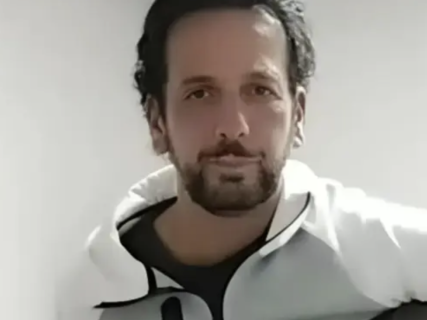

The world of flamenco is in mourning for the death of singer Matías de Paula, artistic name of Matías Corraliza Fernández, who has died at the age of 52 after being shot in Villanueva de la Serena, in Badajoz. The incident occurred this Friday, after three in the afternoon, in Rafael Alberti square in the Badajoz town.
Judicial Police officers from Don Benito-Villanueva de la Serena, Local Police officers, and health workers from the Extremadura Health Service, who could not save the artist's life, were dispatched to the scene. The National Police has taken charge of the investigation to clarify the circumstances of the death.
The death of Matías de Paula has caused shock in Villanueva de la Serena and in the Extremaduran flamenco scene, where he was a well-known figure for his artistic career, his family connection to singing and dancing, and his teaching work after returning to his hometown.
What is known about the death of Matías de Paula
The events took place in broad daylight, in the vicinity of Rafael Alberti square in Villanueva de la Serena. Initial reports point to a violent death by firearm, although the National Police has clarified that it was not a shootout in the sense of an exchange of gunfire.
The singer's body was transferred to the Institute of Legal Medicine of Badajoz for an autopsy, while investigators gathered evidence and testimonies to determine what happened and who is behind the shooting.
As of late Friday afternoon, no arrests had been made in connection with the case, according to information published by El País. Other media outlets suggested that the alleged perpetrator might have been identified, but the investigation remained open and there was no official confirmation of the case being closed.
Who was Matías de Paula
Matías de Paula was one of the recognized names in flamenco in Extremadura. Born in Villanueva de la Serena, he developed a large part of his career outside his region, especially in Madrid, where he performed for more than two decades in flamenco tablaos.
His career also took him to international stages, with performances in countries such as the United States and Japan. Furthermore, he was part of the National Ballet of Spain's circle and shared the stage with prominent flamenco and Spanish music artists, including Pitingo, José Mercé, Antonio Canales, and Carmen Linares, according to information published about his career.
His real name was Matías Corraliza Fernández, although artistically he was known as Matías de Paula. He came from a family very linked to flamenco: his brother is the guitarist Diego de Paula and his sister, the dancer Sandra Fernández.
The return to Villanueva de la Serena and the Diego El Chucarro peña
After years of career in Madrid, Matías de Paula returned to Villanueva de la Serena, where he promoted the creation of the flamenco peña Diego El Chucarro, in homage to his father. There he also taught classes and worked to bring cante jondo closer to new generations.
That return to his homeland had an artistic dimension, but also a sentimental one. De Paula not only sang: he transmitted craft, memory, and a way of understanding flamenco from the family and popular roots.
The peña had become one of the spaces associated with his figure in Villanueva de la Serena. His death now leaves a particularly hard void in a community that recognized him not only as an artist, but as a promoter of local flamenco culture.
Shock in Extremaduran flamenco
The news has had a strong impact on the flamenco scene in Badajoz and the region. Matías de Paula was a singer with a consolidated career, but also a close presence for many neighbors and students.
His death unites two very different planes: the blow of a violent event and the loss of a voice linked to the recent history of Extremaduran flamenco. A life dedicated to singing that ends abruptly in the same place to which he had returned to teach, create community, and keep family memory alive.
The police investigation will now have to clarify the circumstances of what happened. Meanwhile, flamenco bids farewell to an artist who passed through tablaos, international stages, and local root projects, but who never stopped being united to Villanueva de la Serena.