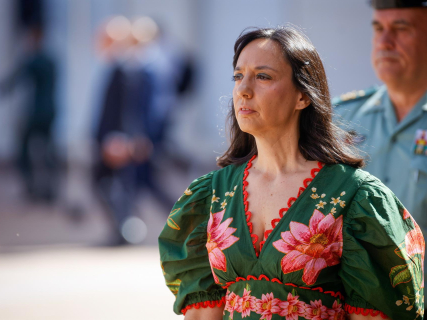
Mercedes González raises to four the number of Civil Guard directors charged in democracy: who they were and how each case ended

The decision of Judge Santiago Pedraz to indict the Director General of the Guardia Civil for the Leire case places Mercedes González as the fourth member of a short list of directors or former directors of the armed institute formally investigated by the Justice system.

4 minutes

fotonoticia 20260701193414 1920

fotonoticia 20260701193414 1920

Add DEMÓCRATA to Google

Ask FREN

Published

Last updated

4 minutes

Most read

The imputation of Mercedes González in the so-called Leire case has opened a new judicial chapter in the leadership of the Civil Guard. With the decision of the National High Court judge Santiago Pedraz to summon her as investigated for alleged crimes of prevarication and obstruction of justice, the current director general becomes part of an exceptional group in the history of the armed institute. Since the arrival of democracy, the Civil Guard has had more than a dozen directors general.

Counting only those who have been formally charged or investigated by judicial resolution, there are four directors or former directors general of the Civil Guard who have gone through that situation since the beginning of democracy.

Luis Roldán, the great precedent

The first case remains the best known. Luis Roldán, director general between 1986 and 1993, ended up starring in one of the biggest corruption scandals in recent Spanish history. The investigation uncovered illicit enrichment linked to the collection of commissions for barracks construction, misappropriation of public funds, and tax offenses.

After going on the run in 1994 and being arrested in Bangkok the following year, he was definitively sentenced to 31 years in prison for bribery, forgery of commercial documents, embezzlement of public funds, fraud, and offense against public finance. His sentence became final after review by the Supreme Court, and he obtained definitive release in 2010.

Félix Azón, investigated for the Pegasus case

The second precedent arrived more than two decades later. In February 2026, Investigating Court number 2 of Barcelona agreed to investigate former director general Félix Vicente Azón within the case opened for the alleged espionage using the Pegasus and Candiru programs.

However, his procedural situation changed shortly thereafter. The judge annulled the investigation in that court upon verifying that Azón was a magistrate of the Supreme Court and, therefore, privileged. The decision responded to a question of judicial competence, not to the merits of the case, so the exit from the procedure did not imply a declaration of innocence or an acquittal.

María Gámez remains linked to the investigation

The same investigation also reached María Gámez, director general of the Civil Guard between 2020 and 2023.

Her indictment made two former heads of the armed institute investigated within the same case related to the alleged use of Pegasus and Candiru for the first time.

Unlike Azón, the investigation regarding Gámez continued, with no final judgment or definitive dismissal of proceedings to date.

Mercedes González, fourth director indicted

The decision known this Thursday adds Mercedes González to that list. Judge Santiago Pedraz has agreed to her indictment along with the deputy operational director (DAO), Manuel Llamas, within the investigation of the Leire case. Both will have to testify as investigated parties for alleged crimes of prevarication and obstruction of justice.

The investigation seeks to clarify whether administrative actions could have been promoted from the Civil Guard's leadership related to the alleged maneuvers attributed to Leire Díez to discredit the Central Operational Unit (UCO) or interfere in investigations of special political relevance.

Mercedes González has denied any participation in a plot of these characteristics from the beginning and maintains that her meetings with Leire Díez were of an institutional or private nature, without resulting in any irregular action. The case is in the investigation phase, so the director general maintains her presumption of innocence intact.

Fernández de Mesa and Mesquida, different cases

In this group of indicted directors general, Arsenio Fernández de Mesa, investigated for the management of the Prestige when he was the Government delegate in Galicia, years before directing the armed institute, and Joan Mesquida, investigated in the context of the Cursach case when he had already left the general directorate, are separate cases since they were not investigated for matters related to their time as the highest authorities of the Civil Guard.


Chronology of Civil Guard directors indicted or investigated during democracy

1994-1998 | Luis Roldán

Former Director General of the Civil Guard between 1986 and 1993. He was investigated after his illicit enrichment was uncovered, he fled Spain and ended up sentenced to 31 years in prison for bribery, forgery, embezzlement, fraud, and a crime against public finance.

February 2026 | Félix Vicente Azón

Former Director General between 2018 and 2020. He was cited as investigated in the Pegasus/Candiru case. He was later removed from the case in the Barcelona court upon confirmation of his status as a Supreme Court magistrate and, therefore, his privilege. His removal was due to a matter of jurisdiction, not an acquittal on the merits.

February 2026 | María Gámez

Director General of the Civil Guard between 2020 and 2023. She was also cited as investigated in the Pegasus/Candiru case, related to the alleged espionage of individuals linked to the independence movement. No sentence or definitive dismissal is recorded.

July 2026 | Mercedes González

Current Director General of the Civil Guard. Judge Santiago Pedraz has agreed to her indictment in the Leire case, along with DAO Manuel Llamas, for alleged crimes of prevarication and obstruction of justice. The case is in the investigation phase, and the presumption of innocence applies.

More key points, information and questions with FREN

AI-GENERATED CONTENT

What is the parliamentary process for the appointment and dismissal of the Director General of the Guardia Civil in Spain?

The Director General of the Guardia Civil is neither appointed nor dismissed through a strictly parliamentary procedure, but rather by a Government decision, formalized by a Royal Decree signed by the King and agreed upon in the Council of Ministers. The Congress and the Senate do not vote on or ratify the appointment or dismissal, but they do exercise intense political control over the Government and, through it, over the actions of the Director General himself. The position is subject to the general regulations for senior officials (incompatibilities, transparency, responsibility), and the Executive has broad discretionary power both to choose the officeholder and to remove them. Therefore, Parliament acts in the control phase, not in the decision-making phase.

1. Nature of the position and basic legal framework

The Directorate General of the Guardia Civil is a senior position within the General State Administration, integrated into the Ministry of the Interior (usually under the Secretariat of State for Security). Its regulation stems from the Constitution (competences of the King and the Government), the Government Law, Law 40/2015 on the Legal Regime of the Public Sector, the Organic Law of State Security Forces and Corps, and the regulations on senior officials (incompatibilities, transparency, code of conduct).

It is not a constitutional body nor a position subject to parliamentary election, but a position of political trust within the Executive structure.

2. Appointment process: who proposes and who decides

2.1. Internal phase within the Government

The political initiative comes from the Minister of the Interior, who, in agreement with the President of the Government, identifies the person to be appointed (usually a Guardia Civil officer or a highly trusted person with security experience). Internally, compliance with formal requirements and senior official regulations (incompatibilities, administrative status, etc.) is verified, and a reasoned proposal is prepared.

This proposal is submitted to the Council of Ministers, which is the body that adopts the appointment agreement. There is no mandatory procedure before the Cortes Generales at this stage.

2.2. Formal decision and effectiveness of the appointment

The Council of Ministers' agreement is formalized in a Royal Decree of appointment, signed by the King and countersigned by the President of the Government (and, if applicable, by the Minister of the Interior). Publication in the Official State Gazette makes the appointment fully effective.

From that moment, the Director General is subject to the political direction of the Government and exercises the administrative and operational leadership of the Corps within the legal framework and the instructions of the Ministry of the Interior.

3. Dismissal process: discretionary decision of the Executive

Dismissal can occur by discretionary decision of the Government (the usual cause, linked to political trust), by resignation of the Director General, or for legal reasons (incompatibilities, criminal conviction, retirement, etc.). Again, the initiative corresponds to the Minister of the Interior, who proposes the dismissal to the President of the Government.

The Council of Ministers approves the dismissal agreement, which is formalized by another Royal Decree, signed by the King and politically countersigned by the President of the Government. The Royal Decree is published in the Official State Gazette and, in parallel or shortly thereafter, the appointment of the replacement usually proceeds. It is not necessary to legally justify the dismissal beyond the Government's decision.

4. Role of Parliament: control without power to appoint or dismiss

4.1. Absence of decision-making intervention

Neither the Congress of Deputies nor the Senate have formal competence to appoint, ratify, or dismiss the Director General of the Guardia Civil. There is no investiture procedure, no ratification vote, nor requirement of specific parliamentary majorities to designate or remove them. All decision-making power resides in the Executive.

4.2. Parliamentary control instruments

Although it does not decide, Parliament politically controls the Government and the actions of the Guardia Civil using general parliamentary control mechanisms:

  • Appearances: the Director General may be called to the Interior Commission of the Congress or Senate to explain actions, work lines, or specific situations. These appearances allow direct scrutiny but do not generate a binding vote on their continuation in office.
  • Oral and written questions: deputies and senators pose questions to the Government about the management of the Guardia Civil or decisions of its Director General. The Executive (usually the Minister of the Interior) responds, not the senior official as such.
  • Interpellations and motions: the Chambers may debate security policy and, after an interpellation, approve motions urging the Government to change course, dismiss officials, or maintain them. These motions have political force but do not automatically produce dismissal.
  • Investigation commissions and information requests: in cases of special relevance, commissions may be created before which the Director General is summoned to appear, and the Government may be required to provide documentation about the Guardia Civil. The conclusions have political value, not decision-making power over the position.
  • Extreme mechanisms (motion of censure, vote of confidence): these are directed at the Government as a whole. A change of Executive is usually accompanied by a general replacement of senior officials, including the Director General of the Guardia Civil.

5. Government's discretionary margin and limits

The Government has a very broad margin to appoint and dismiss the Director General, without public competition or competitive procedure: it is a position of trust. However, this margin must respect the Constitution and the law (it cannot be based on discriminatory or unlawful reasons) and is subject to continuous political control by the Cortes Generales. The combination of executive discretion and parliamentary control configures the balance between Government and Parliament in this area.

What powers and functions does the Director General of the Guardia Civil have according to Spanish legislation?

The Director General of the Guardia Civil is the highest authority of the Corps within the Ministry of the Interior and exercises functions of strategic direction, senior command, and personnel management, always under the guidelines of the Ministers of the Interior and Defense. His status is mainly configured through the regulations on the organization of the Ministry of the Interior and the personnel regime of the Guardia Civil. In practice, he concentrates the key powers over personnel policy and training, the organization of services, and the coordination of the bodies that make up the Directorate General. The following details the functions and powers derived from current legislation.

Basic regulatory framework

The core of the legal regime of the Director General of the Guardia Civil is found in:

1) Law 29/2014, of November 28, on the Personnel Regime of the Guardia Civil, which extensively regulates the personnel and training policy of the Corps and assigns specific functions to the Director General in this area (Law 29/2014).

2) The organizational regulations of the Ministry of the Interior (currently the Royal Decree on basic organic structure and its amendments) which, as stated in the preamble of Order PRE/422/2013, defines the Directorate General of the Guardia Civil, with the rank of Undersecretariat, as the Ministry body responsible for the organization, direction, coordination, and execution of the Corps' missions, according to the guidelines of the Ministers of the Interior and Defense.

3) Order PRE/422/2013, of March 15, which develops the organic structure of the central services of the Directorate General of the Guardia Civil, specifying which units depend directly on the Director General and the role of the Deputy Operational Directorate (Order PRE/422/2013).

General functions of direction and command

According to the organic definition cited in Order PRE/422/2013, at the head of the Directorate General, the Director General assumes:

Organization, direction, and coordination of the missions assigned to the Guardia Civil by current provisions, acting according to the guidelines and orders of the Ministers of the Interior and Defense, within their respective competences.

Execution of those missions through the organization of central and peripheral services (Zones, Commands, Companies, and Posts) and the use of the human and material resources of the Corps.

Law 29/2014 places general officers – the category to which the Director General belongs – as those who exercise “command action in the organic structure of the Guardia Civil and the senior management and administration of human, material, and financial resources” (Law 29/2014), which legally reinforces his status as the highest directing authority of the Institution.

Powers in personnel policy and training

Law 29/2014 details the specific functions of the Director General regarding personnel and training. The consulted excerpt establishes that, concerning the personnel and training policy of the Corps, he is responsible for (Law 29/2014):

Advising and informing the Ministers of Defense and Interior, through the Undersecretary of Defense and the Secretary of State for Security, about the execution of personnel and training policy.

Advising the Secretary of State for Security and the Undersecretary of Defense in the preparation, proposal, and development of that policy, according to the ministers' guidelines.

Planning and directing instruction and training, and developing functions related to teaching and professional promotion.

Defining professional profiles that the Guardia Civil's study plans must address.

Ensuring the morale, motivation, discipline, and welfare of the Corps' personnel.

Approving calls for selective admission processes to the Guardia Civil's training centers, for incorporation into the different scales, with a favorable report from the Directorate General of the Public Function.

Ordering the discharge of those attending courses at Guardia Civil training centers (except for the specific case of article 48.1.e of the law).

Deciding, proposing, or informing, as appropriate, on the basic aspects that shape the professional career of the Corps' personnel.

Other specific formal powers

The same Law 29/2014 includes other specific attributions of the Director General, among which are (Law 29/2014):

– The granting of promotions to all ranks of the Guardia Civil except general officers (which correspond to the Council of Ministers) and those where promotion is by election and must be resolved by the Minister of Defense.

– The power to propose to the Minister of Defense the determination of the insignia of the different ranks of the Corps.

– The initiative for granting honorary ranks to retired Guardia Civil members, submitting the proposal to the Minister of Defense with a report from the Superior Council, and processing granting files to those deceased in the line of duty or retired due to incapacity under those circumstances.

– Approval of the general internal regulations of the Guardia Civil's teaching centers.

– Joint proposal to the Ministers of Defense and Interior of the general system of personal evaluation reports of personnel, as well as their procedures, periodicity, and hierarchical levels.

Units directly dependent on the Director General

Order PRE/422/2013 completes the functional picture by indicating which bodies depend directly on the Director General and are configured as instruments of his directing powers:

Technical Cabinet, with the level of General Subdirectorate, as a body of assistance and support in his directing functions, including internal coordination, economic planning, and formulation of personnel, material, and infrastructure policy proposals.

Legal Advisory, consultative and advisory body on legal matters for the Director General and central bodies and units.

Office Secretariat, a body of personal and immediate assistance, responsible for agenda, travel, personal security, and central registry.

Additionally, the same Order defines the Deputy Operational Directorate as the “main collaborating body of the Director General in the exercise of his functions” and establishes that its head must substitute the Director General “interim or accidentally, as well as in exercising the sanctioning power granted by current legislation on the disciplinary regime of the Guardia Civil Corps.”

What legal requirements exist for a public official to enjoy "aforamiento" (special jurisdiction) in the Spanish judicial system?

In Spain, for a public official to enjoy "aforamiento" (special jurisdiction), essentially three elements are required: that there is a specific office to which the Constitution or an organic law expressly attributes that privilege; that the norm of sufficient rank identifies the competent court (usually the Supreme Court or the regional High Court of Justice); and that the material scope of the special jurisdiction is delimited, almost always criminal. "Aforamiento" is an exceptional rule of objective jurisdiction, not a privilege of impunity, and is interpreted restrictively. Furthermore, its validity is linked to the effective exercise of the office, so generally it ceases when the holder leaves the position, without prejudice to how ongoing cases continue.

1. Minimum normative framework for the existence of "aforamiento"

1.1. Rank of the norm: Constitution or organic law

The first requirement is normative hierarchy. The creation or recognition of "aforamiento" can only be made:

  • Directly by the Spanish Constitution (e.g., art. 71.3 CE for deputies and senators).
  • By an organic law that develops the Constitution, mainly the Organic Law of the Judiciary (LOPJ) and other organic laws of constitutional bodies.
  • By Statutes of Autonomy, which also have the rank of organic law, regarding regional officials.

An ordinary law or regulation cannot create "aforamientos" affecting judicial organization or the basic statute of senior officials; doing so would violate the organic law reservation (arts. 81 and 122 CE).

1.2. Express normative provision

A generic reference to the "status" of the office is not enough; there must be a specific mention that:

  • Declares that office or category of offices as enjoying "aforamiento."
  • Indicates before which jurisdictional body they are tried.
  • Determines, at least implicitly, whether the privilege is only criminal or extends to other jurisdictions.

Otherwise, the general rule of the ordinary judge predetermined by law (art. 24 CE) applies, and the existence of "aforamiento" cannot be presumed.

2. Subjective and functional requirements

2.1. Link to a specific office

"Aforamiento" is always functional, not personal. It is tied to the performance of certain offices, among others:

  • Deputies and senators (Cortes Generales).
  • Members of the National Government.
  • Magistrates of the Supreme Court and Constitutional Court, members of the CGPJ, Ombudsman, and other high bodies.
  • At the regional level, regional deputies and members of regional governments, when established by the Statute and the LOPJ.

As a general rule, the subjective requirement is met while the office is effectively held. Upon leaving, the "aforamiento" ceases and new cases must be processed before ordinary courts; regarding already initiated cases, the continuation of the privilege depends on what the regulations provide and judicial interpretation.

2.2. Institutional purpose and exceptional character

Another substantive requirement, demanded by constitutional jurisprudence, is that "aforamiento" responds to an objective purpose linked to the protection of the institution (parliament, government, judiciary, etc.) and not to a personal privilege. It must be justified by reasons such as avoiding local pressures or guaranteeing the independence of high authorities. Hence, it is configured as an exceptional institution, interpreted restrictively.

3. Objective requirements: competent body and material scope

3.1. Determination of the judicial body

Legally, there is no "aforamiento" without a clear rule of jurisdiction assigning the case to a specific court. The regulation must specify:

  • The court (e.g., Supreme Court or High Court of Justice of an autonomous community).
  • The chamber competent (usually, the Criminal Chamber of the Supreme Court or the Civil and Criminal Chamber of the High Court of Justice).

For most state officials with "aforamiento," criminal jurisdiction lies with the Second Chamber (Criminal) of the Supreme Court; for many regional officials, with the Civil and Criminal Chamber of the corresponding High Court of Justice.

3.2. Material scope of the privilege

The most relevant material requirement is that the norm delimit, expressly or implicitly, the types of proceedings covered by the "aforamiento":

  • Criminal: this is the core of the system. Almost all "aforamientos" operate for "criminal cases" against the official, covering investigation and trial.
  • Civil: very exceptional; the general rule is that officials respond in civil matters before ordinary judges, without special jurisdiction.
  • Other jurisdictions (administrative contentious and social): what exist are rules of jurisdiction by the nature of the act or the body issuing it (for example, that a High Court of Justice or the National Court has jurisdiction), rather than true personal "aforamientos."

4. Distinction from inviolability and immunity

Finally, it is a conceptual requirement to differentiate "aforamiento" from other prerogatives that may coexist with it:

  • Inviolability (e.g., of deputies and senators for their opinions and votes) means exemption from liability for those acts, not a change of judge.
  • Immunity (need for authorization from the Chamber to detain or prosecute them, except in flagrante delicto) conditions the initiation of proceedings but does not define the competent body.

"Aforamiento," on the other hand, is exclusively that the case is processed before a superior and predetermined jurisdictional body, always under the protection of the Constitution and an enabling organic law.

Play

Test your knowledge with FREN!

How much do you know about this topic? Answer the following 3 questions.

How many directors general of the Civil Guard have been formally charged or investigated since the arrival of democracy?

Question 1 of 3

What was the main reason Luis Roldán, former director of the Civil Guard, was convicted?

Question 2 of 3

In which procedural phase is the case against Mercedes González currently?

Question 3 of 3

Hola, soy Fren. ¿Cómo te ayudo?