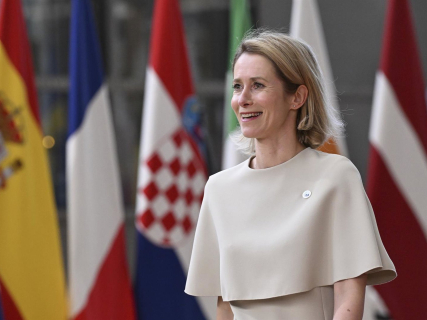

The European Union's High Representative for Foreign Affairs, Kaja Kallas, has expressed her support for the future High Representative for Bosnia and Herzegovina to come from the European Union, in a context where the handover of the current official remains unconfirmed after the resignation of the previous envoy, Christian Schmidt.
During her visit to the Balkan country, Kallas admitted that she was confident the process would be concluded before her arrival in Sarajevo, which ultimately did not happen. However, she recalled the agreement by which the current High Representative resigns and his deputy assumes the role on an interim basis until July 14, while talks continue to choose his successor.
"We hope and are working to find a European Union candidate for the next High Representative, because as we see, the European path is something that unites everyone. And if we want to see the end of this international supervision, the best way is to limit this mandate and focus it on the issues that really concern European accession," she stated at a press conference.
The head of community diplomacy also stressed that "the success" of the High Representative's office "will be measured the day it is no longer needed," emphasizing that, until that moment arrives, this structure continues to be "an important pillar" for the stability of Bosnia and Herzegovina.
Bosnia and Herzegovina faces the challenge of not being left behind
In her meetings in Sarajevo, including with the President of the Council of Ministers, Borjana Kristo, Kallas conveyed that Bosnia and Herzegovina "cannot afford to be left behind" on its path to the EU, in a scenario where other enlargement processes are advancing both in the Balkans and on the eastern flank of the bloc.
She insisted that the country's horizon "is in the European Union" and highlighted that citizen support for accession exceeds 70%, which, in her opinion, makes this objective "an aspiration that truly unites" society, above internal political divisions.
In this context, he has warned that Bosnia and Herzegovina has already let 108 million euros in European aid go by due to the absence of progress and is exposed to losing another 370 million if it does not implement the reform agenda or complete its growth plan. For this reason, he has urged political leaders to "assume their responsibility" and provide tangible progress on the path to EU accession.
The Office of the High Representative, created after the 1995 Dayton Accords, acts in practice as the country's main political authority, with the mandate to oversee the implementation of peace in Bosnia and the ability to impose legislation or dismiss public officials.
The High Representative is appointed by the Peace Implementation Council (PIC), made up of 55 states and international organizations. So far, all incumbents have come from EU countries, while their main deputies have been Americans.
Since Christian Schmidt submitted his resignation as High Representative, the PIC has not managed to reach a consensus on his successor. Among the best-placed names are the Italian Antonio Zanardi Landi, supported by the United States and Italy, and the French René Troccaz, backed by other European partners.