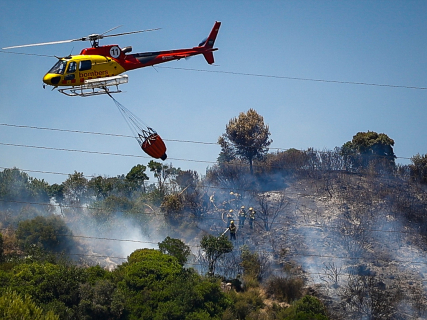
Fire in La Bisbal d'Empordà: 45,000 people confined, roads cut and the tramontana complicating extinction

The forest fire declared this Thursday in La Bisbal d'Empordà has forced about 45,000 people to be confined in several municipalities of Baix Empordà, while the Bombers de la Generalitat are working with a large device to prevent the flames from advancing further. The strong tramontana wind is hindering firefighting efforts and favoring the spread of the fire.

2 minutes

EuropaPress 7624914 helicopteros incendio forestal 26 junio 2026 tiana barcelona catalunya

EuropaPress 7624914 helicopteros incendio forestal 26 junio 2026 tiana barcelona catalunya

Add DEMÓCRATA to Google

Ask FREN

Published

Last updated

2 minutes

Most read

Catalonia is once again facing a significant wildfire in the middle of high-risk fire season. The flames, declared in the vicinity of La Bisbal d'Empordà, have caused the preventive confinement of thousands of residents, road closures, and a large deployment of emergency services, who are focusing their efforts on containing a fire conditioned by one of its worst enemies: the tramontana.

The evolution of the fire keeps Civil Protection and the Generalitat Firefighters on alert, who have mobilized dozens of ground and air units to slow the advance of the flames and protect inhabited areas.

Thousands of people confined and affected roads

Authorities have ordered the confinement of around 45,000 people in various municipalities in Baix Empordà as a preventive measure against smoke and the advance of the fire.

In addition, several roads remain closed or with restrictions to facilitate the work of emergency teams and ensure the safety of residents.

Civil Protection insists that the population remain attentive exclusively to official information and follow the instructions of the emergency services at all times.

Why is the tramontana making this fire so dangerous?

One of the factors that most concerns those responsible for extinguishing the fire is the presence of tramontana, a wind characteristic of northern Catalonia that can reach very intense gusts. When it blows strongly, this wind causes abrupt changes in the direction of the fire, favors the appearance of secondary outbreaks by carrying embers hundreds of meters away, and hinders the work of aerial resources.

In wildfires like the one in La Bisbal, the tramontana can cause an apparently stabilized front to reactivate in a matter of minutes, forcing constant modification of the extinction teams' strategy.

For this reason, firefighters are working not only to extinguish the visible flames but also to prevent new ignitions from appearing outside the main perimeter.

What to do if Civil Protection orders a confinement

The fire brings to the table recurring and frequent questions during the summer in the face of these types of episodes: What should the population do when they receive a confinement order?

Civil Protection's recommendations are clear:

  • Remain inside homes or buildings.
  • Close doors, windows, and any ventilation system that could introduce smoke.
  • Avoid unnecessary travel and do not approach the fire to take photographs or videos.
  • Do not use the vehicle unless authorities order an evacuation.
  • Follow only the information disseminated through official channels of Civil Protection and emergency services.

The objective of the confinement is to protect the population from smoke, facilitate the work of the extinguishing teams, and prevent people from being trapped in risk areas.

Extreme fire risk

The La Bisbal fire occurs in a context of high temperatures, very dry vegetation, and wind episodes that significantly increase the risk of large forest fires. Experts recall that, under these conditions, any spark can spread rapidly and force the adoption of extraordinary measures such as preventive confinements or evacuations.

Authorities insist on exercising extreme caution throughout the summer and avoiding any activity that could cause a fire in the natural environment.


More key points, information and questions with FREN

AI-GENERATED CONTENT

What legal procedures and administrative steps are followed in Catalonia to declare an emergency situation due to a forest fire?

In Catalonia, the formal declaration of an emergency situation due to a forest fire is not regulated in the Rules of the Parliament of Catalonia, but rather in the sectoral civil protection regulations and special plans (such as specific forest fire plans). In the parliamentary documentation consulted, specifically the Rules of the Parliament of Catalonia, there are no references to emergencies, civil protection, forest fires, nor to the INFOCAT or PROCICAT plans. Therefore, it is not possible to reconstruct, based solely on these sources, a detailed and normative scheme of "who declares what," "what levels of emergency exist," or "what specific legal effects" each phase produces. It can be affirmed that the general framework is situated within the autonomous civil protection legislation, but its specific articles are not included in the available document.

1. Scope of the Rules of the Parliament

The text analyzed is the Rules of the Parliament of Catalonia, accessible in this official document. This regulation:

Regulates the internal organization and functioning of the Parliament (constitution, Board, committees, plenary, Permanent Deputation, etc.), as well as ordinary legislative procedures, Government oversight, processing of decree-laws, delegated legislation, and the powers of committees. The text itself contains numerous generic references to “laws” and the “Statute of Autonomy of Catalonia,” but does not delve into specific material sectors such as civil protection, emergencies, or forest fires.

A systematic search within the Rules found no occurrences of terms such as “emergency,” “emergencies,” “civil protection,” “fire(s),” “forest,” “PROCICAT,” or “INFOCAT.” It also does not include references to “bombers” (firefighters) nor to “emergències” in Catalan. This indicates that the specific procedures for declaring emergencies are regulated outside this text, in other laws and decrees of the Generalitat.

2. Where the forest fire emergency is actually regulated

Based on the general structure of the Catalan legal system, and considering what the Rules of the Parliament mention, the following can be deduced without entering into details not present in the sources:

In sectoral matters (such as civil protection), the Parliament approves autonomous laws that set the general framework (competences of the Generalitat, regime of civil protection plans, coordination with local entities, etc.). These laws are processed according to the procedures regulated in the Rules (legislative initiative, consideration, debate and approval, possible legislative delegations, control of Government decree-laws, etc.), but the Rules do not reproduce the sectoral content of those laws.

The special civil protection plans (for example, those related to forest fires) are normally approved by the Government of the Generalitat through regulatory provisions (Government agreements, decrees, etc.), in execution of the framework laws. The Rules of the Parliament do not detail that level of regulation nor the internal administrative procedure of the Government to approve or activate emergency plans.

3. General competences and absence of sectoral detail

The Rules do allude, in a generic way, to:

The Parliament’s capacity to exercise political control over the Government, including the validation or repeal of decree-laws and control of delegated legislation. Thus, if in a forest fire emergency the Government issued a decree-law to enable extraordinary measures, its parliamentary control would follow the procedure established by the Rules for decree-laws, but the text does not specify its material content. It also mentions that, after the dissolution of the Parliament, the Permanent Deputation may assume control functions over decree-laws and matters of extraordinary urgency, which would serve as an institutional channel if serious emergencies coincided with periods between legislatures.

Regarding coordination with municipalities, Firefighters, ADF, or Civil Protection, the parliamentary Rules contain no provision. These aspects are situated in the sectoral civil protection regulations and special plans, which define:

Alert and emergency levels, operational management bodies, chains of command, activation mechanisms for municipal and supra-municipal plans, and procedures for requesting state support through channels enabled by basic state legislation and the autonomous regulations themselves.

However, no further information is available in the consulted sources that would allow detailing, with legal rigor, the specific steps to declare a forest fire emergency in Catalonia, nor the different INFOCAT/PROCICAT levels, nor which authority approves each phase.

4. Limits of the available information

Based solely on the Rules of the Parliament of Catalonia, it is possible to contextualize the Parliament’s role in creating the general legal framework and in the eventual control of urgent norms issued by the Government in exceptional situations. However, the specific administrative and operational procedures to declare and manage a forest fire emergency in Catalonia depend on other autonomous norms (civil protection laws, Government decrees, territorial and special plans) that are not part of the analyzed document and, therefore, cannot be described here without introducing information not supported by the sources.

What are the specific competences of Civil Protection and the Firefighters of the Generalitat in managing emergencies caused by forest fires?

There is no specific information available in the consulted sources about the concrete competences of the Civil Protection of the Generalitat of Catalonia and the Firefighters of the Generalitat in managing emergencies caused by forest fires, so it is not possible to rigorously detail their division of functions in planning, prevention, coordination, operational command, or emergency phases. The information retrieved refers only to general concepts of the Spanish legislative procedure, such as the difference between decree-law and bill or the meaning of the committee with full legislative competence, which do not allow answering your question of material content. To maintain accuracy and avoid introducing unverified data, I cannot reconstruct or summarize the specific competential framework in this area. Below I explain in more detail this limitation and the types of issues I can address with guarantees.

Limitation of the available information

In this case, the accessible sources only provide general definitions about:

– What it means for a law to be processed in a committee with full legislative competence, that is, a parliamentary committee that can approve a law definitively without going through the Plenary, except for later referral.
– What a decree-law is and how it differs from a bill, highlighting that the former is a Government instrument used in cases of extraordinary and urgent necessity, with parliamentary control within 30 days, while the latter follows the ordinary procedure in the General Courts.

None of this information refers to the Catalan emergency system, the organization of the Civil Protection of the Generalitat, nor the specific regime of the Firefighters of the Generalitat in forest fires. Nor are there references to Catalan autonomous civil protection, emergency, or forest fire regulations that would allow even indirectly deriving a division of functions.

Why I cannot "fill in" with general knowledge

The framework in which I operate here requires strict adherence to what appears in the consulted sources. This implies:

– I cannot infer or reconstruct Catalan regulations from prior knowledge external to these sources.
– I cannot cite specific autonomous or state laws nor describe their content if they do not explicitly appear in the available material.
– I cannot describe the operational structure of the Firefighters of the Generalitat, their chain of command, or their relationship with the Civil Protection of the Generalitat if that information has not been provided by the sources.

If I tried to detail, for example, which administration assumes command in each phase of the fire, how special civil protection plans are activated, or what specific role different territorial levels have, I would necessarily be incorporating data outside the sources and thus violating the requirement not to add undocumented information.

Areas of questions I can address

Within this configuration, I can more reliably address:

– Questions about legislative procedures and their political fit in Spain: for example, in which cases a decree-law is used, how its validation is processed, what it means to process a text in a committee with full legislative competence, or what the political and procedural differences with a bill are.
– Analysis of parliamentary and government dynamics linked to norms on security, emergencies, or civil protection, provided the specific norms appear in the consulted sources.
– Questions about political and normative activity related to forest fires (for example, legal reforms, parliamentary debates, use of decree-laws in disaster matters), as long as I have access to texts or news detailing them.

Conversely, when it comes to precisely describing the organizational and technical division of competences among specific autonomous bodies (such as Civil Protection of the Generalitat and Firefighters of the Generalitat), I need that information to be expressly stated in the sources; in this case, it is not.

How to reformulate your query to obtain more detail

If you are interested in the more political and normative angle of the issue, you could orient it, for example, towards:

– The processing of recent state or Catalan laws on forest fires, civil protection, or emergency management.
– The use of decree-laws or other legislative figures to address large fires or disasters.
– Parliamentary debates in the Congress, Senate, or Parliament of Catalonia about the forest fire management model or coordination between administrations.

In any of these cases, if the sources provide the pertinent information, I could offer you a structured analysis of the regulations and the associated political context.

What regulations govern the protocols for confinement and evacuation in case of forest fires in Spain?

In Spain, there is no single regulation that exhaustively details "when to evacuate or when to confine" the population due to forest fires, but rather a tiered framework: a basic state law, basic civil protection regulations, state plans, and especially autonomous and local plans (PLATECAM, PLATECA, etc.) where the protocols are specified. At the state level, the cornerstone is the Law 17/2015, of July 9, on the National Civil Protection System, developed by the Basic Civil Protection Regulation (Royal Decree 524/2023) and the State Civil Protection Plan for Forest Fire Emergencies (Agreement of October 24, 2014). This scheme is complemented by forestry regulations (Forests Law and its reforms) and the Basic Self-Protection Regulation, which require emergency measures to be foreseen in facilities and territory. The terms "confinement" and "evacuation" as operational orders are mainly developed in the homologated autonomous and municipal plans, which rely on these state bases.

1. Law 17/2015 of the National Civil Protection System

The Law 17/2015 establishes civil protection as a public service and creates the National Civil Protection System. It does not explicitly mention "confinement" or "evacuation" in the consulted excerpts, but it establishes:

– The obligation to develop civil protection plans (territorial and special) against specific risks, including forest fires.
– The distribution of competences among the State, autonomous communities, and local entities, and the possibility of declaring emergencies of national interest (article 29, whose constitutionality is confirmed in Constitutional Court Ruling 58/2017, published in the BOE here).
– The framework to declare "areas severely affected by civil protection emergencies," which activates extraordinary measures (labor, social protection, etc.), developed in orders such as Order TES/443/2022.

In practice, this law is the legal umbrella under which the Basic Civil Protection Regulation, the State General Emergency Plan, and specific fire plans are approved, where the devices that then order evacuations or confinements are organized.

2. Basic Civil Protection Regulation and Forest Fire Directive

The current Basic Civil Protection Regulation, approved by Royal Decree 524/2023, replaces the 1992 version and repeals, among others, much of Royal Decree 893/2013, which approved the previous Basic Directive for Civil Protection Planning of Forest Fire Emergencies (RD 893/2013). However, the regulation itself indicates that this Directive will continue to apply temporarily "until the new planning instrument that replaces it is approved."

RD 893/2013 establishes the minimum requirements that forest fire emergency plans must meet "regarding foundations, structure, organization, and operational and response criteria." It defines the planning structure (state plan, autonomous plans, local action plans, and self-protection plans) and requires that plans consider population protection. Although the word "evacuation" does not literally appear in the consulted excerpts, the Directive regulates the organizational model and emergency levels on which autonomous communities build their evacuation procedures, population warnings, shelter, etc.

3. State civil protection plans

The main sectoral instrument is the State Civil Protection Plan for Forest Fire Emergencies, approved by the Council of Ministers Agreement of October 24, 2014, and published by the Resolution of October 31, 2014. The plan:

– Establishes the organization and procedures for the operation of State resources and services to ensure an effective response when "national interest" is involved.
– Sets mechanisms for supporting autonomous plans when they require it or lack sufficient capacity.
– Is expressly inserted in the structure of the Basic Forest Fire Directive.

More generally, there is also the State General Civil Protection Emergency Plan (PLEGEM), approved by the Agreement of December 15, 2020, and published by the Resolution of December 16, 2020. This framework plan defines coordination, communication, and emergency management criteria that also apply in large forest fires, including support to competent authorities when ordering evacuations or confinements.

4. Forestry regulations and land use measures

Fire risk and some preventive measures are regulated in the Law 43/2003, of November 21, on Forests (Law 43/2003), amended by Law 21/2015, of July 20 (Law 21/2015). Within this framework operates Royal Decree-Law 15/2022, of August 1, on urgent measures regarding forest fires (RDL 15/2022).

RDL 15/2022 emphasizes that fires must be addressed with prevention, surveillance, and extinction plans of autonomous scope that cover "the entire territory of each autonomous community" and are applied "continuously throughout the year." Among the minimum content of these plans, it notably cites, relevant to people’s mobility, the “prohibitions or limitations on vehicle circulation and access of persons not involved in fire surveillance, extinction, and management”. These powers are coordinated with civil protection decisions (for example, restricting access, ordering preventive evacuations, or recommending staying in safe areas).

5. Self-protection and autonomous and local plans

At the scale of centers and establishments, the Basic Self-Protection Regulation, approved by Royal Decree 393/2007 and amended by Royal Decree 1468/2008, requires many activities (including some located in urban-forest interface areas) to have internal emergency plans. These plans must foresee the organization of means and actions against fires, including evacuation routes, meeting points, and coordination with public emergency services.

However, the specific protocols for confinement and evacuation of the population in a given forest fire are mainly detailed in the autonomous and municipal civil protection plans (special forest fire plans and territorial plans such as PLATECAM, PLATECA, etc.), approved by the National Civil Protection Commission. They set operational criteria (when to evacuate a neighborhood, when to recommend confinement in homes, how to organize transport and shelter), always within the basic framework described by Law 17/2015, the Basic Civil Protection Regulation, and the State Fire Plan.

Play

Test your knowledge with FREN!

How much do you know about this topic? Answer the following 3 questions.

What weather factor is complicating the extinction of the fire in La Bisbal d'Empordà?

Question 1 of 3

What does Civil Protection recommend during a fire lockdown?

Question 2 of 3

What is one of the main risks of the tramontana during a forest fire?

Question 3 of 3

Hola, soy Fren. ¿Cómo te ayudo?