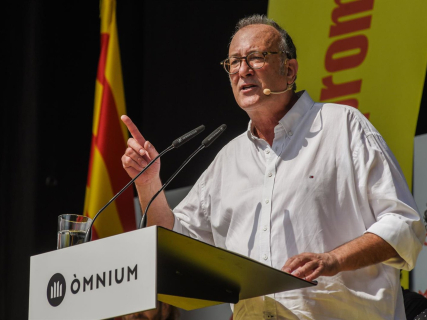

In the session held this Saturday, Xavier Antich has been re-elected as president of Òmnium Cultural. The assembly has also appointed Mariona Lladonosa, Àngel Castiñeira, and Elena Subirà as vice-presidents, and Teresa Navarro as treasurer.
In his inauguration speech, Antich pointed out that a "diabolical" electoral cycle is beginning, which will require the entity to be prepared to "play its cards better to advance the national aspirations" of Catalonia.
The president highlighted the need to maintain Òmnium's activity in the face of the possible impact of the rise of the far-right and assured that he faces the future with "winning ambition" in defense of democracy and the right to self-determination of stateless nations.
National Construction and Strategic Objectives
Antich stated that the entity has a "compass," knows where it wants to go, and "what needs to be done to get there." He proposed national construction as the central axis, understood as comprehensive work that includes language, education, culture, social cohesion, organized youth, the Catalan Countries, international action, and civil society participation.
The president recalled that Òmnium was a pioneer in defending the language in schools, training thousands of Catalan teachers during the 60s and 70s, and highlighted the entity's historical trajectory during the dictatorship.
Antich stressed that Òmnium is synonymous with construction and hope, and that therefore it must be "immune to discouragement" and "the repository of enormous responsibility." According to the president, the entity maintains its position as the main civil society organization, without moving into opposition.
History and Funding of the Entity
Òmnium Cultural was founded in 1961 and does not receive subsidies or bank loans. During Antich's presidency, which began in February 2022 after replacing Jordi Cuixart, the organization has strengthened its promotion of the Catalan language and culture and has sought to coordinate the various sovereignist actors.
The entity has also called on institutions, parties, civil society, businesses, unions, and cultural, educational, sports, and leisure sectors to commit to the Catalan language. Likewise, it has recalled that the national construction of Catalonia requires integrating new Catalans, in the face of the rise of the independentist far-right.