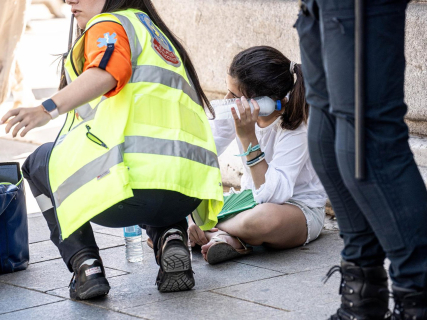


Spain kicks off the astronomical summer this Sunday with the first heatwave of the year. The episode arrives with warnings for extremely high temperatures, health risks, and a high danger of forest fires in a large part of the Peninsula and the Balearic Islands.
The most critical point of the day is in the Basque Country, where a red alert has been activated for high temperatures. There are also orange alerts in large areas of the country, with highs that may exceed 40 degrees in the interior of the Basque Country and in the Ebro, Tajo, Guadiana, and Guadalquivir valleys.
The heatwave will not just be a Sunday affair. Civil Protection maintains the alert from today and at least until Wednesday, June 24, although the heat may remain very intense in some areas for a good part of the week.
Where it is hottest this Sunday
The highest temperatures are expected in the interior of the Basque Country, the Ebro valley, the northeastern depressions, and the Tajo, Guadiana, and Guadalquivir valleys.
In these areas, temperatures can reach or exceed 40 degrees, with locally higher values in inland spots.
Very high temperatures are also expected in the central peninsula, the Northern Plateau, the interior of Galicia, Asturias, and Cantabria, the Balearic Islands, and a large part of the south.
In large inland areas, temperatures will exceed 36 or 38 degrees, a particularly significant figure as it is the first Sunday of astronomical summer.
Red alert and communities on orange alert
The heat episode results in alerts in a large part of the country this Sunday.
The most serious alert affects the Basque Country, where the heat reaches red level due to extreme temperatures.
In addition, there are orange alerts for heat in Andalusia, Aragon, Balearic Islands, Cantabria, Castilla-La Mancha, Catalonia, Extremadura, Madrid, Navarre, and La Rioja.
Asturias, Castilla y León, and Galicia remain on yellow alert for high temperatures.
The recommendation is to check the local forecast before traveling, especially if you plan to engage in outdoor activities, road trips, sports, or work exposed to the sun.
Madrid, Andalusia, Aragon, and the Ebro valley, at the center of the episode
Madrid faces a day of very intense heat, with an orange alert and highs close to 39 degrees in the metropolitan area.
Andalusia is once again among the most exposed communities, especially in the Guadalquivir valley, where thermometers may approach or exceed 40 degrees.
Aragon and Catalonia are also under the impact of the heat due to the rise in the Ebro valley and the northeastern depressions. Zaragoza and Lleida appear among the areas where the episode may be harshest during Monday.
In Extremadura and Castilla-La Mancha, the heat will be persistent and very high, with maximums that may also reach risk values during the central hours of the day.
Tropical and torrid nights: the heat will also continue in the early morning
One of the most dangerous elements of this heatwave is not only in the daytime highs, but in the nighttime temperatures.
Tropical nights are expected, with minimums above 20 degrees, in large areas of the central and southern peninsula, the Ebro valley, the Balearic Islands, and the Mediterranean coasts.
In some places, there may be torrid nights, with minimums above 25 degrees.
This increases the health risk because it prevents the body from recovering during the night, especially in the elderly, children, chronically ill, pregnant women, and people who live alone or in poorly ventilated homes.
Storms, wind, and suspended dust
Although heat will be the protagonist, the day will not be completely stable throughout the country.
During the afternoon, developing clouds may form in areas of the central peninsula and the northwest. In Galicia and the northwest of Castilla y León, locally strong showers or thunderstorms could occur.
Dry thunderstorms or those with little precipitation may also form in mountainous areas. This type of thunderstorm can be accompanied by strong gusts of wind and increase the risk of fires.
In addition, suspended dust is forecast in areas of the eastern peninsula and the Balearic Islands, while in Galicia and the Cantabrian Sea, morning mists and fog banks may appear.
When will the peak of the heatwave be
The heat will continue in the coming days and the episode could reach its harshest point between Monday and Tuesday.
On Monday, temperatures are expected to continue to rise slightly, especially in the interior of the eastern third of the peninsula and the Balearic Islands. In the valleys of the Ebro, Tajo, Guadiana, and Guadalquivir, 39 or 40 degrees may be reached again, and even local values close to 42 degrees.
Tuesday could be the most extreme day in some areas. Civil Protection warns of values of 40 to 42 degrees in the Tajo, Guadiana, and Guadalquivir valleys, without ruling out isolated maximums of 44 degrees.
Starting Wednesday, a slight decrease may begin, although the heat will remain very high in many areas.
When temperatures will drop
The most likely scenario is that relief will arrive more clearly starting Thursday or Friday, although there is still uncertainty.
The drop will not be the same throughout Spain. The decrease could be noticed earlier in the west and north of the peninsula, while the eastern third, the Ebro valley, the Mediterranean area, and the Balearic Islands may maintain very high temperatures for longer.
Even when the heatwave technically ends, values will remain high for the season in many areas.
Risk of forest fires
Civil Protection insists that high temperatures significantly increase the risk of forest fires.
The combination of intense heat, dry vegetation, wind, and dry thunderstorms can favor both the appearance and rapid spread of fire.
The recommendation is to avoid any risky behavior: do not throw cigarette butts, do not leave trash or glass in the countryside, do not light fires, respect regional restrictions, and call 112 immediately if smoke or a fire outbreak is observed.
What to do in extreme heat
The basic recommendations are to limit sun exposure, stay in cool or ventilated places, drink water frequently, and avoid physical exertion during the central hours of the day.
It is also advisable to wear light-colored, light clothing, cover your head, eat lightly, and pay attention to vulnerable people.
In case of dizziness, confusion, very hot skin, intense headache, nausea, extreme weakness, or loss of consciousness, you must call 112. Heatstroke can be serious and requires rapid attention.