
The Parliament of Galicia held this Thursday the first meeting of the non-permanent study commission on the eventual restoration of the lyrics of the Anthem of Galicia. At this session, the president of the Real Academia Galega, Henrique Monteagudo, and the UDC professor and specialist in the work of Eduardo Pondal, Manuel Ferreiro, appeared, who stressed that this issue "from a scientific point of view, does not give more of itself."
During his speech, Ferreiro highlighted the existence of a "scientific consensus" around the recovery "of the true text" of the anthem. From now on, he indicated, it is up to the groups with representation in the Chamber to complete the work initiated in parliament.
The matter reached the Pazo do Hórreo in 2023 through a popular legislative initiative (ILP), promoted by a commission that gathered 16,000 signatures for its processing. Manuel Ferreiro himself was in charge of defending it before the plenary.
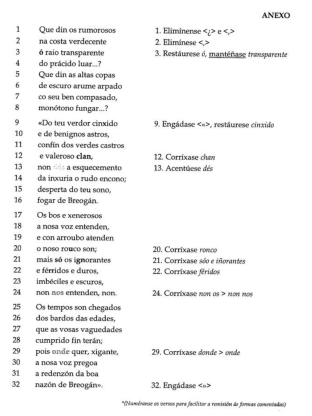
As the UDC professor recalled, the proposal suggests correcting the current lyrics to restore the version of Eduardo Pondal's poem, following what the author left in writing in a 1913 letter, in which he pointed out errors detected in the first reproduction of the text in Havana.
After detailing some of the passages that are intended to be amended, Ferreiro expressed his aspiration that the Parliament "take the lead in giving prestige and popularizing" the anthem in "its faithful composition."
The opinion of the Real Academia Galega
On the other hand, the president of the Real Academia Galega, Henrique Monteagudo, defended the opinion prepared by the institution, which he described as "significant."
He explained that, once the official text of the anthem was compared with Pondal's "authorial text," the RAG verified that "no major changes are needed to get closer" to the original and that "most of the changes would align the anthem with normative Galician." "By doing the philological exercise, we see that Pondal was more correct than the version that was changing from his text," he noted.
Monteagudo added that, although he does not believe that "the text needs to be standardized," he understands that "not many arguments are seen for not doing so." In his opinion, it would not be a strict standardization, but rather that, "by approaching today's Galician, it helps to make a more correct text, more in line with Pondal's will and more familiar to the people who sing it."
In relation to the possible modification of words present in the current version, such as 'nazón' or 'redenzón', he recalled that it is a "historical" text and, therefore, "it does not have to be exactly normative of today".
Position of the parliamentary groups
After hearing the speakers, the groups set their positions. On behalf of the PSdeG, Silvia Longueira stated that "there will be no problem" for the socialists to support the initiative, although she argued that the work calendar should "last longer", considering that "there are few opportunities" to thoroughly address issues related to the Galician language.
For the BNG, Mercedes Queixas expressed "satisfaction" that "all paths lead to the conviction, scientifically supported, of restoring the lyrics of the anthem", with the aim that "the author's will be respected".
The nationalist deputy justified her group's support in "historical justification, the repair of truth, and scientific rigor". In her opinion, this new scenario places the Chamber before "a proposal for the country". At the same time, she censured the PP for its "lack of commitment in substance and form" to the commission's purpose, criticizing that the appearance of a member of the commission promoting the ILP was not allowed and lamenting the prolongation of the process.
Call for consensus and next steps
In representation of the PP, deputy José Luis Ferro defended that the anthem constitutes "a symbol deeply cherished by society", for which he considered that "the best service that can be done to Galician culture is to listen to the experts".
Along these lines, he appealed for any decision to be made "from consensus, respect, and institutional responsibility". He also stressed the importance of distinguishing when a "historical" revision responds to "a widely shared need by society" and when it is "a debate more focused on specialized and academic fields".
After the interventions of Manuel Ferreiro and Henrique Monteagudo, the commission will continue this Friday with the appearances of the president of the Consello da Cultura Galega and a representative of the Instituto de Estudos Galegos Padre Sarmiento.
The next phase of the work plan, once the reports from the different entities and the presentations have been received, will be the start of drafting the opinion proposal in committee. During this stage, if it is necessary to prepare the text, and at the initiative of any parliamentary group, the committee may decide to request new reports, additional documentation, or clarifications related to the object of the study.
Finally, the fourth and last phase of the plan establishes that the committee will conclude with the debate and approval of the opinion proposal within the Chamber itself.