Peru is going through this Wednesday general elections, still without definitive results, where the fragmentation of the vote and the slow progress of its count are prolonging the political uncertainty throughout the country. With more than 90% of the vote count completed, Keiko Fujimori, daughter of former president Alberto Fujimori, has consolidated herself as the most voted candidate, with around 17% of the support, very far, however, from the absolute majority necessary to avoid a second round.
The great unknown has been for days who will accompany her in that second round. With the results still in the air, the leftist Roberto Sánchez has managed to impose himself by a narrow margin over the conservative Rafael López Aliaga thanks to the rural vote, which arrives later in the official count.
Some elections traversed by the fragentation
The first defining feature of these elections has been their extreme fragmentation. Up to 35 candidates have run in the elections, a reflection of a deeply weakened political system. None has managed to exceed 20% of the votes, a scenario that forces a second round scheduled for June.
Fujimori will certainly attend that appointment, heiress to her father's thinking, with a program focused on security. For her followers, she represents a commitment to institutional order and economic stability. For her detractors, she embodies the continuity of a political model associated with fujimorism and its historical controversies.
And if the results advance in this sense, facing him would be Roberto Sánchez, former minister, leftist and close to former president Pedro Castillo. The candidate of the coalition Juntos por el Perú has gained ground as the official count advances, consolidating himself as the main reference of the left in this phase of the electoral process and questioning the initial advantage of other conservative aspirants.
Among his proposals, the greater representation of the so-called “deep Peru” stands out, with special emphasis on rural and Andean areas, which he considers historically marginalized by the centralist political system. On Wednesday's session, the presidential candidate has urged that the election results be accepted without question.
Logistical chaos, unopened tables and extended vote
And it is that the observation mission of the European Union in Peru has concluded that last Sunday's elections were transparent, ruling out the existence of fraud have suggested some candidates.
In the presentation of the preliminary report, the head of the mission, the MEP Annalisa Corrado, has assured that there are no “objective elements” that support the complaints of irregularities in the electoral process. Although she has recognized “serious problems” in the distribution of the material, she has stressed that these do not affect the integrity of the result.
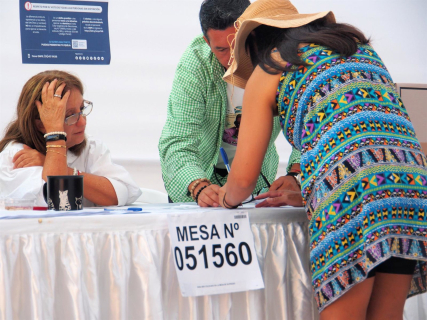
The National Office of Electoral Processes (ONPE), through its head Piero Corvetto, recognized during the election day this Sunday, April 12, that 211 polling stations were not installed, which directly affected 63,300 voters who could not go to vote normally until this Monday, reason why the scrutiny is being extended.
The ghost of fraud
In this context, the ultraconservative candidate of Renovación Popular, Rafael López Aliaga, who is close to third place after being overtaken by Roberto Sánchez, has denounced an alleged electoral fraud, going as far as to call for mobilizations and to demand the annulment of the elections.
Thus, he has led in recent hours a rally in front of the headquarters of the Jurado Nacional de Elecciones (JNE) in Lima. From there he has given the authorities a period of 24 hours to invalidate the elections and call a new appointment with the polls, in the context of his complaints of alleged electoral fraud.
Between Sánchez and López Aliaga barely 26,000 votes separate them, a margin that will decide who qualifies for the second round on June 7, in which she will face the candidate of Fuerza Popular, who is running for the Presidency for the fourth time.
In her last attempt, in 2021, Fujimori lost by a narrow result against Pedro Castillo. This Monday, after the closing of the polling stations, Sánchez went to visit him at Barbadillo prison, where the former president is serving an eleven-year sentence for the attempted self-coup of 2022.
ONPE, for its part, places Sánchez with 12.05% and López Aliaga with 11.8%.
The role of the rural vote and the turnaround of the count
One of the determining factors in these elections has been the growing weight of the so-called “deep Peru”, which has reconfigured the electoral map as the scrutiny advanced. The consolidation of Roberto Sánchez in the first positions is explained, to a large extent, by the temporal lag of the count in rural areas, where the vote is usually processed more slowly, but also by his roots in popular sectors and peripheral regions of the country, traditionally less visible in large urban centers.
That progressive advance has been altering the initial balance of the contest, which in the first hours of the scrutiny was dominated by candidacies with greater strength in cities like Lima. As the vote from the interior was incorporated, the panorama has been shifting towards a much more fragmented and volatile photograph, where the differences narrow and the leaderships are reordered.
The final result points to a politically very tense scenario, in which coexist a competitive but deeply divided right, a left that regains momentum from the interior regions, and an electorate that again shows a persistent territorial and social fracture.
In this context, the eventual second round transcends the simple election of a president. What is at stake is the definition of the country's institutional direction at a time of high distrust and accumulated political wear and tear.
Beyond the proper names, the central question is whether Peru will manage to close the electoral process with a sufficient perception of legitimacy or if, on the contrary, the tensions, delays and cross accusations will end up deepening a crisis that has already been dragging on for years and that threatens to become structural.
Historical figures who are left out of the new Congress
In addition to the presidential election, Peruvians have decided the composition of the new Congress, which recovers bicameralism, as well as five seats in the Andean Parliament. With the count still underway, provisional data indicate that several traditional figures and parties will be left without a seat.
Various parties have not reached the minimum threshold of 5% of the votes and, therefore, will lose all parliamentary representation. Among them are historical ones such as Alianza para el Progreso, Podemos Perú or Somos Perú, which together totaled up to 39 deputies in the outgoing legislature.
Acción Popular, which had ten congressmen, will also be left out of the next legislative period, as will Perú Libre, which has not managed to overcome the required barrier to maintain presence in the new Chamber.