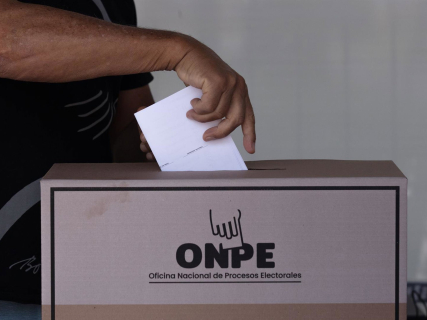
The presidential elections in Peru are approaching their final stretch. With 90% of the votes counted, the preliminary count of last Sunday's elections has registered a relevant change in the fight for second position, consolidating conservative candidate Keiko Fujimori, daughter of former president Alberto Fujimori, as leader of the process and placing leftist Roberto Sánchez in second place.
According to data from the National Office of Electoral Processes (ONPE), Fujimori currently leads the vote with about 17% of the votes, followed by Sánchez, who has managed to consolidate her advance in the final hours of the count.
The former mayor of Lima, the far-rightist Rafael López Aliaga, has fallen to third place in a very tight outcome, separated by just a few tenths of a point from second place in one of the most fragmented contests of recent years.
Rise of Sánchez in the rural vote and reconfiguration of the electoral map
Sánchez's advance has occurred in parallel with the incorporation of votes from rural areas and the interior of the country, where his candidacy has achieved greater support against his urban rivals.
This pattern has once again evidenced the strong territorial division of the Peruvian electorate between the large cities and the so-called "deep Peru", a key factor in the result of these elections.
Allegations of fraud and call for institutional calm
The final stretch of the vote count has been accompanied by a tense political climate. López Aliaga has questioned the electoral process and has hinted at irregularities without providing conclusive evidence, while political sectors have warned of the risk of polarization.
In contrast, an observation mission of the European Union has ruled out indications of fraud, emphasizing that the process has been transparent despite logistical incidents during election day. For its part, other voices within the political spectrum have demanded respect for the results and have asked to avoid unfounded accusations that could increase social tension.
Apart from irregularities in the process, the European mission points out some incidents in several districts, where electoral material arrived late, which prevented the opening of 13 polling stations and temporarily left tens of thousands of citizens without voting. This situation forced the extension of election day until Monday in some parts of the country.
According to the European mission, these setbacks "compromised elections, otherwise well-organized", clearly differentiating between logistical errors and a possible manipulation of the vote.
A country in search of political stability
The result occurs in a context of strong institutional instability, with multiple government changes in the last decade and a sustained increase in citizen insecurity, which has become the main concern of voters.
With the vote count still not officially closed, Peru is heading towards a second round that will again confront two deeply polarized political projects in a scenario of high uncertainty.