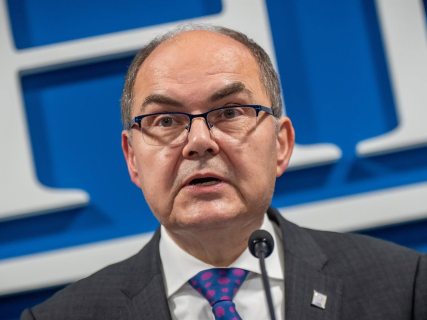

The delegations of the United States and the European Union have concluded two days of meetings of the Peace Implementation Council (PIC) without an agreement, unable to reach a consensus on a new High Representative for Bosnia and Herzegovina following the resignation of the international envoy to date, Christian Schmidt.
The German conservative leader, responsible for overseeing compliance with the Dayton Accords that ended the Bosnian War, confirmed in a video released by his office that negotiations will continue "in the coming days with a view to a transition" in the post "by the end of June."
Meanwhile, the US Embassy in Sarajevo explained on social media that its mission "strove to achieve consensus around a common vision and the Italian candidate, the experienced diplomat and ambassador Antonio Zanardi Landi, who possessed the necessary qualifications."
In the same message, it stressed that "the United States notes the European failure to reach a consensus around a European candidate and regrets that these divisions have prevented the PIC from fulfilling its mandate to elect a new High Representative."
Thus, it warned that, "given the European indecision and the PIC's renunciation of its own duty to Bosnia and Herzegovina," the Trump Administration "will reconsider its role" in the current international presence mechanism in this Balkan country.
The talks within the Council stalled after two main candidates for the position emerged: Zanardi Landi, supported by Washington and Rome, and the French diplomat René Troccaz, backed by other European partners, which highlighted the rift among PIC members.
Schmidt had already revealed at the end of May that one of the reasons for his resignation was the "enormous and unexpected pressures" from the United States, in a context of constant clashes with the authorities of Republika Srpska, the Serb entity of the country.
The origin of these tensions lies in the decision of the National Assembly of Republika Srpska to annul the resolutions of the Constitutional Court of Bosnia, denouncing that it was composed of foreign judges and, therefore, lacked legitimacy to convene or issue rulings without the participation of Serb magistrates.
The president of this entity, Milorad Dodik, announced that he had filed a criminal complaint against the international representative in Bosnia, Schmidt, for having annulled the resolution of the Republika Srpska Chamber by interpreting it practically as a secessionist gesture, within the framework of the powers granted to him by the peace agreements signed in 1995 in Dayton, United States.
Dodik —already sentenced to six months of disqualification for disobeying Schmidt's decisions— refused to recognize his authority, alleging that he had not been confirmed by the United Nations Security Council.