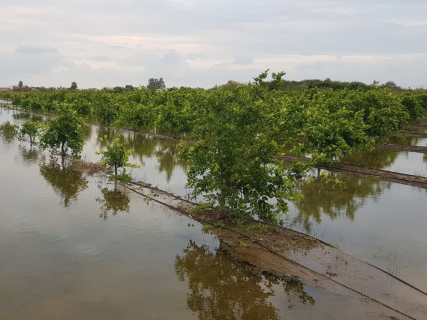

The Valencian Association of Farmers (Ava-Asaja) has "exploded" this Thursday on the occasion of the conference "Metropolitan Parks: Territorial Regeneration, Landscape and Flood Mitigation", held in València and co-organized by the commissioner for Recovery after the DANA, Raúl Mérida. The agricultural organization denounces that this department of the Generalitat "has invited all the groups involved in the reconstruction of the flood to debate about the floodable parks, except for the owners of the fields affected by this measure who are the ones who are going to pay the price".
During the meeting, Mérida announced that the Generalitat is finalizing an international competition with a jury of 12 "top-level" members to select the proposal that will mark the design of the future metropolitan floodable parks. This evaluation body will choose, through a two-phase process, five finalist projects, from which the winning alternative will emerge.
The agricultural entity presided over by Cristóbal Aguado demands from all administrations, "starting with the Generalitat", that "instead of ignoring farmers, they sit down, listen and reach an agreement with the agricultural sector on the actions that should be implemented in the territory to prevent damage and save lives in future floods". In their opinion, the design of these infrastructures cannot be done with their backs to the countryside.
Aguado also reproaches that the conference leaves out farmers "despite being protagonists directly harmed by this decision". He warns that "before addressing parks that, in the event of a strong flood, would worsen the flooding of hundreds of agricultural holdings, the Administration should exhaust all possible hydraulic infrastructures that maximize the storage, retention, distribution, and rapid discharge to the sea of the waters. As long as all the infrastructures that can be built are not built, we will be against this alternative that no one has consulted us about and that would cause us more losses in our lands".
In a statement, the president of Ava-Asaja emphasizes that "in most of the affected fields there are woody crops, which are not changed from one year to another, so in case of a serious flood that suffocates the tree roots, it would probably cost between eight and ten years to recover the productive potential." Therefore, the organization questions that, when proposing floodable parks on agricultural land, "the affected areas and appropriate compensation are not agreed upon with the agricultural collective."
Aguado also recalls the precedent of the Law for the Protection of the Huerta of Valencia and asks: "Does the Generalitat Valenciana want to do the same as the Botànic did in the Huerta, first prioritizing supposed landscape policies over the rights of agricultural owners and then we will see if they compensate for the damages caused? Time has shown that this way of protecting the orchard has only managed to leave the farmer unprotected, increase the abandonment of fields, and worsen environmental degradation. The territory cannot be cared for without caring for the people who preserve it."
In conclusion, Ava-Asaja blames the Generalitat Valenciana for promoting the study of these floodable parks "without negotiating" with the agricultural sector, "without first exhausting the construction and modernization of all pending hydraulic infrastructures" and "without defining compensation for farmers for their exposure to floods aimed at preserving urban areas."