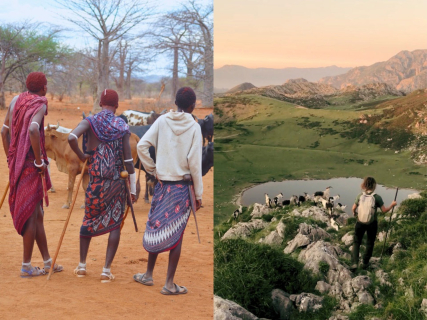

A recent meeting held in northern Spain has highlighted that, despite great geographical and cultural distances, shepherds from different continents share a very similar way of relating to the land, livestock, and their way of life.
During a visit to the mountains of Asturias and Cantabria, partners of the Horizon Europe CoCo project, in which the Aragon Institute for Research and Technology in Food and Agriculture (CITA) participates as the Spanish partner, gained firsthand knowledge of the area's pastoral traditions and the problems associated with the presence of wolves.
The experience, however, went beyond expectations: the research team detected striking parallels with pastoral communities in East Africa, especially in their way of life, the knowledge passed down from generation to generation, and their relationship with the natural environment.
As the group visited livestock farms, from the valleys of Onís to cheese dairies located in mountain passes, a common idea was consolidated: pastoralism functions as a cultural link between very distant regions, articulated around a shared perception of nature's cycles and livestock management.
One of the most symbolic episodes of this connection occurred during a visit to local farmers, when the group noticed a traditional wooden staff leaning against a stone wall.
The object was immediately recognizable to the researcher from CITA's Animal Science department, Ana Grau Valenciano, who commented: "It's the same type of staff used by shepherds in Tanzania." This coincidence demonstrates how simple tools, developed independently, address similar herding needs in very different environments.
Grau Valenciano, who has over ten years of experience working with shepherd communities in Tanzania in contexts of coexistence with lions, emphasizes that the similarities go beyond the purely material. "Shepherds in Spain and East Africa share a way of looking at the world. It's a deep relationship with animals, landscapes, and movement. Although the contexts differ, the herding identity and the conception of the environment are very familiar," she points out.
ALSO SIGNIFICANT DIFFERENCES
Alongside these similarities, important contrasts also emerge. In Tanzania, the presence of large predators such as lions poses a direct physical risk to both livestock and people, whereas in Spain the impact of the wolf falls mainly on the livestock herd. Even so, in both territories the social and emotional effects associated with this coexistence show evident parallels.
The visit to the Enrique Remis Cheese Factory, where Sara and Rubén carry out their work in the pastures near the Covadonga lakes, allowed for a deeper understanding of these connections. During the tour, the exchange of experiences about coexistence with predators generated a strong sense of mutual recognition.
"Hearing about lions, I realized that many feelings and challenges are similar," Sara expressed. "Even though the fauna is different, the concerns, the adaptation, and the bond with the land are very similar."
The meeting made it clear that, beyond whether they are wolves or lions, mountains or savannas, the great challenges of pastoralism—such as protecting livestock, the continuity of extensive models, and the defense of traditions—transcend physical borders.
This experience has reinforced the philosophy of the CoCo project, aimed not only at improving coexistence between livestock and wildlife but also at recognizing the value of traditional knowledge, pastoral culture, and shared heritage among pastoral communities from different parts of the world.
As the participants summarized, sometimes a simple wooden stick is enough to remember that seemingly distant territories share the same language.
The CoCo project, supported by the Horizon Europe program, brings together 17 entities from 12 countries with the goal of designing innovative solutions that promote coexistence between livestock and wildlife, relying on the exchange of knowledge among the different stakeholders in the territory. For more information about the CoCo project: https://cocoproject.eu/