

The attack by the US and Israel on Iran, which continues to escalate throughout the Middle East, has once again shaken markets, reopened the scars of soaring prices and economic tension for industry and citizens. Despite the shock, today we are more prepared. Unlike in 2022, when the previous energy crisis hit us, today we have a more integrated, autonomous, renewable, and decarbonized energy system.
That crisis was a turning point. We accelerated reforms that were unthinkable until then, turning urgency into our roadmap. Since then, the EU has redoubled its commitment to renewable energies, diversified its supply, and reformed the electricity market to prioritize security, stability, and consumer protection.
With more renewables, gas pollutes our prices less
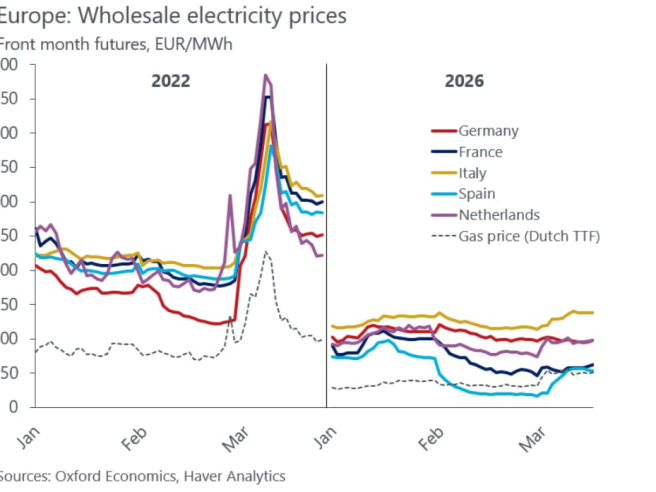
The current crisis confirms that where renewables have a greater weight in the electricity mix, gas pollutes prices less. Countries that bet heavily on clean energy, like Spain, show less exposure to the international volatility of fossil fuels.
Our country has taken this European roadmap seriously. For example, in 2018, Spain, weighed down by an incomprehensible "sun tax," barely had 5GW of installed solar photovoltaic power. During Pedro Sánchez's government, that figure quadrupled, reaching 21GW in 2022 when the severe energy crisis derived from the war in Ukraine hit us.
It was here when in Europe we learned that the Green Pact is synonymous with energy sovereignty. Today our solar capacity is 51 GW, ten times more than eight years ago. Right now our renewable resources allow us to face this new crisis by displacing gas in electricity generation. Today renewable generation is close to 60% of the electricity mix and gas only sets the price of electricity 15% of the time.

Precisely because of this, prices have not replicated the dramatic jumps of four years ago in recent weeks. Our stability is explained by the commitment to lasting and indigenous solutions (renewables, takeoff of storage, long-term contracts) that decouple the fossil impact from the daily pulse of the market. Every renewable electron shields us from new geopolitical turbulence.
But not everything is bright, with greater electrification of our economy, the relief for households and businesses would be even greater. Today, whoever charges their electric car does not suffer the same shocks as whoever needs to fill their gasoline or diesel tank. Electrification continues to be the great lever we need to activate to continue decarbonizing our economy while it becomes more competitive: transforming imported, expensive, and volatile fossil demand into renewable electrical demand that we produce here affordably.
More Protected Consumers and a More Robust Regulatory Framework
Furthermore, European citizens are today less exposed to international turbulence. The lessons of 2022 inspired the creation of a range of protective measures: gas storage and saving targets, prohibition of electricity cuts to vulnerable households, temporary limits on energy prices and windfall profits, etc.
And although the last reform of the electricity market did not solve all the challenges, it did mark a turning point in preparation for price shocks: reinforcing consumer protection, giving them more options, and reducing dependence on short-term volatilities through long-term market tools (CfDs and PPAs). This is the political direction we must consolidate and accelerate.
Featured story
Von der Leyen endorses extending the closure of nuclear power plants like Almaraz
4 minutes
For exceptional crisis moments, Europe resorted to improvised mechanisms such as emergency caps or the valuable “Iberian exception”. To avoid resorting to improvisation again, the reform of the electricity market establishes structurally and predictively the way to identify electricity price crises and act accordingly with temporary price interventions. Some adjustments may be necessary, but proposing drastic changes in this new crisis or weakening climate policies will not make Europe stronger; on the contrary, it will only generate uncertainty and put our security and competitiveness at risk.
In the same way, governments and political forces that try to blame the European carbon market - ETS - or the bet on clean technologies are actually increasing our dependence on fossil fuels and on those who control their supply.
Despite our progress, we are seeing that Europe is still not free from risks. We continue to depend on fossil autocracies and are excessively vulnerable to energy blackmail. But today we face this energy crisis more prepared and with a more resilient energy system. The European green agenda reduces the impact of the weaknesses of a fossil system.
And this is no longer just a political or technological advance: it is a tangible promise of prosperity and energy freedom for 450 million Europeans today and for all future generations. The challenge now is to avoid costly U-turns and stay the course despite the threats. No matter how much some deny it, advancing the decarbonization of our economy makes us freer as Europeans. Being a patriot is betting on renewables.