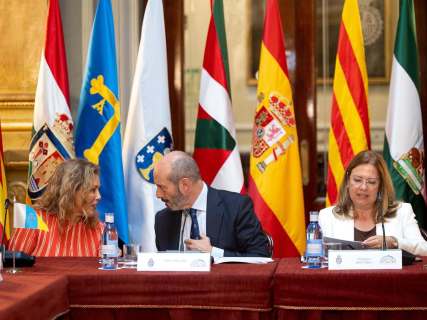

The Conference of Presidents and Presidents of Autonomous Parliaments (COPREPA) held a special session on Artificial Intelligence (AI) this Thursday in the Senate, focusing on its application to document management, information search and analysis, archive digitization, and the treatment of parliamentary knowledge.
The president of the Parliament of the Canary Islands, Astrid Pérez, participated in the meeting, advocating for legislative chambers to progress "jointly" in the implementation and development of Artificial Intelligence in their daily activities, sharing experiences and best practices.
According to her, this coordinated work should serve to reinforce democratic quality and strengthen the relationship between institutions and citizens.
"Artificial intelligence will change the relationship between institutions and citizens, allowing for more participation and interconnection. One example is the subtitling of all parliamentary activity, which brings our Chamber closer to people with hearing disabilities, and who can now follow us thanks to technological advancements," recalled the president of the regional Chamber.
This Friday, Astrid Pérez will also preside over the meeting of the Standing Committee of the Conference of European Regional Legislative Assemblies (CALRE) at the Senate headquarters, the first meeting of the governing body of this organization after her re-election as president of the European conference.
Artificial Intelligence in Parliaments
At the COPREPA, under the title "Artificial Intelligence in Parliaments: agility, transparency, and modernization," the Director of Information and Communication Technologies of the Senate, Manuel Pereira, gave a presentation detailing the Upper Chamber's experience in using AI.
His intervention focused on the opportunities and challenges posed by Artificial Intelligence for different parliaments, in a context where several autonomous assemblies have already begun processes to adopt these tools.
Currently, autonomous chambers are beginning to incorporate AI, especially in document management, data location and analysis, digitization of collections, and the organization of parliamentary knowledge.
The Senate's technology officer stressed that the introduction of these solutions must be accompanied by adequate governance, oversight systems, transparency guarantees, and robust data protection.
Likewise, he emphasized the need to maintain "permanent human oversight" to ensure their "alignment with democratic values."
The centrality of people in digital transformation
The president of the Assembly of Murcia and of COPREPA, Visitación Martínez, underlined three key ideas: the advisability of acting with a strategic vision, the relevance of generating trust through responsible use of technology, and the "central" role of people in any digital transformation process.
In this regard, she reiterated that "digital transformation will only be successful if it is accompanied by institutional responsibility and a firm commitment to democratic quality."
She also called for intensified cooperation between regional parliaments, in order to share experiences and move forward jointly towards institutions that are "more modern, open, and prepared" for the challenges of the 21st century.
In her first speech, Martínez recalled that AI is already "a present reality" that is beginning to modify the way parliaments manage information.
Furthermore, she pointed out that this technology "can become a decisive tool for advancing in three fundamental objectives of parliamentary institutions: agility, transparency, and institutional modernization."
The president of the Senate, Pedro Rollán, also intervened to highlight that the Upper House has become the first legislative institution in Spain to approve specific guidelines for the use of AI in its parliamentary work.
However, he warned that the use of these technologies must be done responsibly and based on ethical and legal principles, alerting that "under no circumstances" should information protected by parliamentary secrecy be introduced.