CEO's Surprise! Aliança Catalana Surpasses Junts and Illa's PSC Revalidates Victory in Catalonia

The first 2026 barometer from the Centre d’Estudis d’Opinió outlines a new political scenario in Catalonia: Illa's PSC holds steady, but the meteoric rise of Aliança Catalana and the fall of Junts shake the Parliament

2 minutes

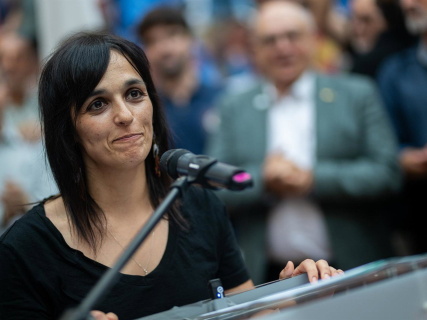
The mayor of Ripoll (Girona) and leader of Aliança Catalana, Sílvia Orriols Lorena Sopêna - Europa Press

The mayor of Ripoll (Girona) and leader of Aliança Catalana, Sílvia Orriols Lorena Sopêna - Europa Press

Add DEMÓCRATA to Google

Ask FREN

Published

Last updated

2 minutes

Most read

The PSC would win again the regional elections in Catalonia, although with wear and tear, according to the latest barometer from the Centre d’Estudis d’Opinió (CEO) published this Thursday, July 9. The survey places the socialists led by Salvador Illa as the leading force, with an estimate of between 36 and 38 seats, ahead of ERC, which would be in second place with 24-26 deputies.

The main novelty that the poll advances is the progress of Aliança Catalana. The formation led by Sílvia Orriols would go from the current two seats to a range of 23-25 deputies, which would place it as the third force in the Parliament and very close to ERC. Furthermore, it would surpass Junts, which would fall to 16-18 seats.

The PSC holds, but loses ground

In vote intention, the PSC is at 24%, ahead of ERC with 18%, and Aliança Catalana, which would reach 15%. Junts would be at 12%, while PP and Vox would tie at 10%. The CUP and Comuns Sumar would both be at 5%.

The poll depicts a more fragmented scenario. The PSC would continue to be the most voted party, although it would lose between four and six seats compared to its current representation.

Aliança Catalana changes the board

The leap of Aliança Catalana is the most relevant political data from the barometer. The party would go from a testimonial presence in the Parliament to competing for second place in Catalonia, with a rise that places it ahead of Junts and very close to ERC.

The rise of AC particularly strains the pro-independence space, where Junts appears as the main loser. The survey also consolidates a relevant presence of radical right-wing forces: Aliança Catalana and Vox could together account for nearly 28% of the Parliament.

Vote intention in Catalonia according to the CEO — July 9, 2026
Position Party Vote intention
1 PSC 24.0%
2 ERC 18.0%
3 Aliança Catalana 15.0%
4 Junts 12.0%
5 PP 10.0%
5 Vox 10.0%
7 CUP 5.0%
7 Comuns Sumar 5.0%

Source: survey by the Centre d’Estudis d’Opinió of Catalonia, July 9, 2026.

Illa's majority, tighter

The barometer also complicates parliamentary arithmetic. The majority that allowed Salvador Illa's investiture —PSC, ERC, and Comuns— would be very tight and might not reach an absolute majority in the least favorable scenario. 

The survey was conducted between May and June 2026 and comes after months of delay in the publication of the CEO's first barometer of the year, attributed to administrative problems in the contracting of the companies responsible for the fieldwork.

More key points, information and questions with FREN

AI-GENERATED CONTENT

What is the parliamentary process for forming a government after regional elections in Catalonia?

After regional elections in Catalonia, the process to form a government revolves around the constitution of the Parliament, the election of its Board, and the investiture procedure of the President of the Generalitat. The main detail is in the Parliament's Rules of Procedure, which regulate the constitutive session, the election of the Board, and the investiture debate and vote. The Statute of Autonomy completes this framework (for example, regarding deadlines and dissolution), but those aspects are not developed in the available excerpt. Below is a step-by-step explanation of the legal-procedural part that can be derived from the Rules of Procedure.

1. Basic normative framework

The procedure is mainly governed by:

  • Rules of Procedure of the Parliament of Catalonia, especially articles 1 to 3 (constitution), 26 et seq. (groups), 37 to 46 (Board) and 149-150 (investiture), according to the text accessible in the Parliament Rules of Procedure.
  • Statute of Autonomy of Catalonia, which sets the general framework for the election of the President of the Generalitat and the possible dissolution and repeat elections (the specific details of these aspects do not appear in the available sources).

2. Constitutive session of the Parliament

According to article 1 of the Rules, the Parliament meets in constitutive session on the day and time set in the call decree, once the elections have concluded and the results proclaimed. The session opens with the reading of the call decree by the Secretary General.

Next, the so-called Board of Age acts (art. 2): it is chaired by the oldest elected deputy present and the two youngest deputies act as secretaries. One of the secretaries reads the list of elected deputies and the electoral appeals filed, and immediately after, the election of the members of the Parliament's Board takes place.

Once the Board is elected, its members take their seats and the new President of the Parliament declares the Parliament constituted and closes the session (art. 3.1). The President must communicate the constitution to the Head of State, the outgoing President of the Generalitat, the President of the Congress, and the President of the Senate (art. 3.2). This communication to the Head of State is merely formal; it does not imply any intervention by the King in the internal parliamentary procedure.

3. Election of the Parliament's Board

The election of the Board takes place during that constitutive session. Article 43 of the Rules establishes that the Plenary elects the members of the Board (presidency, vice presidencies, and secretaries) through successive votes and ballots, which deputies deliver to the Board of Age for deposit in the ballot box. The scrutiny is carried out by the Board of Age itself: the oldest president reads the ballots and one of the secretaries notes results and incidents.

Article 45 specifies that, in these elections, illegible ballots, those containing more names than required, or names of persons who have not validly acquired the status of deputy are null; blank ballots count as such, but all are counted for the number of voters. The body of article 44 (where the specific majorities for each Board position are presumably detailed) is not developed in the available excerpt, so those requirements cannot be specified here.

4. Formation of groups and initial organization

With the Parliament already constituted, deputies have a period of eight working days from the day after the constitution to form parliamentary groups, by written request addressed to the Board (art. 26). This phase is relevant because the Board of Spokespersons and the groups later condition the organization of plenary activity and the investiture dynamics themselves.

5. Candidate proposal and investiture

The investiture is regulated in Chapter III, Section one, Subsection one of the Rules: “The investiture”, articles 149 and 150.

  • Candidate proposal (art. 149.1): the investiture session begins with the reading, by a secretary, of the resolution of the President of the Parliament proposing a candidate for the presidency of the Generalitat. That is, the formal initiative to activate the investiture debate corresponds to the President of the Parliament, who chooses whom to propose.
  • Presentation of the program: after the reading, the candidate presents, without time limit, their government program and requests the confidence of the Plenary.
  • Intervention of the groups: unless the President of the Parliament decides to suspend the session for a maximum of twenty-four hours, a representative of each parliamentary group intervenes for a maximum of thirty minutes.
  • Replies and counter-replies (arts. 149.2 and 3): the candidate may intervene as many times as desired. If responding individually to a deputy, that deputy has the right to reply for the same time used by the candidate. If the candidate's response generates a counter-reply from any group, that group has a single turn of up to five minutes.

6. Voting and investiture majorities

Article 150 regulates the decisive part:

  • First vote: after the debate, voting takes place. To be invested, the candidate must obtain an absolute majority of votes. The election simultaneously entails approval of the presented government program.
  • Second vote: if the absolute majority is not reached, the candidate may submit to a second debate and a second vote two days later. In this second vote, a simple majority (more votes in favor than against) suffices.

The Rules do not detail in these provisions the effects of a possible repeated failed investiture nor the calculation of the overall deadline after which automatic dissolution of the Parliament and the calling of new elections would occur; this aspect is referred to the Statute of Autonomy and other norms, but no further information is available in the consulted sources, so the calculation of the two months mentioned in your question cannot be precisely reconstructed here.

7. Role of the President of the Parliament and the King

From a procedural point of view, the President of the Parliament is the key figure in government formation: declares the Parliament constituted, directs the investiture session, decides possible suspensions of up to twenty-four hours, and, above all, issues the resolution proposing the candidate for the presidency of the Generalitat to the Plenary. The King, for his part, appears only as the recipient of the formal communication of the Parliament's constitution (art. 3.2 of the Rules); the regulatory text does not assign any direct role to the King in the proposal or development of the regional investiture.

In which specific provisions of the Statute of Autonomy are the deadlines and automatic dissolution regulated if no president is invested? How is the consultation round of the President of the Parliament with the groups before proposing a candidate practically structured? What happens if, after several failed investitures, a new different candidate is proposed and how is the vote count restarted?

What powers and functions does the President of the Generalitat have according to the Statute of Autonomy?

The President of the Generalitat, according to the Statute of Autonomy reformed by Organic Law 6/2006 (Statute of 2006), is the highest political authority of Catalonia, directs the action of the Government, and simultaneously acts as the ordinary representative of the State in Catalonia. The Statute defines his functions in three areas: institutional representation, direction of the Government, and relationship with the State. It also regulates his election, dismissal, substitution, and some specific powers such as calling elections and promulgating laws.

1. Institutional position of the president

The Statute establishes that the president:

  • Holds the highest representation of the Generalitat.
  • Directs the action of the Government of Catalonia.
  • Exercises the ordinary representation of the State in Catalonia.

Regarding protocol and precedence within Catalonia, the Statute indicates that he has a preeminent position, consistent with that dual role as representative of the Generalitat and of the State in Catalan territory.

2. Election, appointment, and legislature

Regarding his designation, the Statute provides that:

  • The president is elected by the Parliament of Catalonia from among its own deputies.
  • A term limit may be established by law.
  • Once elected by the Parliament, he is appointed by the King.

Regarding the legislature, the statutory text foresees that:

  • The legislature ends upon completion of four years from the election date, unless ended early.
  • It may end earlier if the investiture of the president is not achieved.
  • Or by early dissolution of the Parliament agreed by the president himself.
  • Fifteen days before the end of the legislature, the president must call elections, which are held between forty and sixty days later.
  • If two months pass from the first investiture vote without any candidate being elected, the Parliament is automatically dissolved and the acting president calls elections, also within a period of forty to sixty days.

3. Functions as representative of the State in Catalonia

The Statute specifies several functions of the president as the ordinary representative of the State:

  • Promulgate, in the name of the King, the laws, decree-laws, and legislative decrees of Catalonia and order their publication in the "Official Gazette of the Generalitat of Catalonia" and, if applicable, in the "Official State Gazette".
  • Order the publication of the appointments of institutional State officials in Catalonia.
  • Request the collaboration of State authorities exercising public functions in Catalonia.
  • Exercise the other functions determined by laws in this capacity.

4. Direction of the Government and relationship with the Parliament

As head of the Government, the president directs the action of the Government of the Generalitat. The Statute also indicates that:

  • The Government is composed of the president, the first counselor (if any), and the counselors.
  • The Government ceases when the president ceases, which reinforces his central role in the Executive.

The Statute points out that there are certain powers that cannot be exercised by substitutes (vote of confidence, appointment and dismissal of counselors, early dissolution of the Parliament), which shows that these are considered core powers of the president, although their details are developed in other norms.

5. Dismissal, substitution, and delegation of functions

The president ceases for various causes regulated in the Statute:

  • Renewal of the Parliament after elections.
  • Approval of a motion of censure or denial of a vote of confidence.
  • Death or resignation.
  • Permanent physical or mental incapacity, recognized by the Parliament, that disqualifies him for the office.
  • Final criminal conviction that implies disqualification for public office.

In case of absence, illness, incapacity, or death, the Statute provides that the first counselor, if any, or the counselor determined by law, substitutes and replaces the president. This substitution does not allow, as mentioned, exercising powers related to votes of confidence, appointment and dismissal of counselors, and early dissolution of the Parliament.

Finally, if no first counselor has been appointed, the president may temporarily delegate executive functions to one of the counselors, always retaining for himself the non-delegable powers that the Statute itself indicates.

Could you explain in detail how the investiture procedure of the President of the Generalitat works according to the Statute? How does the legal role of the President of the Generalitat as head of the Government differ from his role as the ordinary representative of the State in Catalonia? What exact effects does a motion of censure against the President of the Generalitat have and how is it regulated in the Statute?

What political trajectory has Sílvia Orriols had before leading Aliança Catalana?

Before leading and founding Aliança Catalana in 2020, the political trajectory of Sílvia Orriols Serra is characterized by a long path in Catalan ethno-nationalist independentism, with youth militancy in left-wing independentist organizations, her passage through minor parties such as Estat Català and the Front Nacional de Catalunya (FNC), and her institutional breakthrough as a councilor in Ripoll in 2019. From that municipal position, she already deployed a very radical discourse on immigration and security that generated a cordon sanitaire from the other parties. Following the break with the FNC in 2020, she capitalized on that local political capital and the post-1-O climate to launch her own project, Aliança Catalana, which media and analysts later described as an extreme right independentist formation, according to the profile by Demócrata on the leader Sílvia Orriols.

Youth militancy and beginnings in the extreme left independentism

According to various political biographies and journalistic reconstructions, Orriols linked very early to independentism. In adolescence, she tried to join Maulets and ended up entering the Joventuts d’Esquerra Republicana, today Jovent Republicà, where she stayed about two years, as profiles in ModeloCurriculum and media like Newtral report. Simultaneously, she participated in the ethno-nationalist collective L’Intransigent de Catalunya and approached the historic but very minor Estat Català, of which she was a candidate in the 2004 European elections, occupying the seventh place on the list, according to biographical entries in Spanish Wikipedia and Catalan Viquipèdia.

Alongside these early political steps, she worked as a waitress, shop assistant, industrial laborer, and since 2006 as an administrative employee in a private company, besides training in Library Science and Documentation, according to her own municipal curriculum from Ripoll [link] and reports such as those from Crónica Global and El País.

Jump to the institutional level: Front Nacional de Catalunya and Ripoll

The major turning point came after the 1-O referendum in 2017 and the application of article 155, when Orriols gained notoriety in Ripoll leading independentist protests and very harsh speeches against the State and immigration. As a result of this context, she linked to the Front Nacional de Catalunya (FNC), an identitarian independentist formation, with which she ran in the 2019 municipal elections in Ripoll.

In those elections, the FNC list headed by Orriols obtained 503 votes and one councilor seat, allowing her to enter the city council for the first time as a councilor in June 2019; this is reported by the cited biographies and analyses such as those from El Critic (in Catalan) and its Spanish version. From the start of that term, her discourse caused the other municipal groups to form a cordon sanitaire and commit not to negotiate or pact with her, a milestone highlighted by both Wikipedia and political analyses like Política Prosa.

In March 2020, just a few months after starting as a councilor, she left the FNC and became an unaffiliated councilor, breaking with the formation with which she had arrived at the council. This step is key: according to the consistent narrative of Viquipèdia, Wikipedia, and contextual pieces like that of Newtral, she did so after internal disagreements and already surrounded by a core of young leaders encouraging her to take the leap toward her own project.

Foundation of Aliança Catalana and consolidation of leadership

A few months after that break, in spring-summer 2020, Orriols registered and launched Aliança Catalana, a party born in Ripoll that from the start combines independentism with an openly anti-immigration and Islamophobic discourse, frequently described as extreme right by media and analysts. The biographical reference from Demócrata and works like the book analyzed by elDiario.es place this foundation as a direct offshoot of her previous experience in the FNC and her political capital as a councilor in Ripoll.

Although the question focuses on the stage before leading Aliança Catalana, it is relevant that already as founder of the party, but before making the regional leap, she consolidated her profile with municipal re-election and later with her arrival at the Parliament, where she appears in the official file of the Parliament of Catalonia. Since then, the newspaper Demócrata has followed her trajectory and that of her party in numerous chronicles about polls, conflicts with Junts and PSC, or institutional tension (Catalan polls, CEO barometers, clashes with Salvador Illa and other parties in the Parliament and in Ripoll in pieces like Illa predicts the failure of Orriols' project, debates on transport, or the PSC crisis in Ripoll covered in PSC councilors in Ripoll offer their resignation after allowing Aliança Catalana's budgets, The PSC removes the 2 councilors, reaction of former mayors, dissolution of the group and Orriols' own response in Orriols celebrates the dissolution).

Other articles from Demócrata and various media help frame the subsequent impact of her leadership and the perception of her policies, although they do not directly refer to her beginnings: coverage of her regional electoral growth (Ipsos poll, CEO barometer), her stance on immigration (debate on persecuted Iranians), cordons sanitaires and controversies such as the AI video with Puigdemont (video controversy), as well as the national projection of the extreme right phenomenon, in which she is mentioned alongside Vox in analyses like [link].

Finally, it should be noted that Orriols' trajectory has also been narrated in popular biographies such as that of ModeloCurriculum and in political explanation pieces like those from Newtral, which agree in presenting her as the result of a long itinerary through radical independentism and municipal politics before consolidating as leader of Aliança Catalana and mayor of Ripoll.

The consulted documentation also includes numerous references to the general political context in Demócrata (from the Kitchen case or the leadership change in Vox analyzed in Vox removes Ortega Smith and its expansion to profiles of other leaders like Yolanda Díaz, Teresa Rodríguez or María Reigosa), which serve to situate the Aliança Catalana phenomenon in a broader context of right and far-right reconfiguration in Spain and Europe.

Other links present in the sources, although they do not provide additional data on Orriols' beginnings, are part of the same informational ecosystem or the institutional and social context in which current Spanish and Catalan politics move: international debates such as the Trump-Meloni clash analyzed by Demócrata in [link], information about the Parliament of Catalonia (asbestos law, Filmoteca and agricultural sector, recognition of the IEC, eight sectoral motions, Catalan Center for Business and Human Rights), chronicles about other regional and local institutions such as the Cortes of Aragon (PP presidency of Cortes of Aragon), or notes about European leaders like Cristina Lobillo in Von der Leyen's cabinet ([link]). There are also municipal and social information (for example, about urban gardens or other neighborhoods in municipal notes) that do not directly affect Orriols' biography but complete the landscape in which her political career is inscribed.

In sum, before leading Aliança Catalana, Sílvia Orriols accumulates almost two decades of socialization in the hardest independentism, a brief step through municipal representation with the FNC, and a break that leads to the creation of her own party, with Ripoll as a local laboratory and the immigration issue as the central axis of her discourse.

How exactly was Sílvia Orriols' break with the Front Nacional de Catalunya in 2020 orchestrated? What role did her stage as councilor in Ripoll have in shaping Aliança Catalana's program? How do the different parties in the Parliament of Catalonia describe the ideology and positioning of Aliança Catalana since its entry into the Chamber?

Play

Test your knowledge with FREN!

How much do you know about this topic? Answer the following 3 questions.

Which party would remain the leading force in Catalonia according to the CEO barometer of July 2026?

Question 1 of 3

What would be the range of seats that Catalan Alliance could obtain according to the survey?

Question 2 of 3

Which party would experience a significant decline, placing fourth according to the survey?

Question 3 of 3

Hola, soy Fren. ¿Cómo te ayudo?