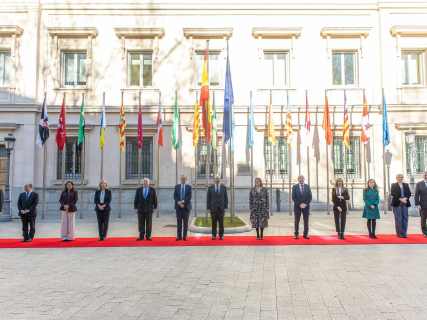

The Conference of Presidents and Presidents of Autonomous Parliaments (Coprepa) will meet this Thursday at the Senate headquarters for a working day focused on how to integrate Artificial Intelligence (AI) into the daily activity of regional legislative chambers.
According to parliamentary sources who have informed Europa Press, several heads of the autonomous assemblies will participate in this meeting, which will be held in the Upper House under the slogan "Artificial Intelligence in Parliaments: agility, transparency, and modernization".
The President of the Senate, Pedro Rollán, will welcome the attendees along with the President of the Murcia Assembly and of Coprepa, Visitación Martínez, and both will feature in an institutional photograph with the flags of the autonomous communities at one of the entrances to the Senate building.
At 10:30 AM, the President of the Senate will officially open the session with welcoming remarks in the room where the day will take place. After his speech, the President of Coprepa will take the floor, and at the end of the meeting, the presidents of the autonomous parliaments will take a guided tour of the institution's facilities.
The Coprepa delegation that will travel to the Senate this Thursday will be made up of the top officials from the Assemblies of Murcia, the Canary Islands, Galicia, Andalusia, Asturias, Cantabria, Aragon, Castilla-La Mancha, Extremadura, Madrid, and Castilla y León.
The Senate's Pioneering Experience with AI
The Senate has become the first Spanish legislative chamber to establish internal guidelines for the use of Artificial Intelligence.
In February, the Senate's Board of Directors approved these rules, which promote senators' ability to use AI tools in carrying out their parliamentary work, always under ethical and legal principles such as human supervision and privacy protection.
The guidelines, applicable to both senators and all staff working in the Upper House, aim to promote the use of AI in the institution and establish the ethical and legal principles that should govern its correct use.
In this context, the Senate will present its own experience to the regional presidents, as the Upper House has equipped itself with standards that regulate the purchase and deployment of AI systems that "maximize" respect for the ethical, legal, and organizational principles set out in said guidelines.
To meet these standards, Senate staff will have to undergo continuous training that allows them to identify the risks and limitations of the AI tools they use, as well as to know their capabilities and functionalities.
In addition, the Director of Information and Communication Technologies of the Senate, Manuel Pereira, will offer a specific conference during this Thursday's meeting.
Risks, secrets, and information protection
Among the issues that the regional parliaments will analyze is the treatment of confidential information. In this area, the Senate will share its experience to guarantee that, under "no circumstances," information subject to parliamentary secrecy will be incorporated into an AI system.
One of the guidelines set by the Upper House establishes that information subject to parliamentary privilege because it is not yet public, as well as that protected by intellectual or industrial property rights, will not be uploaded to publicly accessible Artificial Intelligence systems. It may only be used in AI systems authorized by the Senate itself that work with non-public data when strictly necessary and after consultation with the corresponding hierarchical superior.