General election survey: Vox loses four seats and PP and PSOE advance, according to 40db’s tracking

The general election poll by 40dB. for EL PAÍS and Cadena SER places the PP at 131 seats, the PSOE at 122 and Vox at 55. Abascal’s party falls to 17% in voting intention and loses support among those under 35 years old

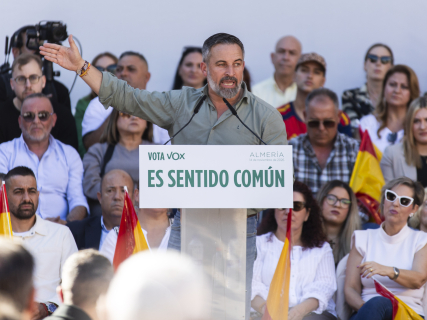
abascal sentido almeria

abascal sentido almeria

Add DEMÓCRATA to Google

Ask FREN

Published

Last updated

6 minutes

Most read

Elecciones 29N · Encuestas

La media de las encuestas

Media a 18 de noviembre de 2026 · 17 institutos

  • PP31,4 %
  • PSOE27,3 %
  • Vox18,9 %
  • Frente Amplio6,2 %
  • ERC2,4 %
01020304050ene 2024jul 2024ene 2025jul 2025ene 2026jul 2026

Media del último estudio de cada instituto en 30 días y su evolución semanal desde el 23J. Partidos con al menos un 2 %.

Todas las encuestas

Elecciones generales del 29 de noviembre · Demócrata

The general election poll of 40dB. for EL PAÍS and Cadena SER of November 18 places the PP at 131 seats and the PSOE at 122. The conservatives maintain their representation compared to the previous day, while the socialists advance by two deputies. Vox falls back to 55 seats, three fewer than on Tuesday.

The block formed by PP, Vox and UPN-PP reaches 188 deputies, twelve above the absolute majority. On the left, the PSOE adds 122 seats, but Frente Amplio, the territorial coalitions and Podemos together maintain ten representatives. The parties of the 2023 investiture pact would bring together 161 deputies.

Vox’s vote estimate drops to 17%, compared with 18.8% at the start of the campaign. The party also loses support among under-35s: it goes from 31.5% to 18% in that group, according to data published by Cadena SER.

The PP maintains 131 seats and the PSOE rises to 122

The parliamentary projection for the PP remains stable compared with the previous day, at 131 deputies. That figure includes the two seats of the coalition of the populars with UPN in Navarre. The PSOE, for its part, advances two representatives and reaches 122.

The socialist improvement does not change the composition of the left bloc. The sum of Frente Amplio, the territorial coalitions and Podemos continues at ten deputies, a representation that, according to information from Cadena SER, would not allow forming a left-wing government.

The poll attributes ten seats to Esquerra Republicana, seven to EH Bildu and four to Junts. The PNV and Adelante Andalucía obtain three deputies each; the BNG achieves two and Coalición Canaria, one.

Vox drops to 55 deputies and the right adds up to 188

Santiago Abascal’s party registers a new setback in tracking. Its vote estimate falls from 18.8% at the start of the campaign to 17%. Since Friday it has lost nine seats, while the comparison with Tuesday reflects a drop of three deputies, to 55. The PP-UPN coalition maintains its two representatives and the right-wing bloc retains 188 seats.

GENERAL ELECTIONS 29N · TRACKING 40dB. ·

Vox slips back to 55 seats and PP and PSOE move forward

The right-wing bloc maintains 188 deputies, twelve above the absolute majority. PSOE reaches 122 seats and Vox falls to 55.

188 Seats of PP, Vox and UPN-PP
55 Vox seats
17% Vox vote intention estimate

Vox vote intention estimate

The publication provides the percentage for Vox and its evolution since the start of the campaign, but it does not offer in this information the current percentages for PP and PSOE.

Vox · start of campaign18.8%
Vox · 18 Nov.17%
Vote intention estimate published by Cadena SER. Visual scale from 0% to 40%.
Vox vote intention estimate since the start of the campaign
Indicator Start of campaign 18 Nov. Change
Vox 18.8% 17% −1.8 pp

pp: percentage points. Variation calculated based on the published percentages, rounded to one decimal place.

Seat distribution

Central projection of deputies published for 18 November. The information does not include seat ranges.

PP, included UPN-PP131
PSOE122
Vox55
Frente Amplio, territorial coalitions and Podemos10
Common scale from 0 to 150 deputies. The PP figure includes the two seats of UPN-PP.
Seats of the 40dB tracking. of 18 November 2026
Candidacy 18 Nov. Change compared to 17 Nov.
PP, included UPN-PP 131 0
PSOE 122 +2
Vox 55 −3
Frente Amplio, territorial coalitions and Podemos 10 0

Cadena SER states that the sum of Frente Amplio, the territorial coalitions and Podemos remains at ten deputies. It does not publish in this information the individual breakdown of their seats.

Majority of PP and Vox

PP and Vox add up to 186 deputies. With the two seats of UPN-PP, the bloc reaches 188. The parties of the 2023 investiture pact add up to 161. The absolute majority is 176. PP + Vox With UPN-PP Pact 2023 Absolute majority: 176 186 188 161 0 200 seats
PP and Vox add up to 186 deputies. By adding the two seats of UPN-PP, the bloc reaches 188 as reflected by the poll. The parties of the 2023 investiture pact would add up to 161.
Parliamentary blocs in the 18 November estimate
Bloc Seats Difference compared to 176
PP + Vox 186 +10
PP + Vox + UPN-PP 188 +12
Parties of the 2023 investiture pact 161 −15

Preference for presiding over the Government

Cadena SER publishes differences between candidates, but it does not provide in this information the absolute percentages of presidential preference.

Advantage of Pedro Sánchez in presidential preference
Comparison Sánchez’s advantage
Against Alberto Núñez Feijóo 10 points
Against Santiago Abascal 16 points

The PP, Vox and UPN-PP bloc retains twelve deputies in margin over the absolute majority. The poll also reflects a reduction in the distance between PP and Vox’s Government options and PSOE and Frente Amplio’s, down to a single point.

Source: 40dB. for EL PAÍS and Cadena SER. Fifth installment, published on 18 November 2026. Fieldwork from 13 to 17 November. Sample of 2,000 online interviews in Spain, except Ceuta and Melilla. Margin of error: 2.2%.

The fall of Vox is especially visible among voters under 35. Their voting intention in that group goes from 31.5% to 18% since the start of the campaign. Among men under 35, the drop goes from 37% to 19%.

The transfer of votes from the PP to Vox is also reduced. The percentage of former PP voters who now lean toward Abascal’s party goes from 21% to 13% in five days, according to data collected by Cadena SER.

The right-wing bloc maintains its advantage over an absolute majority

The sum of PP, Vox and UPN-PP stands at 188 seats, twelve more than the 176 needed for an absolute majority. Separately, PP and Vox together hold 186 seats.

In the other bloc, the parties that would repeat the 2023 investiture pact would total 161 seats, fifteen below an absolute majority and three fewer than on the previous day.

Sánchez leads Feijóo in preference for presiding over the Government

Pedro Sánchez continues as the preferred candidate to hold the Presidency of the Government. His advantage is ten points over Alberto Núñez Feijóo and 16 over Santiago Abascal. Cadena SER does not provide the absolute percentages for each leader.

The preferred Government option remains a coalition between PP and Vox, although the distance from a PSOE and Frente Amplio Executive has been reduced to one point, nearly four less than at the start of the campaign.

Check the polling follow-up in the special on general election polls from Demócrata.

Source: fifth 40dB tracking. for EL PAÍS and Cadena SER, published on November 18, 2026. Information from Miguel Á. Muñoz Encinas. Check the original information in Cadena SER.

```

More key points, information and questions with FREN

AI-GENERATED CONTENT

What is the parliamentary procedure required to invest the Prime Minister in Spain and how many votes does an absolute majority require?

To be invested as Prime Minister in Spain, the candidate must obtain the confidence of the Congress of Deputies after presenting their program and undergoing a debate. In the first vote, an absolute majority: 176 favorable votes in a Chamber of 350 seats is required. If this is not achieved, a second vote is held forty-eight hours later, in which it is enough to obtain more votes in favor than against.

1. Proposal of candidate and convocation

The procedure is structured around Article 99 of the Constitution and Articles 170 to 172 of the Congress Regulations. The initial phase corresponds to the King: he conducts consultations with representatives of political groups with parliamentary representation and proposes a candidate through the Presidency of the Congress.

Upon receiving the proposal, the Presidency of the Chamber convenes the Plenary. It also directs the debate and sets the time for the vote. The Board organizes the parliamentary work, while the Board of Spokespersons participates in the arrangement of the work according to general rules. None of these bodies replaces the Plenary in the decision to grant confidence.

2. Presentation of the program and debate

The session begins with the reading of the candidacy proposal by one of the Secretaries. Then, the candidate presents, without time limit, the political program of the Government they intend to form and requests the confidence of the Congress.

After a break agreed by the Presidency, a representative of each parliamentary group that requests it intervenes, with a thirty-minute turn. The candidate may respond as many times as they request the floor. The representatives have a ten-minute reply, whether the response is individual or addressed jointly to the groups.

3. First vote: 176 affirmative votes

An absolute majority requires surpassing half of the total members of the Chamber. With 350 deputies, half is 175: therefore, at least 176 affirmative votes are needed. It is not enough to gather more supports than rejections nor to obtain half of the votes cast.

The vote is public and by roll call: deputies are named and each responds "yes," "no," or "abstention." Therefore, the vote's direction is known and a secret ballot is not used to decide the investiture.

4. Second vote: simple majority

If the candidate does not reach an absolute majority, the vote is repeated forty-eight hours later. Beforehand, the candidate may intervene for a maximum of ten minutes, and each parliamentary group has five minutes to state its position.

On this second occasion, a simple majority suffices: more affirmative votes than negative. Abstentions are not added to either side. For example, 170 votes in favor, 169 against, and 11 abstentions would allow investiture in the second vote, but not in the first.

5. Appointment or new proposals

If confidence is obtained, the Presidency of the Congress communicates the result to the King for appointment as Prime Minister. If it also fails in the second vote, successive proposals are processed following the same procedure.

There is a limit: if two months pass from the first investiture vote without any candidate obtaining confidence, the General Courts must be dissolved and elections called. The period does not start on election day nor restart with each candidacy. The Presidency of the Congress submits the decree to the King's signature and communicates the decision to the Presidency of the Senate.

What are the competencies and political trajectory of Alberto Núñez Feijóo as leader of the PP?

Alberto Núñez Feijóo has been president of the Popular Party since April 2, 2022. His trajectory combines administrative management, leadership of public organizations, and thirteen years at the head of the Xunta of Galicia. To understand his current competencies, it is useful to distinguish between leading a party and holding a government office: the presidency of the PP does not grant him executive powers over Spain.

What functions does he have as leader of the PP

The party presidency is an organizational and political responsibility, not a State institution. Its main functions include strategic orientation, public representation, and coordination of the organization, according to its statutes and the powers of other bodies. The PP website identifies him as its national president.

  • Political leadership: he leads the definition of priorities, discourse, and electoral strategy of the party.
  • Representation: acts as interlocutor before other political forces, institutions, social agents, and media.
  • Organization: proposes or configures leadership teams through internal procedures and coordinates relations with territorial structures.
  • Parliamentary action: politically guides the activity of PP groups, without replacing the chambers' own competencies.
  • Electoral preparation: leads campaigns and the presentation of a government alternative. For 29N, he entrusted campaign direction to Miguel Tellado (Demócrata, October 8, 2026).

As leader of the opposition, his role consists of overseeing the Executive, formulating alternatives, and seeking parliamentary support. This political condition does not allow approving budgets, directing ministries, or executing public policies. Nor does it equate to being Prime Minister.

From Administration to the Xunta

Born in Os Peares, Ourense, in 1961, he holds a Law degree from the University of Santiago de Compostela and is a civil servant of the Galician Administration. During the 1990s, he held responsibilities in Agriculture and Health, including vice presidency and general secretary of the Galician Health Service. His institutional career is listed in the list of presidents of the Xunta.

Between 1996 and 2000, he was general secretary of Health Assistance at the Ministry of Health and president of Insalud. Later, he directed Correos. These responsibilities gave him experience in public services and state-level organizations before returning to the Galician Government.

In 2003, he assumed the Ministry of Territorial Policy, Public Works, and Housing, and in 2004 was appointed first vice president of the Xunta with Manuel Fraga. After the PP lost the regional government in 2005, Feijóo took over the leadership of the Galician PP in January 2006 (Demócrata, January 14, 2026).

Galician presidency and national leap

He regained the Xunta in 2009 and remained its president until 2022. He achieved four consecutive absolute majorities: 2009, 2012, 2016, and 2020. As regional president, he directed the Executive, coordinated ministries, and promoted its legislative and budgetary action; these were indeed governmental competencies (Euronews, biographical profile).

In April 2022, he replaced Pablo Casado after the PP's internal crisis and was elected national president with 98.35% of the votes. His leadership was reaffirmed in July 2025 with 99.24% (Demócrata, leadership review).

He was a senator between 2022 and 2023 and led the PP candidacy in the 2023 general elections. The party came first in votes and seats, but Feijóo did not gather enough support to be invested. His national trajectory thus shows an essential difference: winning elections does not guarantee forming a Government (Deia, electoral profile).

How many similar polls have CIS or 40dB. published so far during the electoral campaign?

Until today, November 18, the most precise reference is five releases of the 40dB. electoral tracking and no new CIS electoral polls identified since the official start of the campaign, November 13. The CIS did publish a large pre-electoral study on November 12, one day before: if you also include it, there would be six publications between both, although not all strictly within the campaign period.

40dB.: five releases, not six independent polls

Demócrata's November 18 information explicitly identifies that day's publication as the fifth 40dB. tracking for EL PAÍS and Cadena SER. A tracking is a follow-up with successive updates of the electoral estimate; therefore, it is more accurate to count its releases than to present them as five independent surveys. The reference is in the November 18 release.

This distinction matters because the number of news items about a poll does not equal the number of new surveys. The same release can generate one news about voting intention, another about leaders, and another about possible governments. Counting them separately would inflate the total without new interviews or a new electoral update behind.

  • November 13: identified as the first release of the campaign tracking.
  • November 14: Demócrata expressly presents the publication as the second release, in its information about the second 40dB. tracking.
  • November 16 and 17: new updates of the tracking are identified; the November 17 one can be consulted in this Demócrata information.
  • November 18: the news calls it the fifth release, which is the decisive data to close the count.

A sixth would not be automatically added due to publications on November 15: a recap of the evolution of polls does not by itself prove that there was an additional 40dB. release that day. The count of five follows the explicit numbering of the most recent publication, rather than deducing a poll for each day elapsed.

CIS: the pre-electoral was just before the campaign

The CIS electoral study located was published on Thursday, November 12. The campaign officially began on Friday, November 13 at 00:00, according to the campaign start calendar. Therefore, that study is not included in a count strictly limited to publications made during the campaign.

It is a pre-electoral study conducted with 45,074 interviews in 4,190 municipalities, whose fieldwork took place between October 7 and 30. It includes vote estimates and seat ranges, so it is comparable in electoral purpose with the trackings you mention, although not in publication frequency or interview dates. These data appear in the pre-electoral information.

No other CIS electoral poll published between November 13 and 18 is recorded in the sources consulted. This allows speaking of zero new publications identified during the campaign, without confusing that result with the absence of a recent pre-electoral study.

In short: to compare activity strictly during the campaign, use five 40dB. releases and no new CIS identified. For a comparison that also includes the eve of the start, add a CIS pre-electoral. In both cases, it is advisable to keep separate the publication date and the dates when the interviews were conducted.

Play

Test your knowledge with FREN!

How much do you know about this topic? Answer the following 3 questions.

How many seats would Vox obtain according to the electoral tracking of November 18, 2026?

Question 1 of 3

What advantage does Pedro Sánchez have over Núñez Feijóo in preference to preside the Government according to the survey?

Question 2 of 3

What is the absolute majority of seats in the Congress of Deputies in Spain?

Question 3 of 3