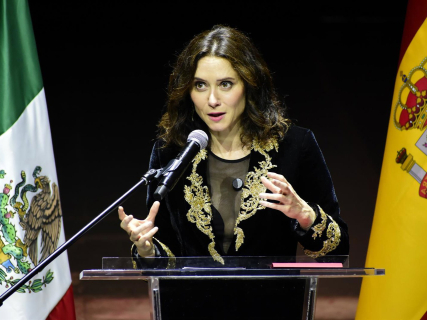

The episode has opened a new political clash between Madrid, Mexico and the Government of Spain, with cross-accusations over Ayuso's tribute to Hernán Cortés, the tension with Sheinbaum and the criticisms of Pedro Sánchez's Executive, which maintains that the Madrid president “went to provoke” and that the trip “turned out badly for her”.
An institutional trip that ends up suspended
Isabel Díaz Ayuso's trip to Mexico has ended earlier than planned and turned into a high-voltage political crisis. The president of the Community of Madrid decided to suspend the final leg of her agenda, which included her presence at the Platino Awards and a subsequent visit to Monterrey, after denouncing a climate of "boycott" driven, according to Sol, by Claudia Sheinbaum's government.
The Community of Madrid maintains that the Mexican Government threatened the organizers of the Platino Awards with closing the complex where the gala is held if Ayuso attended the event or the venue. The regional Executive described the episode as an “unprecedented event” and defended that the president decided not to attend so as not to harm the organizers, businessmen, and participants of an international event linked to Ibero-American cinema.
The version is not shared by all parties. The Xcaret hotel group, owner of the complex where the awards are held, denied having received threats or instructions from the Mexican Government and confirmed that it asked to withdraw the invitation to Ayuso to avoid the politicization of the event.
What the Community of Madrid Denounces
The Community of Madrid states that the pressure against Ayuso grew during the trip. According to the statement released by the regional government, the Mexican Executive allegedly demanded to know the full names of those who would meet with the Madrid president and allegedly threatened to close the Platino Awards venue if she attended.
Sol maintains that the situation forced Ayuso to cancel the third part of the trip and return to Madrid. The Community frames what happened as an attack against a Spanish political representative, against freedom of enterprise, and against freedom of expression.
The Madrid government has also accused Sheinbaum of daily attacks on Ayuso in her public appearances and of encouraging the climate of rejection surrounding her visit. Sol's thesis is that the Madrid president did not leave due to a lack of agenda, but due to political pressure that made it unfeasible to maintain the visit under the planned terms.
What Xcaret says
Xcaret has categorically denied having received threats or instructions from the Mexican Government. The business group does acknowledge that it requested the organizers withdraw the invitation to Ayuso, but attributes it to the desire to prevent the Platino Awards from being used as a platform for political confrontation.
This point is key because it introduces a different version of events. According to Xcaret, there was no order or threat from Sheinbaum, but rather a business decision linked to the tone of the trip and Ayuso's statements. The company defends that the Platino Awards are a space for Ibero-American cultural coexistence and not a forum for partisan dispute.
Therefore, the core of the controversy lies in the authorship and nature of the pressure: for the Community of Madrid, it was a political boycott by the Mexican Government; for Xcaret, it was its own decision to protect the character of the event.
What Claudia Sheinbaum said
Claudia Sheinbaum has been very critical of Ayuso during the visit. The Mexican president reproached the Madrid leader for her tribute to Hernán Cortés and stated that this gesture showed "ignorance" about the history of Spain and Mexico.
Sheinbaum also criticized the Mexican opposition for giving political space to Ayuso. In her statements, she linked Cortés's claim with sectors of the right and defended a historical reading that was very critical of the Spanish conquest.
The episodes that raised the tension
The trip was already loaded before the suspension. Ayuso was heckled during her visit to Aguascalientes, where a representative linked to Morena interrupted an event and criticized her speech on the conquest and the Mexican political situation.
Furthermore, the Madrid president had cited Mexico and Spain as examples of how democracies can deteriorate, in a speech given at a university linked to a businessman who opposes Sheinbaum. That intervention fueled the interpretation that the trip carried a political weight far superior to that of an institutional or cultural agenda.
The controversy is also framed within previous statements by Ayuso about Mexico. Media outlets like El País recall that in April the Madrid leader even referred to the country as a "narco-state," at a time when Spain and Mexico were trying to recompose bilateral relations.
What the Government of Spain Says
The Government of Spain has avoided escalating the episode to a diplomatic crisis, but it has politically attacked Ayuso. Óscar López, Minister for Digital Transformation and Secretary General of the PSOE of Madrid stated that the Madrid president “went to provoke” Mexico and that “it went badly for her”.
López also described the trip as "ridiculous" and asked for explanations about its cost for the people of Madrid. According to his interpretation, the visit will not have relevant consequences in the relations between Spain and Mexico, but it does leave a bad political image of the president of Madrid.
The central Executive tries to separate the incident from the bilateral relationship. La Moncloa has worked in recent months on a recomposition with Mexico, after years of tensions over the memory of the conquest and the role of the Crown.
Más Madrid and the PSOE have harshly criticized the trip. Manuela Bergerot, spokesperson for Más Madrid in the Assembly, described it as a "terrible ridicule" and has demanded explanations about the agenda, cost, and results of the visit.
The diplomatic context between Spain and Mexico
The controversy is not born in a vacuum. Spain and Mexico have experienced several years of tension since Andrés Manuel López Obrador demanded in 2019 an apology for the abuses committed during the conquest. That demand opened a symbolic crisis that also affected the relationship with the Crown.
The situation worsened when Claudia Sheinbaum did not invite King Felipe VI to her inauguration. In recent months, however, the Government of Pedro Sánchez and the Mexican Executive had tried to normalize the relationship. Felipe VI himself spoke in March of "abuses" and "ethical controversies" during the colonization, in a gesture seen as a rapprochement.
The Platino Awards, at the center of the conflict
The Platino Awards for Ibero-American Cinema have ended up becoming the stage for political clashes. The gala is linked to the Ibero-American audiovisual industry and has institutional support from Madrid in its alternating celebration between Spain and Mexico.
Ayuso had planned to attend the event and give a few words at the end of the gala, according to RTVE. However, Xcaret requested to withdraw the invitation to avoid a political use of the event, while the Community of Madrid maintains that the withdrawal was a consequence of pressure from the Mexican Government.
The deputy mayor of Madrid, Inma Sanz, who had also traveled to Mexico to participate in the event, will also not attend the gala, according to published information.