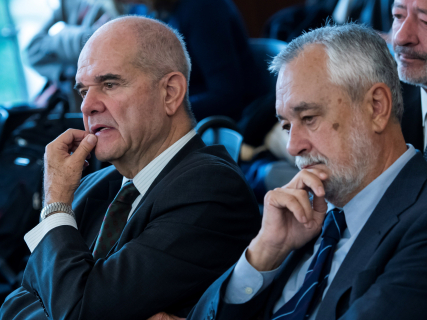

The European Commission (EC) has requested that the question raised by the Provincial Court of Seville before the Court of Justice of the European Union (CJEU) regarding the decision of the Constitutional Court (TC) that annulled the convictions of a dozen defendants in the specific procedure for financing irregular employment regulation files (EREs), including former Andalusian presidents Manuel Chaves and José Antonio Griñán, not be admitted for processing. In the opinion of the Community Executive, "the CJEU is manifestly incompetent" to answer the questions formulated by the Sevillian court.
In its statement of allegations, to which Europa Press has had access and which was reported by Diario de Sevilla, the EC maintains that the preliminary questions raised are "inadmissible" and states that it "will refrain from submitting observations on the merits of the case".
The document recalls that the Court of Justice has already established that it "is not competent to rule on a matter in which it is evident that the provision of Union law submitted for interpretation by the Court of Justice is not applicable to the main proceedings or in which a legal situation is not covered by the scope of Union law".
In this regard, it underlines that "as the source of financing appears to be the budget of the Autonomous Community and there is no financing charged to the Union budget, the main issue does not fall within the material scope of Article 325 TFEU nor within the provisions of derived law for the protection of the financial interests of the Union mentioned in the preliminary questions. Therefore, these provisions are simply inapplicable".
It further details that "in the present matter, the interpretation requested of those provisions of Union law has no relation to the reality or the object of the main dispute". Regarding Community financial interests, which "constitute the center of gravity of the request for a preliminary ruling", the Commission notes that it is not proven "nor is it even alleged that the funds in question in the main case come from the Union budget".
"In the rulings of the Provincial Court, the Supreme Court, or the Constitutional Court, there is no reference to European Union funding in relation to the controversial program," the brief adds.
The EC notes that the Court of Appeal of Seville would have invoked that "given the close relationship that exists between the Union budget and the budgets of the Member States, the misappropriation of public funds from a Member State can potentially or indirectly affect the financial interests of the Union", but understands that these considerations "do not justify the admissibility of the request for a preliminary ruling with regard to said provisions".
In the absence of "a sufficiently direct link with the Union budget to the main issue, the questions are purely hypothetical," explains the Commission, which adds that if the questioned jurisprudence "were to prove problematic in other matters relating to Union funds, a new preliminary ruling could (or should, as the case may be) be sought."
The Court of Appeal of Seville decided last July to refer a preliminary question to the CJEU regarding the obligation to issue new judgments in accordance with the criterion set by the Constitutional Court, which annulled the convictions of former socialist high-ranking officials of the Regional Government of Andalusia. The court justified this step to "avoid a systemic risk of future impunity in similar scenarios" and "safeguard the financial interests of the EU".
Before that, the Court requested the parties to the proceedings to state whether, in this case, the Constitutional Court "has overstepped its bounds" with an "alternative interpretation of prevarication and embezzlement" in the rulings that annulled the convictions, whether the doctrine established by said court for new sentences "fails to meet international requirements for the fight against corruption," and on the possibility of not applying those annulment rulings.
Last year, the Constitutional Court declared that the First Section of the Court of Seville, in its initial conviction ruling, and the Supreme Court, by rejecting the defendants' cassation appeals, would have "incurred in an extravagant and unforeseeable interpretation of the typical elements of 'resolution' and 'administrative matter' that violates the fundamental right to criminal legality guaranteed by article 25 of the Spanish Constitution".
Subsequently, the First Section of the Sevillian Court chose to suspend the issuance of new rulings ordered by the TC, alleging "doubts about their adequacy to European Law and the jurisprudence of the CJEU" and with the objective of "avoiding that, due to the effect of the doctrine included in the repeated rulings of the TC, a systemic risk of future impunity occurs in similar scenarios" and of "safeguarding the financial interests of the EU".