
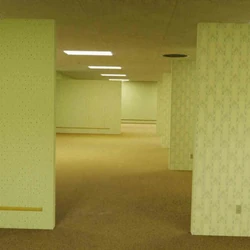
The story does not come from a novel or a classic Hollywood saga. It comes from forums, viral videos, collaborative stories, and a very specific aesthetic: deserted rooms, office corridors, fluorescent lights, old carpets, beige walls, and a difficult-to-explain feeling. Everything seems recognizable, but nothing seems right.
It's everywhere. Backrooms is the #1 movie in the world. pic.twitter.com/TMGrfKqJHD
— A24 (@A24) June 3, 2026
That is the heart of the Backrooms phenomenon: liminal horror.
What are Backrooms
The Backrooms are a universe of seemingly infinite rooms and corridors. They are not a haunted castle, nor a possessed house, nor a dark forest. They are something much more modern and rarer: everyday spaces emptied of life.
The original idea comes from a disturbing image spread on the internet: a yellowish room, without windows, with carpet and office lights. From there, thousands of users began to build a mythology around that impossible place.
In the stories, a person can “slip out” of reality and end up in the Backrooms, a parallel dimension made up of endless rooms. There is no clear exit. There are no stable rules. And the worst is not always what appears, but the possibility that nothing appears for too long.
What the Backrooms movie is about
The film follows Clark, played by Chiwetel Ejiofor, a furniture store owner going through a personal crisis who discovers an entrance to an unknown territory under the guise of endless offices and rooms.
That place, the Backrooms, functions as a physical and mental labyrinth. As Clark delves deeper into it, the film mixes psychological horror, science fiction, found footage, and an atmosphere of bureaucratic nightmare: as if someone had turned the interior of an abandoned office into an entire universe.
Renate Reinsve plays Dr. Mary Kline, a therapist who becomes linked to this quest and is also trapped in a reality that is increasingly difficult to understand.
What is liminal horror
Liminal horror is the fear of transitional spaces. Places that are not meant to be stayed in, but to be passed through: corridors, stairs, waiting rooms, empty hotels, offices at night, closed shopping malls, schools without students, or underground parking lots.
They are familiar spaces, but stripped of their normal function. And that is why they are disturbing.
A crowded corridor is not scary. A corridor lit by fluorescents, empty, silent, and too long begins to look like something else. There is no need for a monster to appear. The place itself is already saying: "you shouldn't be here."
That is what Backrooms exploits: the fear of the everyday when it loses its logic.
Why Backrooms is scary
Backrooms does not base all its horror on blood or cheap scares. Its fear is born from waiting, silence, and disorientation.
The viewer knows that something can appear around a corner, but the film also plays with the opposite: with not showing, with prolonging the tension, with making an empty room seem like a threat.
The fluorescent light, the electric hum, the repeated corridors, and the anonymous rooms create a strange sense of confinement. It is a very contemporary fear: not the gothic castle, but the infinite office; not the classic ghost, but the space that seems generated by a system that no one controls.
The viral origin of Backrooms
Before becoming a film, Backrooms was an internet phenomenon. The idea was born as a creepypasta, a digital legend shared and expanded by users on forums and networks.
Then came Kane Parsons, known on YouTube as Kane Pixels, who turned that concept into a series of horror videos with a found-footage aesthetic. They were short, unsettling pieces, appearing to be lost recordings or secret archives, which perfectly captured the feeling of looking at something forbidden.
The success of those shorts caught Hollywood's attention. A24 bet on Parsons when he was still very young and turned that digital universe into a feature-length horror film.
Who is Kane Parsons
Kane Parsons is the young director behind Backrooms. Before entering cinema, he had built his reputation on YouTube with videos created with a logic very different from traditional Hollywood.
His style combines visual effects, fragmented narrative, archival atmosphere, and a precise understanding of how the internet-born audience looks. His videos didn't explain too much. They left gaps. And those gaps were part of the fear.
In the film, Parsons maintains part of that identity: he doesn't seek to close all the questions, but to turn the Backrooms into a sensory and mental experience.
Why A24 bet on Backrooms
A24 has become one of the studios most associated with auteur horror and films that mix genre, prestige, and cultural conversation. Hereditary, Midsommar, Talk to Me, and The Witch helped consolidate that image.
With Backrooms, the studio takes another step: it turns a digital phenomenon into a film with great commercial impact. It doesn't adapt a comic, a famous novel, or a decades-old franchise. It adapts a nightmare born on the internet.
That detail explains a good part of its strength. Backrooms doesn't seem designed from the top down to create a phenomenon. It was born at the bottom, in digital culture, and then climbed its way to theaters.
The success of Backrooms in cinemas
The film has become a box office hit for A24 and has confirmed that terror born on the internet can compete with major franchises.
Its performance is especially striking because it starts from a seemingly small idea: people trapped in infinite rooms. But that image connects with a generation accustomed to consuming fragmented stories, theories, unsettling videos, and open narrative universes.
Backrooms demonstrates that contemporary fear doesn't always need an iconic creature. Sometimes a damp carpet, a cursed light, and the feeling that the world has rooms that no one should find is enough.
Backrooms and the new internet terror
The film is part of a broader trend: the leap from digital terror to cinema. YouTube, TikTok, Reddit, 4chan, and forums have created their own legends, their own creatures, and their own visual codes.
Internet terror works differently. It doesn't always tell a linear story. It often proposes fragments, files, recordings, incomplete maps, and theories that users complete among themselves. That fear has a name: liminal terror.