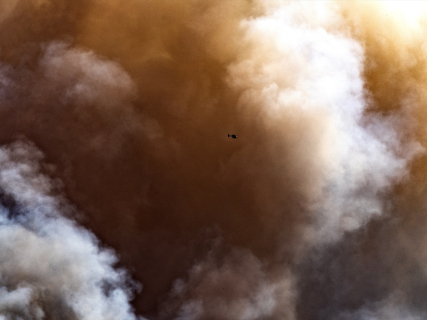
Fire on the Costa Brava: latest news and keys to the fire burning 2,300 hectares and confining 10,000 people

A large forest fire started in La Bisbal d’Empordà keeps the Costa Brava on alert after already burning about 2,300 hectares and forcing about 10,000 people to be confined in several municipalities in Baix Empordà. The Mossos d’Esquadra have arrested a man for his alleged connection to the origin of the fire, which is being investigated for the use of an angle grinder at the roadside. The Generalitat has asked to avoid travel to the area and has requested the intervention of the UME

6 minutes

EuropaPress 7640760 helicoptero sobrevuela humo incendio bisbal demporda girona catalunya

EuropaPress 7640760 helicoptero sobrevuela humo incendio bisbal demporda girona catalunya

Add DEMÓCRATA to Google

Ask FREN

Published

Last updated

6 minutes

Most read

A large-scale fire has kept the Costa Brava on alert this Friday after ravaging some 2,300 hectares and forcing the confinement of around 10,000 people in several municipalities of Baix Empordà.

The fire originated in the morning in La Bisbal d’Empordà and spread rapidly towards the Les Gavarres massif, a natural area particularly vulnerable due to accumulated vegetation, the tramontana wind, and its proximity to inhabited areas and tourist zones.

The Mossos d’Esquadra have arrested a man for his alleged involvement in the origin of the fire. Initial investigations point to the use of an angle grinder by the roadside on a day of extreme fire risk.

The Generalitat has asked the public to avoid traveling to the area, especially those with second homes on the Costa Brava, so as not to hinder firefighting efforts or cause traffic jams on roads already affected by closures.

Latest data on the fire in Costa Brava

The fire now affects about 2,300 hectares, according to the latest report communicated by the Generalitat.

The fire has kept about 10,000 people confined in municipalities around La Bisbal d’Empordà, Calonge, Platja d’Aro, and Santa Cristina d’Aro.

Firefighters are working with a large deployment to limit the fire's perimeter, protect inhabited areas, and prevent the right flank from opening up with the entry of new winds.

The emergency is particularly complex because the fire is occurring in the middle of the tourist season, in an area with a lot of mobility, second homes, housing developments, summer camps, and high-traffic roads.

Where the fire started

The main focus started in La Bisbal d’Empordà, in Girona.

From there, the flames advanced towards Les Gavarres and affected neighboring municipalities. The tramontana wind has been one of the main factors of propagation, generating secondary outbreaks and hindering the work of the extinction teams.

The fire has caused a smoke column visible from several points on the Costa Brava and a large pyrocumulus, a cloud generated by the heat of the fire itself that can alter the fire's behavior.

Affected municipalities and confinements

The fire has forced the activation of confinements in several municipalities of Baix Empordà.

Among the affected areas are La Bisbal d’Empordà, Calonge, Platja d’Aro, Santa Cristina d’Aro, and areas near the Les Gavarres massif.

Civil Protection has asked residents to remain in their homes, close doors and windows, avoid unnecessary travel, and follow only official instructions.

A colony house with children in La Bisbal d’Empordà has also been confined. Emergency teams considered it safer to keep them inside the building than to evacuate them during the fire's evolution.

Evacuations in Romanyà de la Selva

Firefighters have ordered the evacuation of about 150 people in Romanyà de la Selva, between a housing development and a colony house.

The decision was made as a preventive measure due to the fire's advance and the risk of flames approaching inhabited areas.

The evacuated individuals have been transferred to safe locations while emergency teams work to protect homes, access roads, and nearby forest areas.

One arrested for the possible origin of the fire

The Mossos d’Esquadra have arrested a man for his alleged involvement in the start of the fire.

The main hypothesis is that the fire may have originated from the use of an angle grinder at the roadside. On a day of extreme risk, this type of work can generate sparks capable of igniting dry vegetation in a few seconds.

The investigation will need to determine if there was negligence, non-compliance with restrictions, or criminal responsibility in the origin of the fire.

Roads closed in Girona

The fire has forced the closure of several roads in the area.

Affected roads include the C-66 in the vicinity of Palafrugell, the GI-660 between La Bisbal d’Empordà and Calonge, and the GIV-6612 between Llagostera and Calonge.

Authorities are asking people to avoid traveling to the area because the closures may change depending on the fire's evolution, smoke visibility, and the needs of emergency teams.

The priority is to keep access roads clear for firefighters, police, civil protection, ambulances, rural agents, and support personnel.

Illa asks to avoid travel

The president of the Generalitat, Salvador Illa, has asked citizens not to travel to the affected area.

The message is particularly aimed at those who have second homes on the Costa Brava or were planning to travel to Baix Empordà this weekend.

Illa has called for caution, asked people to follow the instructions of firefighters and Civil Protection, and announced that he will travel to the operations center to monitor the emergency's evolution.

The UME joins the operation

The Generalitat has requested the support of the Military Emergencies Unit.

The UME has mobilized about 200 soldiers and 60 vehicles to the area to reinforce response capacity to the fire and the possibility of other simultaneous fires in Catalonia.

Their deployment allows for the release of resources, reinforcement of night work, and an increase in logistical capacity in an emergency that the Firefighters expect may last for days.

Why this fire is so concerning

The fire is concerning for four reasons.

First, its scale: it has already burned about 2,300 hectares and remains active.

Second, the area: it affects Les Gavarres, a protected natural space very close to tourist towns and urbanizations.

Third, the wind: the tramontana has driven the flames and generated secondary outbreaks.

And fourth, the timing: the Costa Brava is in the middle of the tourist season, with thousands of people traveling, second homes occupied, and roads with heavy traffic.

What are secondary outbreaks

Secondary outbreaks are new points of fire that appear far from the main front.

They occur when the wind carries embers, incandescent leaves, or fragments of burning material and deposits them in areas not yet burned.

This phenomenon makes extinguishing very difficult because it forces firefighters to divide resources and monitor areas that were apparently outside the immediate reach of the flames.

In the La Bisbal d’Empordà fire, the tramontana has been key to explaining the appearance of these outbreaks and the speed of propagation.

What is a pyrocumulus

The fire has generated a large column of smoke and a pyrocumulus.

A pyrocumulus is a cloud formed by the extreme heat of a fire. Hot air rises forcefully, carrying smoke, ash, and moisture, and can modify the meteorological conditions around the fire.

This phenomenon is concerning because it can increase instability, alter the wind, and make it difficult to predict the fire's behavior.

This is why specialized teams monitor not only the perimeter of the flames but also the evolution of the smoke column.

The wind change, the big unknown

One of the critical points of the emergency is the wind change.

During the day, the tramontana favored the spread of the fire. The unknown is how the fire will behave with the decrease of that wind and the arrival of the marinada from the south.

That change can modify the active flanks and open new risk scenarios, especially on the right flank of the fire.

Firefighters are working to shorten that front and prevent the fire, if it opens up, from gaining more ground towards inhabited or difficult-to-access areas.

What Civil Protection Recommends

Civil Protection asks residents of the confined areas not to leave their homes unless expressly instructed by emergency services.

The basic recommendations are to close doors and windows, turn off ventilation systems that could introduce smoke, stay informed through official channels, and not approach forest areas or closed roads.

Those outside the area are asked not to travel to the affected area, even if they have a home there, so as not to interfere with extinguishing efforts.

The Worst Fire of the Year in Catalonia

The La Bisbal d’Empordà fire is already the worst of the year in Catalonia in terms of surface area burned and the complexity of the operation.

The combination of wind, forest mass, tourist mobility, and risk to inhabited areas has forced the activation of the highest level of command for the Fire Department. The immediate priority is not only to extinguish the fire but also to prevent it from growing, protect the population, and ensure that no new simultaneous fires occur that would saturate available resources.

More key points, information and questions with FREN

AI-GENERATED CONTENT

What is the parliamentary procedure for declaring a severely affected area due to a civil protection emergency in Catalonia?

I do not have information from the consulted sources that allows me to describe, with documentary basis, the specific parliamentary procedure for declaring a "severely affected area due to a civil protection emergency" in Catalonia, neither in the Cortes Generales nor in the Parliament of Catalonia. The only information received from the search systems indicates that the chamber has not been correctly identified under the label "Cortes Generales," so there is no usable normative or parliamentary content. Under these conditions, I cannot rigorously detail which body initiates the request, what legal form is used, or what specific phases are followed in each chamber. Below I explain in more detail what limitations I have and what type of information I could offer if it were available in the consulted databases.

Scope of the available information

The system I work with is designed to rely on specific documentary sources (parliamentary, executive, and political press databases) and respond exclusively based on what those sources contain. In this case, the technical query made about the procedure for declaring severely affected areas due to civil protection emergencies in Catalonia has not returned normative data, Council of Ministers agreements, parliamentary initiatives, debates, or references to the Parliament of Catalonia. The internal response received is limited to indicating that "no known chamber was identified in 'Cortes Generales'," which indicates a failure in locating the institution and, above all, the absence of useful results.

According to the operating rules, in the absence of relevant content, I cannot reconstruct or fill gaps with external knowledge, no matter how plausible or common they might be in Spanish law. That is, I cannot:

• Affirm which State body formally initiates the declaration.
• Determine whether it is always articulated through a Council of Ministers agreement, royal decree-law, or another figure.
• Describe what debates or initiatives (such as non-legislative proposals) are usually processed in the Congress or Senate in these cases.
• Explain what specific institutional role the Parliament of Catalonia adopts in relation to these declarations.

Limits to explaining the procedure in this case

Although your question is fully political and normative (and therefore falls squarely within the type of topics I specialize in), the key restriction is that no further information is available in the consulted sources. This implies that:

• I cannot cite specific articles of laws, royal decrees, or agreements because none have been located and returned by the system.
• I cannot summarize parliamentary debates or describe "usual interventions," as there are no minutes, session diaries, or initiatives associated with the query.
• I cannot differentiate, with documentary basis, between the state phase (Cortes Generales / Government of Spain) and the autonomous phase (Parliament / Generalitat) in the specific case of declaring severely affected areas.

Any attempt to detail the procedural itinerary (who requests what, in what order, with what legal instrument, and how the Congress, Senate, and Parliament intervene) would be based on assumptions not verified by the databases I have access to, and that directly contravenes the obligation not to invent information.

What type of response I could offer if data were available

If the normative and parliamentary databases had returned results, the response I could give you — and that would fit what you are asking — would include, for example:

• The identification of the basic state regulation governing the declaration of a severely affected area due to a civil protection emergency, with its key articles and the type of act through which the declaration is formalized.
• The description of the role of the Government of Spain (initiative, Council of Ministers agreement, possible parliamentary ratification if instruments like the royal decree-law are used, etc.).
• The analysis of how cooperation with the Generalitat of Catalonia is articulated (formal requests, reports, proposals, participation in damage assessment, or other procedural elements).
• The list of usual parliamentary initiatives in Congress and Senate (monographic debates, non-legislative proposals, motions, appearances) when these areas are declared or their declaration is requested.
• The explanation of the possible participation of the Parliament of Catalonia: resolutions urging the Government of Spain, debates on requests from the Generalitat, or associated political pronouncements.

However, all that level of detail requires having official diaries, normative documents, or parliamentary chronicles that have not been found by the system at this time.

What type of questions I can normally answer

Within politics and institutional activity, I can usually offer:

• Summaries of laws, royal decree-laws, and legislative proposals at the state level and, in many cases, at the autonomous level.
• Explanations of parliamentary procedures in the Congress, Senate, and various autonomous parliaments, as long as there are accessible diaries and processing records.
• Analysis of party positions, relevant debates, and votes, when recorded in parliamentary sources or political media such as the newspaper Demócrata.
• Context on public policies and regulatory reforms in Spain: objectives, involved actors, and processing status.

In this specific case, however, the total absence of results prevents me from rigorously reconstructing the parliamentary procedure you are interested in.

What powers does the president of the Generalitat have in emergency management according to the Statute of Autonomy?

The Statute of Autonomy does not detail specific "protocols" for the president in an emergency, but it does establish a clear legal framework that gives him a central role. As the highest authority of the Generalitat and ordinary representative of the State in Catalonia, he directs the Government's action in civil protection and security and exercises the supreme command of the Mossos d'Esquadra. Additionally, he presides over the Security Board, a key coordination body with the State in public security matters. On this basis, the political and strategic management of emergencies in Catalonia revolves around his figure, although daily operations are carried out through the competent departments.

1. Institutional position of the president according to the Statute

Organic Law 6/2006, reforming the Statute of Autonomy of Catalonia (text in BOE), defines the statute of the president in Title II:

The Statute establishes that the President:

– "has the highest representation of the Generalitat and directs the Government's action. He also has the ordinary representation of the State in Catalonia." – Is elected by the Parliament and appointed by the King, and a Catalan law specifies his personal statute.

These clauses do not explicitly mention "emergencies," but they are fundamental: any competence of the Generalitat in civil protection or security is politically exercised under the president's direction, who sets priorities and coordinates the Government.

2. Competences of the Generalitat in civil protection and emergencies

In civil protection matters, the Statute grants the Generalitat very broad competence (article located in Title IV, according to the wording consulted in the BOE):

– "The Generalitat has exclusive competence in civil protection matters, which includes, in any case, the regulation, planning, and execution of measures related to emergencies and civil security, as well as the direction and coordination of civil protection services, which include fire prevention and extinction services, without prejudice to the powers of local governments and what is established by the State in public security matters." – The Generalitat, "in cases related to emergencies and civil protection of greater scope in Catalonia, must promote collaboration mechanisms with other Autonomous Communities and the State."

Although the article refers to the "Generalitat" as a whole, the combination of this competence with the president's role implies that:

– The political direction of emergency plans and measures falls on the Government under the president's leadership. – In large-scale scenarios (forest fires, floods, chemical emergencies, etc.), the president is the figure statutorily empowered to lead strategic decisions and activate collaboration with the State and other Autonomous Communities.

3. Public security, Mossos d'Esquadra, and the president's command

The Statute also regulates public security, closely linked to emergencies of public order or citizen security. The text states that:

– "The Generalitat is responsible, in public security matters, in accordance with state legislation: a) Planning and regulation of Catalonia's public security system and the organization of local police. b) Creation and organization of the Police of the Generalitat–Mossos d'Esquadra. c) Traffic control and surveillance." – "The Generalitat has the supreme command of the Police of the Generalitat–Mossos d'Esquadra and coordination of local police actions."

Additionally, the Police of the Generalitat has competences in:

– "Citizen security and public order." – "Administrative police." – "Judicial police and criminal investigation, including various forms of organized crime and terrorism, under the terms established by laws."

In practice, this means that, in emergencies affecting public order, terrorist threats, major disasters impacting citizen security, or mass evacuation operations, the president exercises the ultimate political command over the Mossos, through the competent minister, within Catalonia's security system.

4. Security Board of Catalonia and coordination with the State

The Statute introduces a key element of institutional coordination:

– "The Generalitat participates, through a Security Board of equal composition between the Generalitat and the State and presided over by the President of the Generalitat, in coordinating security policies and the activity of the State and Catalonia's police forces, as well as in exchanging information internationally and in collaboration and assistance relations with police authorities of other countries."

This provision is especially relevant for serious emergencies in which the Mossos d'Esquadra, National Police, Civil Guard, or other state forces must intervene simultaneously. The fact that the Board is presided over by the president places the Presidency at the center of political coordination with the State in security crisis situations.

5. Limits and general framework

The Statute makes clear that all these competences are exercised "respecting what is established by the State in exercising its competences in public security" and within the framework of state legislation, including the National Civil Protection System Law, interpreted by the Constitutional Court in STC 58/2017. Therefore, the president leads emergency management within the Generalitat's competences, but must coordinate with the State when an emergency is of national interest or exceeds the autonomous scope.

In what cases can the central Government assume the direction of an emergency in Catalonia and how is this coordinated with the president of the Generalitat? What specific role do the Mossos d'Esquadra have in managing major emergencies according to the Statute and the state civil protection legislation? How has the president of the Generalitat applied these competences in practice in recent emergencies (fires, storms, attacks, etc.)?

What legal requirements must the Military Emergency Unit meet to intervene in an autonomous community?

The Military Emergency Unit (UME) can intervene in an autonomous community without the need to declare a state of alarm, but always within a clear legal framework: the Constitution, the National Defense Law, and the National Civil Protection System Law. In practice, activation is decided by the Government of Spain, usually at the request of the community itself or when the emergency exceeds its capabilities. No prior legal authorization from the autonomous community is required for the Armed Forces to act, because defense is an exclusive state competence, but a cooperation and coordination scheme with the autonomous civil protection services is respected. Only in states of alarm, exception, or siege can the central Government impose a more intense and direct command over all resources, including the UME.

Basic constitutional and legal framework

The UME's intervention is supported, first of all, by the Spanish Constitution. The State has exclusive competence over defense and the Armed Forces, while autonomous communities have broad competences in civil protection and ordinary emergency management. This requires articulating cooperation but makes clear that the deployment of military units depends on the Government of Spain.

At the legal level, the main pillars are:

• The Organic Law of National Defense, which defines among the Armed Forces' missions the contribution to citizens' security and welfare in cases of serious risk, catastrophe, or public calamity, providing general coverage to the UME.
Law 17/2015, of the National Civil Protection System, which regulates how national-scale emergencies are organized and the possible intervention of state means, including the Armed Forces, when a community's ordinary resources are overwhelmed.
• The specific regulations that create and organize the UME (mainly its creation royal decree and development regulations), which set its mission in emergencies of special severity (forest fires, floods, snowfalls, CBRN risks, etc.).

Who can request the UME and how is it activated?

In an ordinary emergency situation (without state of alarm, exception, or siege), the general logic is as follows:

• The autonomous community, through its president or the competent civil protection authority, declares the emergency according to its territorial civil protection plan and assesses whether its own means are sufficient.
• When the situation clearly exceeds the autonomous capacity, the community usually requests support from the State. The request is normally channeled through the Ministry of the Interior (Directorate General of Civil Protection and Emergencies) or the Government Delegation in the community.
• The Government of Spain, coordinating between Interior and Defense, decides the activation of the UME. Legally, the decision is state-level: it is not the community that "orders" the UME, but requests it; the military command activates it according to Government instructions.

It may also happen that the General State Administration itself (for example, the Government Delegation or state Civil Protection) proposes the intervention upon assessing the emergency's magnitude. In any case, the action is integrated into the National Civil Protection System framework, where emergency levels and coordination mechanisms with the autonomies are defined.

Is formal authorization from the community needed?

From a strictly legal point of view, no autonomous authorization is needed for the UME to deploy in a community, since competence over the Armed Forces is exclusively state-level. The Government can order its intervention throughout the national territory.

However, in practice and according to the Civil Protection Law and the Statutes of Autonomy, work is done under the principle of loyal cooperation. Therefore, it is usual that:

• There is a request or at least an express acceptance from the autonomous community.
• The UME is integrated into the command structure of the activated civil protection plan (for example, in the autonomous coordination center), maintaining its military chain of command but coordinated with the responsible civil protection authority.

Role of territorial civil protection plans

Each community has its territorial civil protection plan and special plans (for forest fires, floods, chemical risks, etc.). These plans:

• Set the severity levels of the emergency and the thresholds from which state means are requested.
• Determine how external resources, including the UME, are incorporated into the coordination structure.
• Provide for the relationship with the State General Emergency Plan and other state plans, where the UME's role is already contemplated as a reinforcement resource.

Differences in states of alarm, exception, or siege

Article 116 of the Constitution and the Organic Law of states of alarm, exception, and siege allow the Government, in extreme cases, to declare these states and assume reinforced powers:

• In a state of alarm, the Government can assume the direction of all civil authorities in the affected area, order mandatory services, and deploy the UME without prior agreement with the community. The community continues to exist institutionally, but emergency direction clearly passes to the State.
• In exception or siege (much more serious cases), the State and Armed Forces' prominence is even greater; the UME would act within an essentially state command framework, with autonomous institutions playing a very subordinate role.

In summary, under ordinary regime, the UME's intervention is based on cooperation and the autonomous request or acceptance, while in exceptional states the central Government can order its action with much greater margin, even without that prior consent.

Play

Test your knowledge with FREN!

How much do you know about this topic? Answer the following 3 questions.

Where did the fire that has affected the Costa Brava originate?

Question 1 of 3

What weather phenomenon has especially hindered the control of the fire?

Question 2 of 3

What motivated the arrest of a man by the Mossos d’Esquadra in relation to the fire?

Question 3 of 3

Hola, soy Fren. ¿Cómo te ayudo?