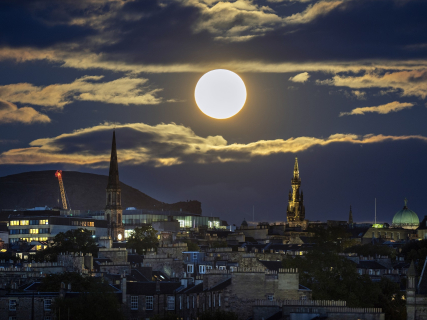

The lunar cycle lasts 29.5 days, slightly less than a standard month, so occasionally the same month can contain two full moons. The second of these is called a calendar blue moon.
This phenomenon occurs approximately seven times every 19 years, according to EarthSky. In some years, two blue moons can be recorded; for example, in 2018 there were two in January and March, while February had none. The next calendar blue moon after 2026 will be in 2037.
There is also the seasonal blue moon, which occurs when a three-month season has four full moons instead of three. The third of these moons is called a seasonal blue moon. The next one will occur on May 20, 2027.
Real color of the moon
Despite its name, the moon will appear in its usual color, silvery white or golden. The expression “blue moon” has been used since the 16th century to indicate something extraordinary or unlikely. Its first record in relation to the current lunar event appears in the Maine Farmer’s Almanac of 1937, according to Dr. Pamela Gay, senior scientist at the Planetary Science Institute.
Under exceptional atmospheric conditions, with smoke or dust particles of approximately 900 nanometers, the moon can acquire a bluish hue. One recorded case occurred after the eruption of the Krakatoa volcano in 1883.
Observation of the May 2026 blue moon
The moon will reach its maximum fullness on Sunday at 4:45 a.m., Miami time, coinciding with a micromoon, as it will be located near its apogee, the farthest point in its orbit from Earth. The distance will be 406,093 kilometers, compared to the average of 384,400 kilometers, which reduces its apparent size by around 10%.
In contrast, the 2023 calendar blue moon was a supermoon, as it coincided with perigee, the closest point to Earth, at 363,300 kilometers.
Visibility by region
- America, Europe, and Africa: night of May 30
- Australia, New Zealand, and Asia: night of May 31
The apparent size will not differ significantly for most observers, although a slight change may be appreciated if compared with known objects on the horizon, explained Gay.
The May 2026 event will be the farthest full moon of the year and coincides with optimal conditions for photographic recording due to the proximity of apogee and nighttime visibility.