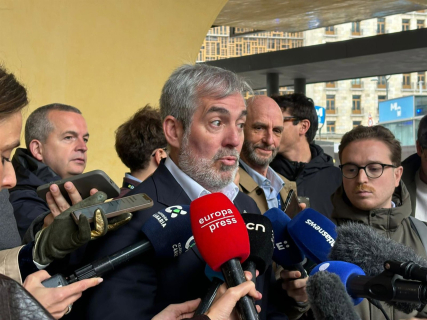
The arrival of the MV Hondius in the Canary Islands after the outbreak of hantavirus detected on board caused a public clash between the Canary Government and the Ministry of Health in recent days. The differences appeared from the beginning of the operation and intensified after several statements by the President of the Canary Islands, Fernando Clavijo, about the docking of the ship and the possibility of rats on board.
The Government of the Canary Islands expressed its doubts from the very first moments about the cruise ship's arrival in the islands. Clavijo publicly defended that the ship should not dock in Canarian territory while the health situation was clarified and demanded more information from the central Executive and the international organizations involved in managing the outbreak.
As the days passed, the debate also moved to the place where the cruiser should remain and to the conditions of the health operation deployed in Tenerife. The Canary Executive even raised the advisability of the ship remaining anchored outside the port while evacuations and epidemiological controls were organized.
Meanwhile, the Ministry of Health and the World Health Organization (WHO) maintained that the risk to the general population remained low and defended that the designed protocol met the necessary health guarantees.
The controversy about rats
One of the most tense moments came after some statements by Clavijo in which he raised doubts about the possibility that there could be rodents on board and about the risk that “the rats would come down from the ship”.
The words of the Canarian president generated a rapid response from the Ministry of Health, which ended up disseminating specific explanations to rule out that possibility and clarify how the operation was being managed.
Health insisted that there was no evidence of the presence of rodents on the MV Hondius and recalled that epidemiological investigations indicated that the first infections were related to passengers who had previously traveled through South America before boarding.
The Ministry also defended that the operation was being developed under international health supervision and with coordinated protocols together with the WHO, Foreign Health and different European organizations.
What the WHO says about the outbreak
The WHO maintains that the outbreak detected on the MV Hondius is associated with a very specific environment of prolonged coexistence and enclosed spaces within the ship.
The Director-General of the organization, Tedros Adhanom Ghebreyesus, has reiterated in different appearances that human-to-human transmission of Andes hantavirus continues to be considered infrequent and normally linked to close and prolonged contact.
Maria Van Kerkhove, technical lead for epidemics at the WHO, has also insisted that the organization is not treating the case as a global epidemic situation and maintains that the risk to the general population is low.
The operation deployed in Tenerife
The MV Hondius finally arrived at the port of Granadilla de Abona, in Tenerife, where Spain activated a broad health and logistical device coordinated with international organizations.
During the weekend, dozens of passengers of different nationalities were evacuated through medical checks, special transfers, and preventive epidemiological surveillance.
Part of the Spanish passengers were subsequently transferred to the Gómez Ulla Hospital in Madrid for health monitoring, while other travelers returned to their countries under control and observation protocols.
The Minister of Health, Mónica García, defended throughout the entire operation that there was no risk to the Canary Islands population and maintained that the evacuated people were asymptomatic at the time of disembarkation.
Institutional Differences
Despite the public shock of recent days, both the central Government and the Canary Executive finally participated in the coordination of the operation developed in Tenerife.
The discrepancies focused mainly on the ship's berthing location, anchoring conditions, public information management, and health risk assessment.
While Health insisted on conveying a message of calm and epidemiological control, the Canary Islands government demanded for several days more guarantees and more information about the development of the operation and about the management of the cruise ship.