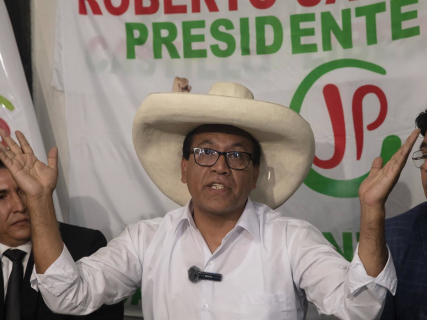

The second round of the presidential election in Peru starts in a technical tie. A poll by the Institute of Peruvian Studies (IEP), released by La República and collected by Electomanía, places Roberto Sánchez, candidate for Juntos por el Perú, slightly ahead of Keiko Fujimori, leader of Fuerza Popular, ahead of the runoff scheduled for June 7.
According to the projection on valid votes, Sánchez would obtain 50.8%, versus 49.2% for Fujimori. The difference is minimal and confirms that the election remains completely open. In direct voting intention, other aggregators show 32% for Sánchez, 31% for Fujimori, 24% of blank or null votes, and 13% undecided, which shows the high margin of volatility in the contest.
A second round of maximum tension
The result pits two very different political projects against each other. Keiko Fujimori, daughter of former president Alberto Fujimori, is once again competing for the presidency after several failed attempts and represents the conservative and Fujimorista space. Roberto Sánchez, former minister during Pedro Castillo's term and leader of Juntos por el Perú, arrives driven by the rural vote and by left-wing sectors that hold weight outside of Lima.
The first round already left a very fragmented scenario. Fujimori led with around 17% of the votes, while Sánchez managed to enter in second position by a very narrow margin against the ultraconservative Rafael López Aliaga, who denounced irregularities despite international observers finding no evidence of widespread fraud.
Lima versus the interior
One of the keys to the process is once again territorial division. Fujimori maintains strength in Lima and in conservative urban sectors, while Sánchez obtains better results in provinces and rural areas, especially in the Andean south. That gap is reminiscent of the 2021 election, when the rural vote was decisive in Pedro Castillo's victory.
For a Spanish media outlet, the reading is relevant because Peru is once again entering a phase of high institutional uncertainty. The country has had eight presidents in the last decade, a succession that reflects the fragility of its political system and the distrust towards traditional parties.
A survey, not a sentence
The IEP data does not allow us to speak of a consolidated advantage. The difference between Sánchez and Fujimori is too narrow and the volume of blank, null, and undecided votes could alter the final result. Furthermore, other polls, such as Ipsos, have shown an exact tie between both candidates.
The campaign that now opens will be decisive for two objectives: to reduce the rejection that both candidates generate in broad sectors of the electorate and to convince a voter who, more than ideological, is moved by weariness, insecurity, corruption, and fear of a new cycle of political crisis.