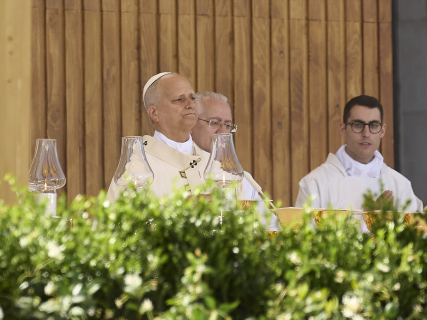

Pope Leo XIV presided this Sunday at the Movistar Arena in Madrid over one of the most symbolic events of his visit to Spain: the ‘Tejer Redes’ meeting, an event conceived to bring together the Church with representatives from culture, art, education, the economy, and sports.
The event brought together diverse voices from Spanish civil society on stage and turned the Madrid venue into a large forum on the role of culture, education, artistic creation, and public commitment at a time marked by polarization, technological changes, and the need to rebuild common spaces.
The Pontiff arrived at the Movistar Arena to applause and great anticipation from attendees. Upon his entrance, the crowd stood up while the visit's anthem, ‘Alza la mirada’ (Look Up), played. Leo XIV approached several sections of the venue to personally greet those present before taking his place on the central stage.
Antonio Banderas Reclaims Art Against Artificial Intelligence
One of the most notable moments of the meeting was the speech by Antonio Banderas. The actor, director, and producer from Malaga focused his speech on the link between art, faith, culture, and the human condition, with a reflection heavily marked by the impact of artificial intelligence.
Banderas argued that art remains an essential tool for regaining depth in an era where too many things are reduced to quick messages, immediate consumption, and automatic responses. In this context, he warned that artificial intelligence must be at the service of humanity and not replace what makes creation human.
His intervention connected with one of the major debates of the moment: what place does culture occupy in an increasingly accelerated, technological, and fragmented society. Before the Pope, Banderas positioned art as a language capable of awakening consciousness, denouncing violence, and restoring spiritual depth to public life.
The actor also recalled the Holy Week in Malaga to explain how the artistic and the religious can merge in popular experience. His speech was met with several rounds of applause from the audience, and Leo XIV himself thanked him for his words afterward.
Sara Baras Brings Flamenco Before Leo XIV
The artistic dimension of the meeting has had another of its great moments with the performance of Sara Baras. The dancer from Cadiz has taken the stage at the Movistar Arena to perform before Leo XIV in an intervention that has positioned flamenco as a cultural, spiritual, and popular expression.
The presence of Sara Baras has reinforced the weight of Spanish art within the event. Her performance has served as one of the most powerful images of the afternoon: flamenco, with its language of body, music, and silence, presented before the Pontiff as a form of living culture.
The meeting has not sought only a succession of interventions, but to construct a broad scene: artists, academics, athletes, businessmen, and social representatives gathered around the idea that a society is not sustained solely by institutions, but also by bonds, shared narratives, and meeting places.
Education, social justice, and the digital divide
Education has been another of the central axes of the event. Representing the academic sphere, the vice-rector of the Complutense University of Madrid, José María Coello de Portugal, has defended the role of education as a decisive tool for equal opportunities and social cohesion.
His intervention has focused on the early educational cycles, but also on lifelong learning. The underlying message has been clear: in a society permeated by technology, education can no longer be limited to a specific stage, because digital literacy and knowledge updating have become factors of inclusion.
Coello de Portugal has also presented the university as a space for social convergence and has claimed the importance of Madrid as a capital of knowledge, with public, private, pontifical, and ecclesiastical universities educating thousands of Spanish and international students.
José Cobo calls to combat extremism and recover dialogue
The archbishop of Madrid, José Cobo, has placed the meeting in a broader context: the need to combat extremism, rebuild bridges, and recover questions of meaning in an increasingly tense society.
Cobo has used the image of a stained-glass window to explain the diversity of sectors gathered at the Movistar Arena. Each piece, isolated, may seem incomplete; viewed as a whole, it makes sense. This has been one of the main ideas of the event: culture, education, economy, and sport not as separate worlds, but as parts of the same social conversation.
The cardinal has argued that dialogue should not be a one-off gesture or a one-day photograph, but a stable way of walking together. His speech has served as a prologue to the message that Leo XIV is to deliver at the end of the meeting.
Culture, sport, and economy: the other languages of the meeting
'Tejer Redes' has not been limited to the strictly religious world. The presence of figures from culture, sport, education, and business has responded to a clear intention: to show that the Pope's visit to Madrid also wants to dialogue with civil society and with contemporary challenges.
Sport has appeared as a space for discipline, overcoming, and community. Culture, as memory and conscience. Education, as a tool for social justice. And the economy, as an area called to put the person at the center and not reduce progress to a matter of numbers.
It is at this intersection of languages that the title of the event, 'Tejer Redes', is understood. It is not just about bringing together well-known names, but about presenting an idea of society where different sectors can recognize themselves as part of a shared task.