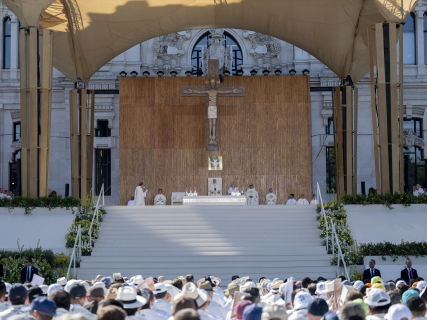

Pope Leo XIV closed this Sunday the ‘Tejer Redes’ meeting at the Movistar Arena in Madrid with a speech that went far beyond the closing of a cultural event.
The Pontiff outlined a moral roadmap for culture, education, business, sports, and technology in a time marked by speed, artificial intelligence, polarization, and the loss of shared meaning.
Before an audience with representatives from the artistic, academic, business, union, and sports worlds, Leo XIV defended a society capable of producing, innovating, and competing without forgetting the decisive question: for what and for whom is all this being done.
The central message was clear: it is not enough to be more effective, faster, or more productive. A truly renewed society must safeguard memory, foster dialogue, protect the dignity of the person, and not leave out those who have less ability to make themselves heard.
A warning about progress without a soul
Leo XIV began his speech by recognizing Spain's creative footprint, visible in its cities, music, painting, dance, monuments, and gastronomy. But this look at heritage was not nostalgic. The Pope used it as a starting point to ask a question of the present: what legacy is this generation leaving for the future.
The Pontiff warned that a society can become expert in means and tremendously effective in production, but remain lost regarding the big questions: why it produces, for whom it produces, with whom it produces, and what kind of humanity it is building.
Therein lay one of the keys to the speech. Leo XIV did not reject progress, technology, or innovation. What he asked was that they not advance disconnected from meaning, justice, and the concrete person.
Culture to safeguard memory and open dialogue
In the section dedicated to culture, Leo XIV argued that cultural expressions are not an ornament of society, but a form of memory and encounter.
The Pope asked that culture safeguard memory and foster dialogue. That is, that it not be limited to entertainment nor become a tool of elites, but rather help society to recognize itself, to tell its story, and to open spaces for conversation where today there is often only noise or confrontation.
The message connected directly with several previous interventions at the event, especially that of Antonio Banderas, who had advocated for art as a way to recover human depth in the face of the advance of artificial intelligence that must be at the service of people, and not the other way around.
Education with truth, critical thinking, and the real world
León XIV also sent a message to the educational and university world. He asked that the university not live with its back to the world of work, but also not renounce truth.
The phrase summarizes a very current tension. Education must prepare for professional life, but it cannot be reduced to a factory of useful profiles for the market. It must foster judgment, the search for truth, critical thinking, and social responsibility.
Within the framework of ‘Weaving Networks’, this idea connected with the intervention of the Complutense University, which had defended education as an irreplaceable tool for social justice and as a renewed right also for adults, especially in the face of the digital divide.
Business and the dignity of the worker
One of the most relevant passages of the speech was directed at the economic world . León XIV called for business activity not to view the employee as just another piece in the equation of its interests.
The phrase places work at the center of human dignity. For the Pope, economic and institutional structures can only be considered just if they serve the integral development of the person and promote the responsible participation of all.
The message links with the block led by businessmen and trade unions. Antonio Garamendi, Ángela López de Miguel, Unai Sordo, and Pepe Álvarez had previously advocated for social dialogue, collective bargaining, and an economy that measures progress not only by efficiency but also by the humanity of its relationships.
Technology with the poor, the elderly, and those without a voice
The Pope also placed technological progress under an ethical condition: it must take into account the elderly, the poor, and those without a voice.
This was not a minor statement. At an event where artificial intelligence, business, education, and the future were discussed, León XIV recalled that technology can open opportunities, but also generate new forms of exclusion.
The warning points to a very specific risk: that innovation advances faster than the capacity for social integration. In that scenario, those who are already on the margins may be left even further behind: the elderly, workers with less digital training, vulnerable families, or citizens without real access to new tools.
Sport cannot be reduced to business or spectacle
Leo XIV has also dedicated part of his speech to sport, one of the focal points of the meeting. The Pope has asked that it not be reduced solely to spectacle or business.
His reflection has connected with the testimony of Carolina Marín and Teresa Perales, who had defended sport as a school of life, resilience, and respect for the opponent. Leo XIV has recalled that many people have learned values on a playing field such as respect for the adversary, the ability to lose without hating, to win without humiliating, and to get up after a fall.
Sport, in that reading, is not just competition. It is social pedagogy. It teaches limits, discipline, cooperation, and humanity.
Communication that can hurt or heal
Another of the central points of the speech was communication. Leo XIV has recalled that every expression transmits something and can have consequences: it can hurt or heal, destroy expectations or open horizons, sow division or awaken hope.
The message fits with a society crossed by social networks, polarization, aggressive discourse, and an increasingly accelerated public conversation. The Pope has asked for communication capable of building something genuinely human.
It is not just about talking more. It is about talking better. About not turning public speech into a permanent weapon.
A renewed society: Leo XIV's "new threads"
The closing of the speech condensed the central image of the event. Leo XIV has invited those present to be "new threads" to weave new networks.
With that metaphor, the Pope has asked to harmonize the different areas of life: a culture that dialogues, an education that seeks truth, an art that awakens wonder, a business that recognizes the dignity of the person, and work that continues to be a motor of hope.
Rozalén provides the musical finale and the Pope closes the event
After the speech, Rozalén provided the musical finale to the meeting with the performance of ‘Y busqué’. Then, the presenters Lara Síscar and Carlos Franganillo thanked the Pontiff for his presence and the participation of the guests.
Leo XIV imparted the final blessing and thus closed ‘Weaving Networks’, one of the most symbolic events of his second day in Madrid.
After the meeting, the Pope went to the residence of the cardinal archbishop of Madrid, José Cobo, where he was scheduled to dine before facing a new day of institutional agenda this Monday.