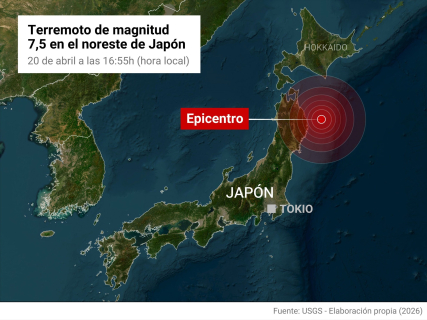
A strong earthquake of 7.5 magnitude off the northeast coast of Japan activated the tsunami alert this Monday in several prefectures of the country and put other areas of the Pacific on alert, as reported by Japanese authorities after the earthquake registered in the ocean, very close to the coast.
The tremor, located off the north and northeast of the archipelago, has forced the immediate activation of emergency protocols, with warnings to the population to abandon coastal areas and head to elevated areas due to the risk of dangerous waves arriving.
Tohoku, ground zero of tsunami risk
The first alerts are concentrated in the Tohoku region, in northeastern Japan, especially in the prefectures of Miyagi, Iwate, and Fukushima, located off the epicenter of the earthquake. This is one of the most vulnerable areas in the country due to its direct exposure to the Pacific Ocean and the shape of its coastline, with numerous bays that can amplify the force of the waves.
Also under surveillance are other areas in the north, such as the east coast of Hokkaido, where waves could arrive in the early stages after the earthquake.
Tokyo and the East Coast, on preventive alert
Further south, the Kanto region —where the capital, Tokyo, is located— remains on preventive alert. Although the impact is usually less at that distance, authorities warn of the risk in ports, rivers, and low-lying areas, where currents can intensify even with smaller waves.
Notice for the Pacific: possible effects in other countries
The earthquake has also activated international monitoring mechanisms due to the possible spread of the tsunami across the Pacific. Territories such as Hawaii or the west coast of the United States could receive the impact hours later, although presumably with less intensity.
Depending on the evolution of the phenomenon, alerts are not ruled out in other areas of the Pacific, from Alaska to Latin American countries, where the waves would arrive with greater delay.
Japan activates its tsunami emergency system
Japan has one of the most advanced earthquake and tsunami warning systems in the world, capable of issuing alerts in a matter of seconds. Following the earthquake, sirens have been activated in coastal areas and emergency messages urging immediate evacuation.
The authorities remind that the first waves are not always the most intense and that the danger can last for hours, so they ask the population to follow official instructions at all times.
Keys to the risk
- Immediate impact on Japan's northeast coast
- Possible arrival of waves in other regions of the country in the following hours
- Surveillance throughout the Pacific for tsunami propagation
- Elevated risk in ports, bays, and low-lying areas