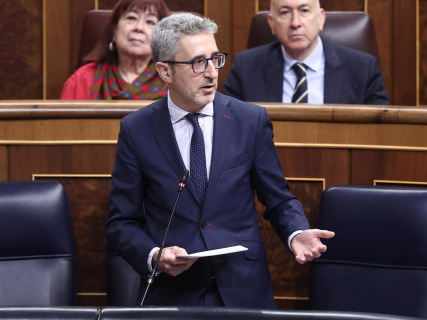

Debut in Congress of the Minister of Finance, Arcadi España, with an 'impossible mission'. 'Resurrect' the levy on energy companies, a figure terminated by the Lower House this legislature, in which it has also rejected recovering the figure on several occasions.
Without this stopping the Executive, the successor of María Jesús Montero pledged his support for the creation of a new temporary tax so that these companies contribute part of the extraordinary profits derived from the war in Iran and contribute to alleviating the burden borne by consumers and taxpayers.
He did so when answering a question from Bildu deputy Óskar Matute, in which he recalled that Spain, Germany, Austria, Italy, and Portugal have submitted a formal request to the European Commission to be able to launch “a temporary solidarity instrument” aimed at companies in the energy sector, with the objective of sending “a clear message of unity and of fiscal justice regarding the distribution of the burden of the consequences of the war”.
Arcadi España has also stressed before Matute that Spain was “pioneering” within the European Union by applying on its own a temporary levy on energy companies with a turnover exceeding 1,000 million euros per year, a measure that has been established for the years 2023 and 2024.
“And we have also brought to this Chamber a Royal Decree-Law with this levy on energy companies, just as we committed to with different parliamentary groups. But we are aware of the positions that each party has and of the difficulty that this entails,” the minister acknowledged.
The Bildu deputy has stated that he does not question the Executive's intention to move towards this tax, although he has demanded greater firmness from it. “More must be done, because we all know that from these wars provoked by a few, a few win and we all suffer them.”
Matute has criticized that, since the outbreak of the war in Iran last February 28, “oil companies fundamentally, and energy companies as a whole, have done nothing but grow in their profits”, while diesel and gasoline became more expensive.
“It is evident that some think of making a lot of money, think of making a fortune and they are the big oil companies and they are also, unfortunately, the arms companies. And what we propose and ask of him is that make policies for the people, that he not limit himself to being a mediator between the market, the big companies and the citizens. That it be clear that this Government does not make policies at the dictate of the big oil companies,” the Bildu parliamentarian emphasized.
The head of the Treasury has responded that the Executive is already acting decisively to face the economic consequences of the war conflict, “but also prudence and caution”.
“We are facing a scenario that requires prudence due to the high uncertainty that still exists in relation to the circumstances in the war in the Middle East and the evolution of oil prices, as well as other raw materials and their second-round effects that may occur if the conflict lasts more months. But have no doubt, have no doubt. This Government will continue protecting families and the most affected sectors (...) And we are going to do it with an equitable distribution of the costs of this conflict”, Spain has concluded.