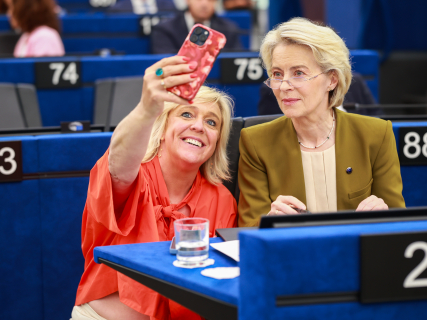

The President of the European Commission, Ursula von der Leyen, set during her speech on the State of the Union in September the protection of minors in digital environments as one of the priorities of her second mandate. Thus, on this path, one of the solutions she is preparing to tackle the problem is the creation of a European age verification application, which “is technically ready” and will soon be available to all citizens of the European Union.
Brussels is finalizing the details of a platform that will allow users to prove their age when accessing online platforms, similar to how, for example, stores request an ID from those buying alcoholic beverages. Von der Leyen argues that it is a tool “very easy to use”. “You download the app, set it up with your ID, and then prove your age when accessing online services,” she defended in a statement to the press.

Data Protection
The Community Executive wants to allay the concerns of those who warned of a possible violation of user data protection and insists that “no other personal information will be revealed”. “It is completely anonymous: users cannot be tracked,” the leader reiterated. In this way, the application will be available to work on any device: phone, tablet or computer, which reinforces its accessible and transversal nature.
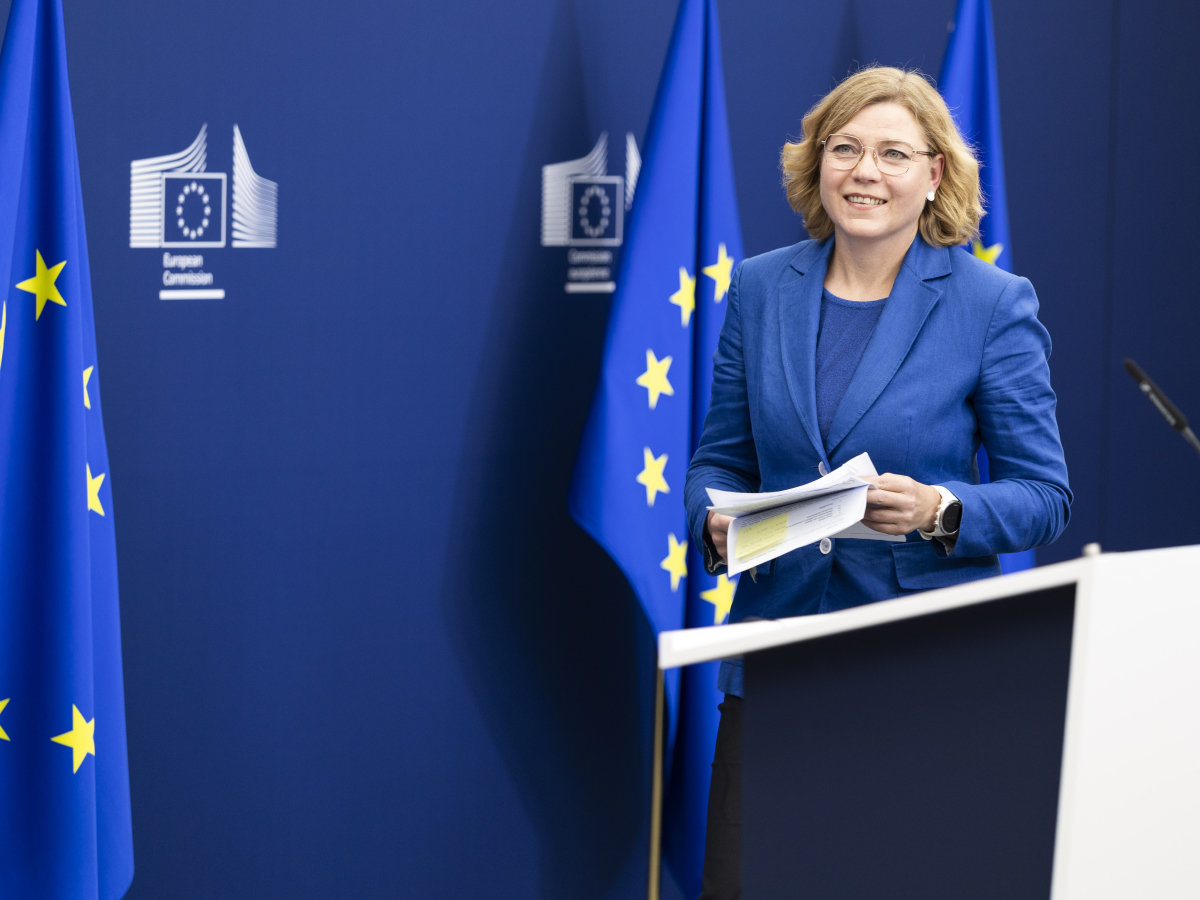
“Our solution is based on zero-knowledge proof. When users want to access an age-restricted service, they will maintain full control of their data”, said the European Commission's technology officer, Henna Virkkunen. What is intended, ultimately, is to design a structured approach among the Twenty-Seven for the accreditation of national solutions: a single solution for the entire community bloc, beyond twenty-seven different systems that could generate fragmentation and inefficiencies.

Featured story
Europe places digital violence at the center of its new offensive for gender equality
5 minutes
Furthermore, the Commission assures that it will be open source, which will allow non-EU partners to access it. All this with the aim that online platforms trust the European Executive's application. “There are no excuses,” appeals the German, who celebrates that Europe is offering a solution free, interoperable, and easy to use, “that can protect our children from harmful and illegal content.”
On this path, there are States more advanced than others, such as France, Denmark, Greece, Italy, Spain, Cyprus or Ireland, which are already planning to integrate the application into their national digital models. Brussels hopes that increasingly more Member States and the private sector will follow their example so that soon all Europeans can use the application. This progressive deployment will be key to ensuring homogeneous adoption and avoiding digital divides between countries.
European digital offensive
Furthermore, through other channels, the European Commission continues to deploy all instruments provided for in its digital services regulations, with special attention to the protection of minors in the online environment. In this context, in March it announced the opening of a formal investigation against Snapchat with the aim of determining whether, as it suspects, the platform is exposing minors to contact with sexual predators or to recruitment for criminal purposes.
To be able to access the platform, and in accordance with its own terms and conditions, users must have reached a minimum age of thirteen years. However, Brussels considers that self-declaration as the sole verification system opens significant security loopholes. The community services point out that this method does not prevent minors under 13 from accessing the service, nor does it allow for a correct assessment of whether users are under 17, “which is necessary to guarantee an age-appropriate experience.” Furthermore, the Commission points out that Snapchat would not be offering effective tools to report the presence of minors, which aggravates the risks of exposure to dangerous situations.
Risks of grooming and criminal recruitment
“From grooming and exposure to illegal products to account settings that undermine the safety of minors, Snapchat seems to have overlooked that the Digital Services Act requires high safety standards for all users,” declared the Vice-President of the Commission responsible for technological sovereignty, Henna Virkkunen.
According to preliminary investigations, these practices would be resulting in an insufficient protection of minors against users with harmful intentions, such as sexual exploitation or recruitment for criminal activities. This type of risk not only affects the individual safety of minors, but also poses a structural challenge for European institutions, which seek to strengthen trust in the digital ecosystem.
The proliferation of social platforms with rapid interaction dynamics and scarce control has increased the exposure of minors to these dangers. In this regard, the European Commission considers it essential to move towards more robust systems that combine technology, regulation, and corporate responsibility.
An increasingly active regulatory framework
Since the entry into force of the Digital Services Act (DSA), the Commission has intensified its supervisory activity, accumulating investigations against large platforms such as X, Shein or Google. The objective is to determine if these companies facilitate access to illegal or harmful content for minors, as well as evaluate their compliance with obligations regarding privacy, security and user protection.
Community guidelines clearly state that self-declaration is not a reliable method of age verification, that minors must not be easily identifiable by adults, nor recommended as contacts, and that default settings must offer the maximum level of protection. These demands reflect a paradigm shift in European digital regulation, moving from a reactive approach to a clearly preventive one.

The Commission's decision is based on the analysis of the Snapchat risk assessment reports for 2023, 2024, and 2025, as well as the company's response to a request for information sent in October 2025. This evidence-based approach allows Brussels to base its regulatory actions on concrete data and detailed technical assessments.
In said request, Brussels asked for details about the age verification system and the measures to prevent access to illegal or age-restricted products. Likewise, information collected by the Dutch competition authority (ACM) has been taken into account, along with data provided by the Federal Network Agency of Germany (BNetzA), in addition to contributions from academic researchers, civil society organizations, and other public authorities.
Taken together, all these initiatives reflect a comprehensive strategy on the part of the European Union to strengthen the digital security of minors, combining technological innovation —such as the future age verification application— with stricter supervision of large platforms. The challenge, however, will remain finding the balance between protection, privacy, and usability, in a constantly evolving digital environment.