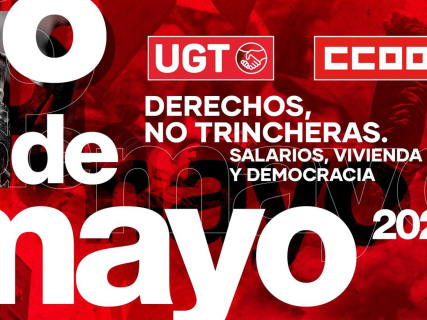

CCOO and UGT will once again fill the streets of all of Spain this May 1st to demand improvements in salaries and defend access to housing, in a scenario marked by the rising prices as a result of the war in Iran, which boosted inflation in March to 3.4%, one point more than in February.
Under the slogan "Rights, not trenches. Salaries, housing, and democracy", both union confederations have decided to move the main event of International Workers' Day to Malaga this year, a few weeks before the Andalusian elections on May 17.
In this way, the general secretaries of CCOO and UGT, Unai Sordo and Pepe Álvarez, will lead the march in the Malagueñan capital, instead of taking part in the traditional demonstration in Madrid.
As every year, CCOO and UGT have called for more than 70 demonstrations and rallies spread throughout the country. In the last edition, the focus was on reducing the working day to 37.5 hours per week and on the reform of dismissals.
Although these two claims remain on the table and have not yet prospered despite the push from trade union organizations and the Ministry of Labor, on this occasion they will emphasize the need to raise salaries, in an inflationary context derived from the conflict in the Middle East, and the guarantee of the right to housing.
Convinced that rights "are not given away", but rather conquered and that "faced with noise, hatred and division" the answer lies in unity, CCOO and UGT will once again call on the working class to mobilize massively this May 1st throughout the territory.
SALARIES
Salaries agreed in collective agreements increased on average by 2.92% in March, a slight advance compared to 2.91% in February, but still almost five tenths below the CPI for the same month, whose year-on-year rate stood at 3.4%, the highest level since June 2024.
After 17 consecutive months with salary increases above 3%, in the first quarter of 2026 these raises have lost intensity and are below that reference.
This year, unions and employers should agree on a new Agreement for Employment and Collective Bargaining (AENC), after the previous one expired in December, which set recommendations for increases of 3% for 2025, with a review clause that allowed additional increases of up to 1% per year if inflation deviated (2023-2025).
Despite the fact that trade union organizations assure that there are already informal contacts to bring about a new AENC, the general secretary of CCOO, Unai Sordo, warned this week that the international context and the uncertainty linked to the war in Iran are acting right now as "a trap" to close the agreement with the CEOE.
Among the points of contention for this negotiation, Sordo has pointed out the business "raca-raca" about absenteeism and salary increases.
On this line, he admitted that "it is very difficult to close a salary agreement or even propose a range" of increases in the current situation.
"Nobody is in a position to make a general agreement on conventions if you don't know if inflation can go up to 6%, 7% or 8% in the summer," stated Sordo, who considers that, as long as there is no certain stability in the Middle East and it is not guaranteed that energy, fuels, and fertilizers will not push prices up again, it will be "very difficult" to seal a salary pact with the CEOE in the short and medium term, that is, before the summer.
Even so, he has stressed that this does not imply that CCOO will remain "with folded arms". "Collective agreements were registering salary increases above 3% with inflation well below 3%, but this has changed and from the moment this has changed, the union will have to enable new tools to strengthen the negotiating position in those collective agreements," he has remarked.
HOUSING
In housing matters, the May 1st holiday will take place a few days after the debate in Congress on the validation of the decree that extends the conditions of rental contracts for two years.
For now, the Government does not have sufficient support to pass this regulation in the vote on April 28, although it has rushed the deadline to the maximum so that, during the month in which it has been in force, tenants have been able to request said extension.